Orchestration is the new interface. Chat was the training wheels.
I've been deep in OpenClaw for the last 2-3 weeks - nights, weekends, fully consumed - and I've realized something has just flipped.
Over the past year, I've been a heavy AI user - chatGPT pro + claude max + nano banana... And it's great: your brainstorming partner, an expert on tap, super productive.
But also, always felt limiting. You ask, it answers - one conversation at a time.
Last few weeks with OpenClaw have been fundamentally different:
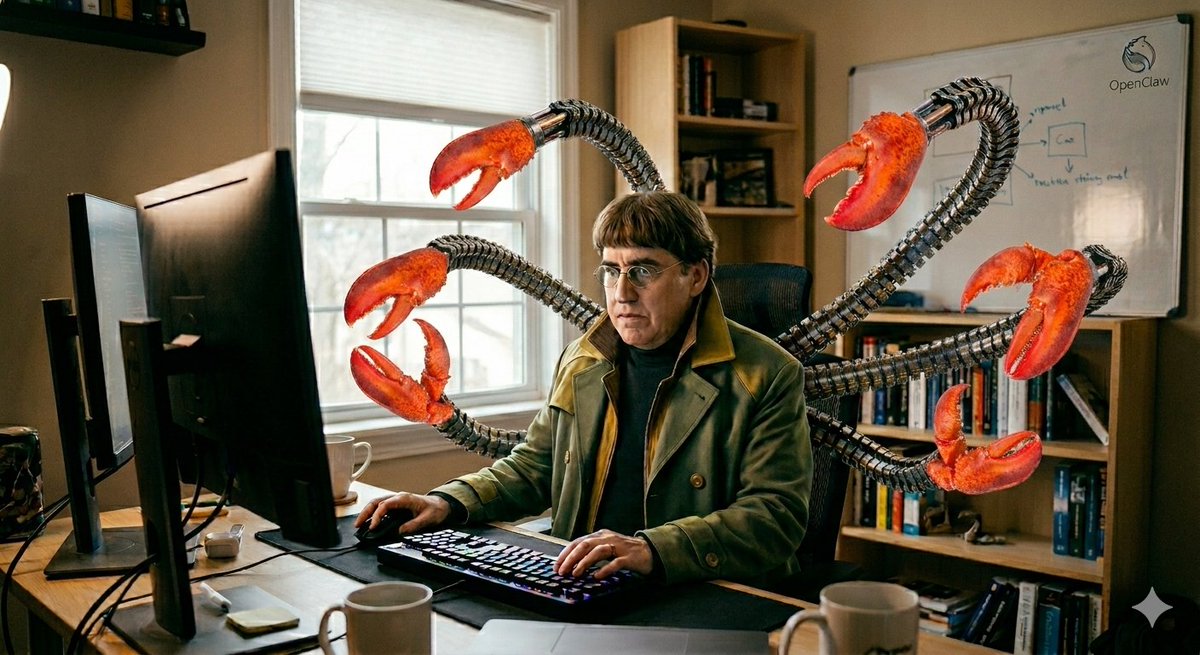
1. It's like suddenly becoming Dr. Octopus. Not a back-and-forth, linear productivity hack like chat. But a system with many tentacles, all working simultaneously, each one an extension of your thinking.
2. And it compounds. Every workflow you build doesn't just solve today's problem, it expands what you're capable of tomorrow morning.
And that makes it insatiable. First time I actually feel like I cannot get enough of AI. Every time I build 1 use-case, I'm already thinking of 2-3 more I wish I could spend time building.
That's when it hit me: Orchestration is the new interface - the 10x unlock for AI.
@JCanNuSH Was Lilly’s data coming largely from standard insurer-payment channels or did it also include cash-pay and other gray channels?
That could be 1 discrepancy apart from what you mentioned as compounded channel demand.
Completely opposite view-point on this: measure your biomarkers, and track them well.
Visibility is the highest-leverage tool we have. Making something visible is consistently proven to drive actions.
You mentioned CAC. In a RCT study, the people who actually saw their CAC score were measurably more likely to act on it - better adherence, better control of risk-factors - and the effect actually increased with the number: the higher the score, the bigger the change.
On the stress point: I get what you are saying, but I’d reframe it. A person wired to ruminate will find something to ruminate about with or without a biomarker: a news, a symptom, a passing comment. And to be clear, it’s not a knock on the person. We all are wired to react certain ways, and the real fix is to address the wiring, not to choose to go blind.
@DrChalmers1 Yes - and the practical miss is treating this as a weight loss drug only.
The sharper way is to see how visceral fat and food-noise behaviour shift even when the scale change looks only "moderate".
Undergrad students at top colleges (e.g. Stanford undergrads for tech).
Largely because curiosity is peak at that stage and high-agency filter has already been applied by the colleges.
Just see what are the things they are spending time on or are most excited about.
They may be wrong about a lot of things but they are never late. So, you will have to be careful of a lot of false-positives, but you will never miss what's important.
Yup.. And the irony is that the richest “history” may increasingly sit outside the medical system or doctor conversations entirely.
Quietly accumulating in their Claude/GPT chats.
People tell AI the small, weird, half-formed details they don’t think are “worth” telling a doctor.
So, the most useful medical records will be built completely outside the hospital system.
@austinlwright_ Exactly.. that's why the impact of Tirzepatide on visceral fat is higher than what most assume when they think of this as just a newer semaglutide and only compare the weight-loss efficacy.
Yup, tracking the right continuous-use subgroup is the challenge in real-world studies.We have seen the same in Indian OPDs - the median path is ambitious start, missed 3rd or 4th fill, dose run by fear and GI, not markers. Meds 'lose' to surgery when the med arm is intermittent use dressed up as treatment intention.
@andrewchen It won’t become a verb - it has become a person. “I’ll ask ChatGPT” “I’ll brainstorm with Claude”…
Because Google & Uber had 1 function (Search, Go somewhere) - hence replaced that particular verb. With ChatGPT and Claude, you can do too many things to box it in 1 verb.
@thekitze Don’t give in to the temptation.
It seems a ‘useful’ thing to do - give them tech that will be an integral part of their life, but IT’S NOT.
Let them build natural curiosity, agency & judgement - that comes by playing out, reading etc. They’ll ‘learn’ & ‘catch-up’ on tech later
Wow..
The infrastructure leapfrogging story in India is always the super-interesting - we skipped landlines for mobile, and now we might skip deep-trenching fiber for free-space optics.
For a country with our geography and urban density, physical cables are a nightmare of permissions and "dig-ups." This may change the economics of rural connectivity massively.
@DrDatta_AIIMS Just like what happened in Covid. Black swan events force social change, and then tech that enables that change becomes pervasive quickly... So, this might actually be the bull-case for AI.
Christina, this is bad today since training data is largely saturated with "textbook" cases, and so they struggle with the messy, atypical presentations in clinical settings.
But isn't this just the "last mile" problem of clinical AI - and will get solved soon as models get access to real-world data through EHR integrations and medical scribes etc?
@HealthcareAIGuy This list segments well by "physicality of presence" - the less you touch the patient or patient-products (like samples), the more the model can do.
Do you think we’ll see a new category of "AI-augmented" clinical roles emerge that aren't on this list yet?
Exactly the target segment most consumer health-tech should target - high-output people whose biology is basically being redlined by life.
I’ve seen this pattern consistently: the products that win aren't the ones that demand more discipline, but the ones that provide a "performance floor" when life happens.