The launchpad where every coin is a yes or no question. If it does, holders split the pot in ETH. If it doesn't, it burns $DOES. Live on Robinhood Chain.
Introducing https://t.co/TK0tpYjLDx & $DOES on Robinhood Chain.
Every coin is a question. Does it happen? If it does, holders get paid.
https://t.co/TK0tpYjLDx is a launchpad on Robinhood Chain where every coin is a yes or no question with a deadline. Every trade of the coin pays into the question's pot. If it happens, the pot is paid out in ETH to the people holding the coin. If it doesn't, the pot buys $DOES and burns it.
Live now on Robinhood Chain.
$DOES CA: 0x8de860190dae784a9e676cf9056f026f7c9b4848
Launch your own coin, ask anything. If it does, you get paid.
Start now: https://t.co/TK0tpYjLDx
A verified connection tells you something about who is speaking. It cannot establish that an event happened.
On https://t.co/TK0tpYjLDx, linked-account badges add context to chat and evidence posts. They do not change payout weights. More badges do not earn a larger pot share.
The same care belongs in reading a claim: a recognizable account may point you toward a source, but that source still needs to support the question's actual resolution criteria.
One fast trade can produce a striking spot price. That alone does not settle a https://t.co/TK0tpYjLDx market-cap question.
The condition uses the question coin's own 30-minute average market cap. That average must reach the target during the eligible period before the deadline.
A spot reading and a resolution measurement can therefore disagree without either display being broken. They answer different questions. Averaging reduces dependence on one instant; it does not stabilize the token or eliminate trading risk.
An event happens. Evidence arrives. A proposal is submitted. Resolution appears on screen. Those moments need not be simultaneous.
For a https://t.co/TK0tpYjLDx real-world question, the YES proposal includes the time the event happened. That timestamp ends the relevant holding window. Buying after the event adds no weight to that payout, even if finalization is still ahead.
Establishing when something happened is therefore part of establishing the outcome. The timestamp on an article about an event is not necessarily the timestamp of the event itself.
Suppose a question launches in the morning and its real-world event happens that afternoon. It can resolve YES without paying the pot to holders.
That is the first-day rule on https://t.co/TK0tpYkjt5. Nothing in a question's first 24 hours pays its pot. A real-world event, or a stock close, that resolves YES during that period routes the pot to the $DOES burn mechanism instead. Price touches and market-cap targets only become eligible from day two.
Trading itself is not free during that first day. Fees accumulate from the first trade, so a pot can grow before any outcome is eligible to pay it to holders.
The practical consequence is worth checking before launch: the scheduled event time and the age of the question need to fit together. A later deadline does not move an earlier event outside the first-day rule.
The most useful moment in a conversational launch flow is the pause before signing. A short message can leave important details unstated: the target, the deadline, or whether a price needs to touch a level or close beyond it.
https://t.co/TK0tpYjLDx AI can turn the conversation into a launch draft. The next step is to read the draft as if someone else had written the question. Does the target match your view? Is the deadline the one you intended? Could the chosen condition resolve differently from the sentence you had in mind?
A familiar ticker does not compensate for the wrong resolution terms. The assistant helps prepare the action; your wallet approval is where that proposed question becomes an action you have chosen to take.
Market cap is not money waiting in the pot.
On https://t.co/TK0tpYkjt5, market cap expresses the question token's valuation. Its pot holds ETH accumulated under the fee rules. A large valuation does not imply a comparably large distribution to holders.
Trading price, pot size and eligibility each matter when evaluating a position. Multiplying tokens by the market price estimates something different from calculating a share of the pot.
Imagine two wallets holding the same number of question tokens when an event happens. One held that balance throughout the preceding week. The other bought it a day before the event.
On https://t.co/TK0tpYjLDx, those positions do not contribute the same payout weight. Under those simple assumptions, one day with the same balance contributes one seventh as much balance-time as seven days. The final share also depends on all the other eligible holders.
For a question younger than seven days, the window begins at launch instead. For an older question, only the relevant seven-day window counts.
This is why the current balance is an incomplete picture. The calculation needs the balance history inside the window and the total eligible weight across wallets. A screenshot of what someone holds at the end cannot tell that whole story.
Touch and close express different views, even with the same asset and target.
A price could cross a level and fall back before the deadline. That can satisfy a touch condition without satisfying a close condition.
The https://t.co/TK0tpYjLDx launch form lets you choose between them. Settlement uses Chainlink data, and touch eligibility starts after the first 24 hours.
Expecting a brief move and expecting it to hold are different positions. The choice belongs in the question before the coin launches.
Before a question becomes a coin, its wording has a job to do.
"Will this project do well?" leaves almost everything open to interpretation. "Will this project release its public app before the deadline?" gets closer, provided the criteria also define what counts as a public release.
On https://t.co/TK0tpYjLDx, real-world questions are screened before launch and their resolution criteria are locked in. That gives everyone something specific to evaluate before they trade.
A useful question leaves room for disagreement about what will happen. It should leave much less room for disagreement about what was asked.
Why we believe in our product, from the team building it.
Prediction markets are one of the few things in crypto people use to say something real about the world. But the classic model asks a lot of its users:
Someone has to list the market.
Someone has to take the other side.
Someone has to bring liquidity before anyone can trade.
And when it's over, you have to come back and claim.
We kept asking ourselves: what if a prediction market worked like the thing people on-chain already love doing? Trading coins.
So that's what we built. On https://t.co/TK0tpYjLDx, every coin is a question.
Here's why we think this model can become the way Robinhood Chain does prediction markets:
1. Anyone can ask.
Markets aren't limited to what a team decides to list. Any argument can become a coin in one transaction: prices, stocks, market caps, real-world events.
2. It trades from the first block.
No order book to fill, no market makers to recruit. Every coin opens in its own Uniswap v4 pool, with liquidity locked forever.
3. Attention becomes the prize.
2% of every trade goes into the question's pot. The more people argue about a question, the bigger the pot gets. Nobody has to lose for holders to get paid.
4. Being wrong isn't the end.
If it doesn't happen, you still hold a coin you can sell. Coins keep trading after their question resolves.
5. Conviction pays.
Payouts are time-weighted over the 7 days before the event. Someone who held all week counts for far more than someone who bought at the last second.
6. It fits Robinhood Chain.
Stock and crypto questions settle on Chainlink. Real-world questions go through our AI judge, with a public 24-hour dispute window. Prices show in dollars first, and you can sign in with an email or a wallet.
7. Everything feeds $DOES.
1% of every trade on every coin buys and burns $DOES. Every question that doesn't happen burns its whole pot too.
We don't think we've built the final form of prediction markets. We think we've built one that feels native to how people already trade on-chain, and that's what makes things spread.
It's day one. We ship every day, and we want to hear what you'd ask, what's missing and what should come next.
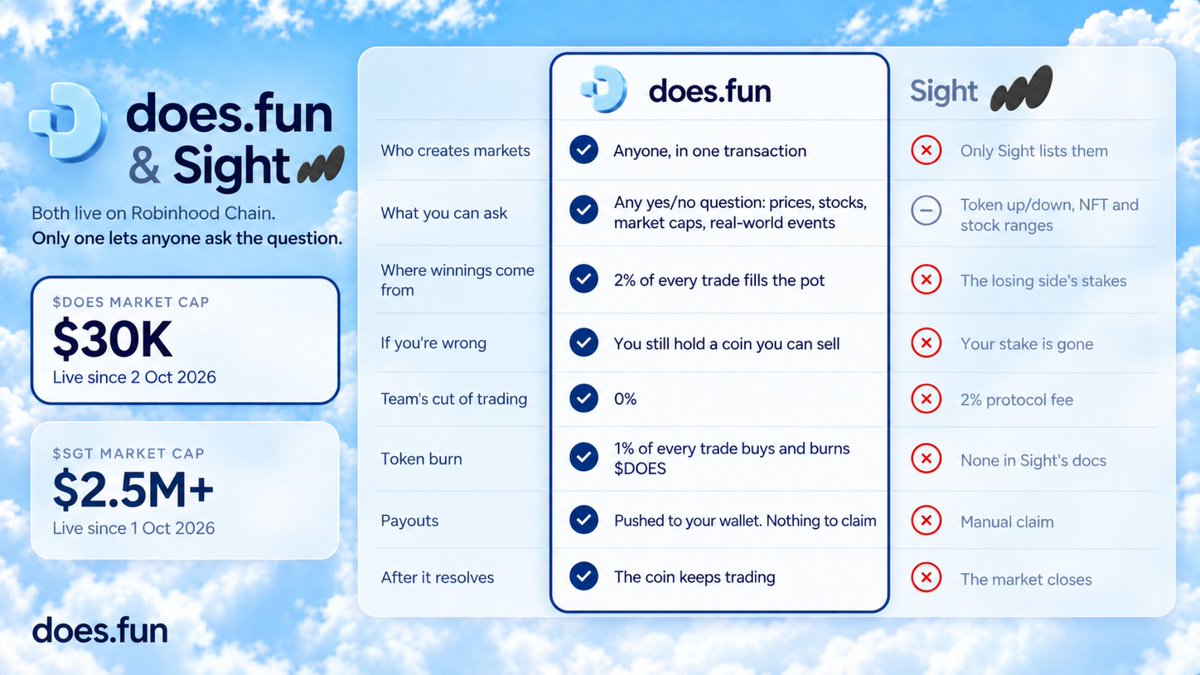
How https://t.co/TK0tpYjLDx compares to @sight_hood?
We're both building prediction markets on Robinhood Chain, and we made very different design choices.
Sight went with fast parimutuel rounds. A token goes up or down over 5 minutes to an hour, there are two pots, and the winning side splits them. It's simple, quick and clean, and it works well for short calls.
We wanted something that could ask any question and run for days, so we built it differently:
The question is the coin. Every question is its own ERC-20, trading in its own Uniswap v4 pool with liquidity locked forever. Anyone can launch one in a single transaction.
The pot comes from volume. A hook sends 2% of every trade into the question's pot, in ETH. Nobody has to take the other side.
Holding is what counts. Payouts are time-weighted over the 7 days before the event, so buying at the last second earns almost nothing.
Payouts are pushed. On YES, a keeper sends ETH straight to holders' wallets in batches. Nobody has to claim.
Both projects have a token now: $SGT for Sight, $DOES for us. On our side, 1% of every trade on every coin buys and burns $DOES, and when a question doesn't happen, its whole pot buys and burns $DOES too.
@TRElls37 Feel free to share your suggestion here in the comments, we'll take a look at it! Any feedback is more than welcome during these early stages.
We built an AI into https://t.co/TK0tpYjLDx that launches coins with you. Here's the whole thing, start to finish, in one minute.
What you're watching:
1. We open https://t.co/TK0tpYjLDx AI and tap "Launch a coin"
2. It asks what kind of question. We say BTC.
3. It asks up or down, and the target. We say $125,000.
4. It drafts the coin: "Does BTC hit $125k by Oct 9?" Ticker $BTC125K, with the live BTC price and how far it has to go.
5. We add an image, hit launch and sign in our wallet.
6. The coin is live. We open it and post in its chat.
What's going on under the hood:
The AI never touches your wallet. To launch, it has exactly one tool: draft_launch. It returns a draft, nothing that signs or sends. Our API validates the draft against the launch rules before it ever shows up as a card. If it doesn't validate, there's no card.
The card launches through the exact same code path as the normal launch form. Same contract call, same checks. The chat is just a faster way to fill in the form.
The AI drafts. You sign. That split is the whole design.
This one is a price question, so it settles on Chainlink's BTC/USD feed and no judge is needed. Real-world questions go through the AI judge first, in the chat too, exactly like in the form.
Then the chat. Every coin has its own. It's where people talk, and where the proof gets posted when a real-world question comes true.
After that, every trade sends 2% to the pot and 1% to the $DOES burn.
Ask it anything, or just say "launch a coin."
Prediction markets are one of the best ideas in crypto. But most of them work the same way: pick YES or NO, and wait for the other side to lose.
https://t.co/TK0tpYjLDx brings that idea on-chain in a way we haven't seen before.
Every coin is a question:
"Does it happen?"
Here's how it works in practice.
Say someone launches a coin called "Does the Fed cut rates at its next meeting?"
That coin is the question. There's no YES share and no NO share. You buy the coin, or you don't.
Every time someone buys or sells it, 3% of the trade is taken in ETH:
- 2% goes into the question's pot
- 1% buys $DOES and burns it
So the pot grows with every trade. The more people argue about the question, the bigger it gets.
Then one of two things happens.
It does?
The Fed announces a cut. Someone posts the news in the coin's chat, the AI judge checks it and calls YES, and anyone has 24 hours to challenge the call. Then the pot is split between everyone holding the coin and sent straight to their wallets in ETH. Nobody has to claim anything.
It doesn't?
The deadline passes with no cut. The whole pot buys $DOES and burns it.
A few things keep it fair:
The longer you hold, the bigger your share. It's based on how much you held, and for how long, over the 7 days before it happened. Buy a minute before and you get almost nothing. Buy after and you get nothing.
The first day never pays. Launch a coin minutes before news you already know, and the pot burns instead. No insider shortcuts.
The pot can only go two places: to the holders, or to the burn.
A question can be about a real-world event, a crypto or stock price, or the coin's own market cap. Prices settle on Chainlink, so nobody has to decide those.
Anyone can launch one, with a deadline 2 to 30 days out.
Think it does? Buy in.
Know it will? Launch it.
It's a coin, not a bet. Its price can go to zero, and the pot isn't a payout anyone is owed.
How to launch a coin on https://t.co/TK0tpYjLDx?
On https://t.co/TK0tpYjLDx, every coin is a yes/no question.
"Does BTC hit $150k by Nov 30?"
"Does GTA 6 get delayed again?"
If it happens, holders split the pot.
If it doesn't, the pot burns $DOES.
Here's how to launch your own:
1. Go to https://t.co/TK0tpYjLDx and tap Launch.
2. Pick a question type:
• Price: BTC, ETH, NVDA, TSLA and more. Chainlink settles it.
• Market cap: does this coin itself hit a market cap?
• Anything: any real-world event. Our AI judge settles it.
3. Set your target and a deadline (2 to 30 days).
For "Anything", just write your question in plain words. The AI judge checks it and writes the exact rules for YES before you launch.
4. Give your coin a name and a ticker.
5. Make it yours (optional): add an image, a short description and your X, Telegram or website link.
6. Want in first? Add a first buy in ETH. It happens in the same transaction as the launch, so nobody can buy ahead of you.
7. Connect your wallet (or log in with email) and hit Launch.
That's it. Your coin is live and its page is ready to share.
Don't want to fill in a form? Open the https://t.co/TK0tpYjLDx AI chat and say "launch a coin". It drafts everything for you.
The Judge:
Price questions settle on Chainlink. Market caps settle on the coin's own 30-minute average price. Nobody decides those, and anyone can trigger them.
Real-world questions settle on evidence. Anyone posts it in the coin's chat. The AI judge proposes YES with the time it happened, and a 24-hour public dispute window opens. Anyone can dispute with a 0.01 ETH bond. The team then confirms, overturns or voids, and a disputer who was right gets the bond back.
A voided question refunds its pot to holders by the same 7-day rule. Nobody, the team included, can send a pot anywhere else: holders on YES or VOID, the $DOES burn on NO.
Introducing https://t.co/TK0tpYjLDx & $DOES on Robinhood Chain.
Every coin is a question. Does it happen? If it does, holders get paid.
https://t.co/TK0tpYjLDx is a launchpad on Robinhood Chain where every coin is a yes or no question with a deadline. Every trade of the coin pays into the question's pot. If it happens, the pot is paid out in ETH to the people holding the coin. If it doesn't, the pot buys $DOES and burns it.
Live now on Robinhood Chain.
$DOES CA: 0x8de860190dae784a9e676cf9056f026f7c9b4848
Launch your own coin, ask anything. If it does, you get paid.
Start now: https://t.co/TK0tpYjLDx
It didn't happen?
If the deadline passes and it didn't happen, the whole pot buys $DOES and burns it.
After a question resolves, either way, the coin keeps trading. Its 2% stops filling a pot and goes to the $DOES burn as well.
$DOES is the platform token, and it has one job: getting burned.