@PicturesFoIder He didn't blow it, tho. Now, that young lady knows he could possibly leave for some tig ol' biddies. That changes the dynamic completely. Instead of him being "whipped", now she'll always be wondering if he's satisfied with her. That's playing chess vs checkers
W polskim malarstwie powstało kilka ikonicznych wizerunków Stańczyka. Wśród ich twórców był Leon Wyczółkowski, zmarły 27 grudnia 1936 roku.
1) Jan Matejko, 1862
2) Jan Matejko, 1882
3) Leon Wyczółkowski, 1898
4) Jacek Malczewski, 1908
The act of scraping, cutting, or drilling an opening into cranium was practiced around the world, primarily to treat head trauma, but possibly to quell headaches, seizures and mental illnesses, or even to expel perceived demons. According to a new study led by the University of Miami Miller School of Medicine's David S. Kushner, M.D., clinical professor of physical medicine and rehabilitation, trepanation was so expertly practiced in ancient Peru that the survival rate for the procedure during Incan Empire was about twice that of American Civil War - when, more three centuries later, soldiers were trepanned presumably by better trained, educated and equipped surgeons.
"There are still many unknowns about procedure and individuals on whom trepanation was performed, but outcomes during Civil War were dismal compared to Incan times," said Kushner, a neurologist who has helped scores of patients recover from modern-day traumatic brain injuries and cranial surgeries. "In Incan times, mortality rate was between 17-25%, and during Civil War, it was between 46-56%; that's a big difference.
Ancient Peruvians had plenty of practice. More than 800 prehistoric skulls with evidence of trepanation - at least one but as many as seven telltale holes - have been found in the coastal regions and Andean highlands of Peru, earliest dating back to about 400 BC. That's more than combined total number of prehistoric trepanned skulls found in the rest of the world. Which is why Verano devoted an entire book, Holes in the Head - The Art and Archeology of Trepanation in Ancient Peru, to the 800-plus skulls, most of which were collected from burial caves and archaeological digs in the late 1800s and early 1900s and reside in museums and private collections today.
The book analyzes techniques and survival rates of trepanation in Peru through demise of Incan Empire in early 1500s. Researchers gauged survival by classifying extent of bone remodeling around trepanned holes, which indicates healing. If there was no evidence of healing researchers assumed patient died during or within days of the surgery. If margins of trepanation openings showed extensive remodeling, they considered operation successful and patient long-lived.
World Neurosurgery Paper, reports how ancient Peruvians significantly refined their trepanation techniques over the centuries. They learned, for example, not to perforate protective membrane surrounding brain - a guideline Hippocrates codified in ancient Greece at about same time, 5th Century BC, that trepanning is thought to have begun in ancient Peru. Long-term survival rates from such "shallow surgeries" in Peru during those early years, from 400-200 BC, proved to be worse than those in Civil War, when about half patients died. From 1000-1400 AD, survival rates improved dramatically, to as high as 91% in some samples, to an average of 75-%83 during Incan period.
Over time, from earliest to present, they seemed to understand head anatomy and purposefully avoided the areas where there would be more bleeding. They also realized that larger-sized trepanations were less likely to be as successful as smaller ones. Physical evidence definitely shows that these ancient surgeons refined the procedure over time. Their success is truly remarkable. By the end of WWI, cranial surgery evolved into distinct profession of neurosurgery, which continues to improve our understanding of brain anatomy, physiology and pathology. As today's neurosurgeons regularly cut into brain to remove tumors and blood clots, reduce intracranial pressure from massive strokes and trauma, repair vascular and structural anomalies and treat a myriad of other complex problems with great success. Today, neurosurgical mortality rates are very, very low; there is always a risk but likelihood of a good outcome is very high, just like in ancient Peru.
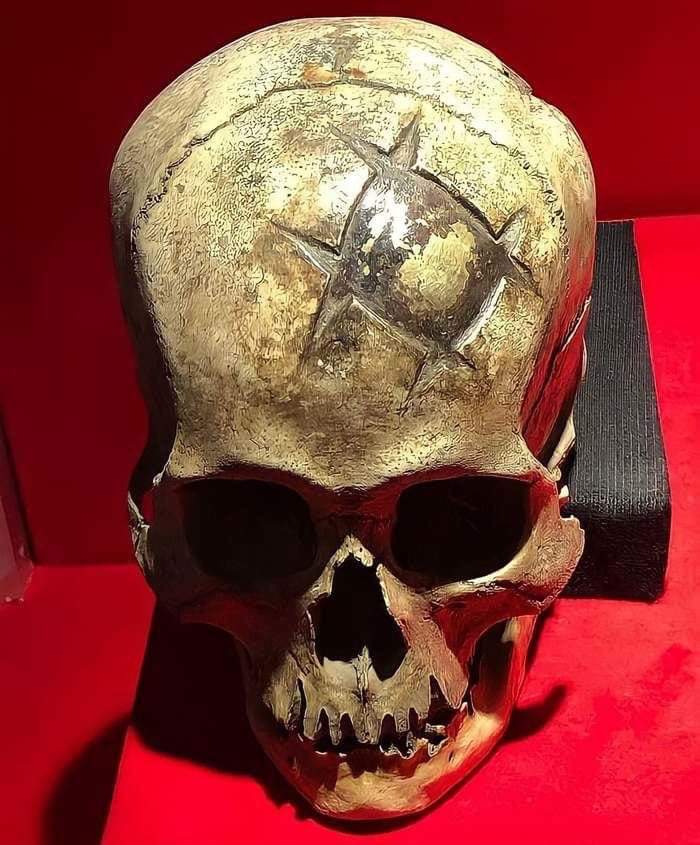
📷 : Early Incan Cranioplasty done with gold inlay whish is well healed. (Museum of Gold, Lima, Peru)
#archaeohistories
“Death Blowing Bubbles,” one of several depictions of death created by Johann Georg Leinberger between 1729-1731 CE, for ceiling of Holy Grave Chapel in Michaelsberg Abbey in Bamberg, Germany.
(Bubbles are symbols of fragility of life)
#archaeohistories