Physics ditched the ether and unlocked a deeper understanding of space-time. Genomics still clings to its equivalent: the reference genome. What if ditching it unlocks a deeper understanding of the genome itself?
Part 2 of the series where we look at how physics dealt with absolution position and it's parallel in genomics. On the surface the idea of genomic relativity seems like semantics but we think that it would unlock a new way of looking at the hardest genomics problems.
We've shown genomic position needs reform. It's based on a broken reference based system. Through special relativity, physics ditched the idea of absolute rest, so @infoecho and @domenjemec propose that we need Genomic Relativity https://t.co/Tn0HY6eaga
Having helped bring long-read technology from its dark age to a new dawn by tackling genome assembly, I've been reflecting on what it all means.
I'll never forget the first time I understood the beauty of Einstein's relativity. I hope we can get there with genomics soon.
Physics for a long time focused on swapping out what the reference for object position was, from earth, to the sun, to the ether, and eventually Einstein just removed the need for absolute position. We're seeing a lot of similarity in genomics with position/variants.
@infoecho and @domenjemec continued to think about how genomics is defined by the reference. They found there was a parallel with physics and its attempts to understand what the center of the universe was https://t.co/lBuXFQBAzo
@levelsio I briefly wrote about this a while back and came to the conclusion that there's going to be a sea of slop. One of the ways to stand out is to be excellent at knowing users so you can develop taste and build coherence so your products have the spark https://t.co/iky1X6c5Pq
It is somewhat like if I ask a radiologist give me the X-ray slide of my broken wrist bone, he or she would give me a reference image of other's bone and where the break is on the reference image. It could be useful, but it is not the my bone x-ray image 😆 3/N
I remembered when I was in Applied Biosystems as a software engineer discussing about "copy number variation". I was so confused about the concept.... 1/N
https://t.co/QFw6ahCukp
The reference genome has been useful for advancing genomics, but, it's starting to become a systemic limitation. @infoecho and @domenjemec explored what a "variant" actually means and why the relying on references is holding the space back. https://t.co/uOFGP7fQPz
If you've wondered how the layer by layer mechanics of protein folding models work, I created a series of notebooks that walks through each layer. This was way easier to do thanks to @biohub who kept the ESM models open source. https://t.co/6Io9VJnEjo
@DrMorganLevine I think a lot of AI-first takes on biology underestimate that “more data” is not just a scaling problem. Often we don’t yet know what data should be collected, in which context, or how to make it reusable etc. i also wrote a bit about my thoughts here: https://t.co/RPwC59yfNw
@domenjemec@infoecho and @BMLauro19 have teamed up to dig into the modern history of comp bio. The first chapter, now available, focuses on how modern statistics and biology co-evolved to form the foundations for comp bio. https://t.co/LZ7fBtWlT2
@domenjemec@infoecho and @BMLauro19 have teamed up to dig into the modern history of comp bio. The first chapter, now available, focuses on how modern statistics and biology co-evolved to form the foundations for comp bio. https://t.co/LZ7fBtWlT2
I enjoy using IGV, but I need a more efficient tool for analyzing diploid genomes. So, I developed one for myself. It provides exceptional GPU acceleration, allowing me to uncover all essential information spanning six orders of magnitude. #bioinformatics#genomics#visualization
@AnthropicAI I don't think it's news to anyone in the bio space that disparate data and differing protocols are a huge issue. @GA4GH and others have been trying to solve the FAIR problem for a while.
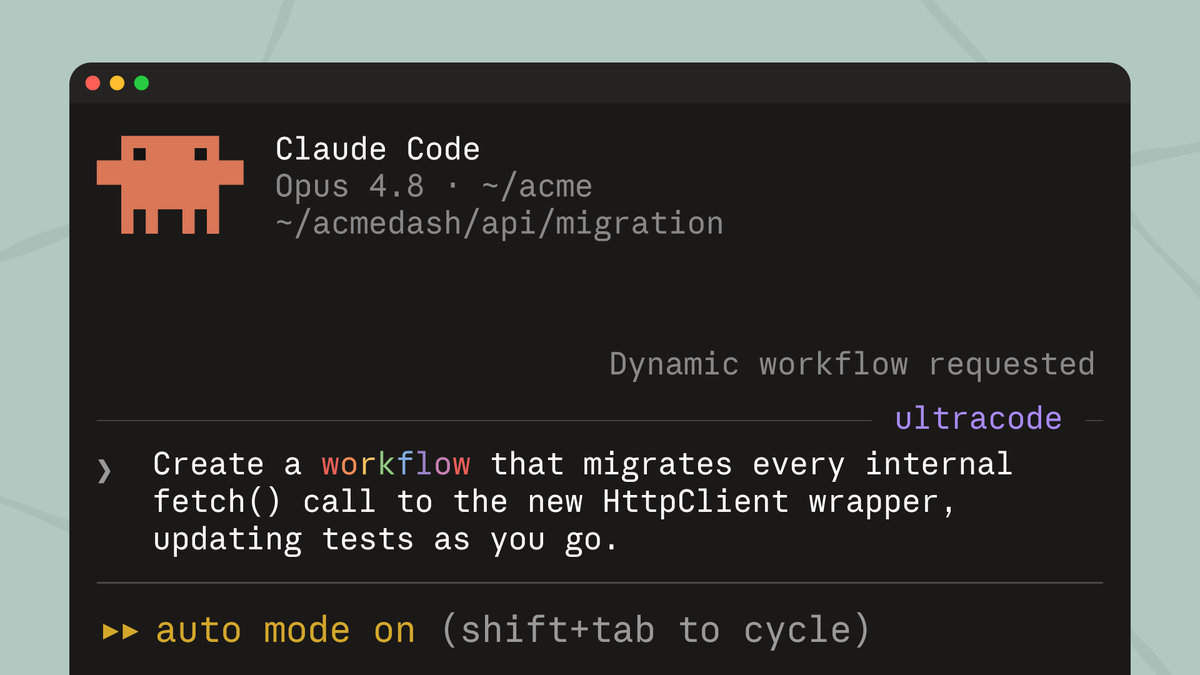
New in Claude Code (research preview): dynamic workflows.
Claude writes an orchestration script on the fly, then spins up a large fleet of coordinated subagents in parallel to take on your most complex tasks.
Use the word "workflow" in a prompt to get started.
@infoecho@domenjemec reviewed Conway's Law and the history of genome assemblers to see how including agents in academic labs will shape the research software ship. PIs will bifurcate further: either they'll ship more or end up even more removed. https://t.co/gHrjbJT0HB
It was really interesting seeing the insight @infoecho brought about the history of genome assemblers and how they were shaped so much by their different lab dynamics.
@infoecho@domenjemec reviewed Conway's Law and the history of genome assemblers to see how including agents in academic labs will shape the research software ship. PIs will bifurcate further: either they'll ship more or end up even more removed. https://t.co/gHrjbJT0HB