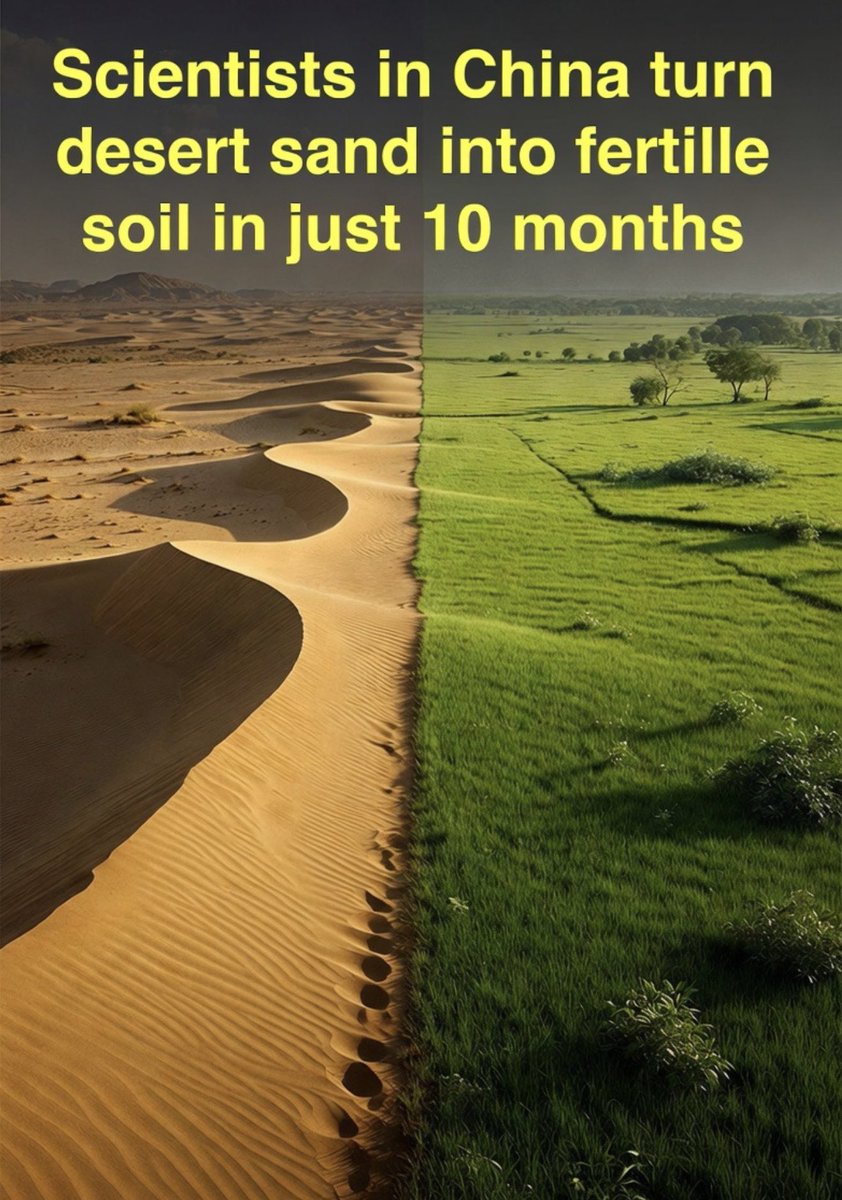
China may have discovered a quicker method to help slow the expansion of deserts. The approach focuses on biological soil crusts, which are very thin natural layers made up of microorganisms such as cyanobacteria, fungi, mosses, and other microbes that gradually form on desert surfaces. These are often described as a kind of living protective covering for sandy ground.
Under normal conditions, these crusts take many decades to develop on their own. However, researchers at the Chinese Academy of Sciences report that they were able to speed up the process by cultivating cyanobacteria in a lab and spraying them onto loose sand. Once applied, the microbes begin to spread and quickly bind sand particles together.
As they grow, they release sticky substances that act like a natural adhesive, gradually creating a stable surface layer that can withstand wind erosion and reduce the impact of dust storms. In experimental areas near the Taklamakan Desert in northwestern China, scientists observed that strong, stable crusts formed within roughly ten to sixteen months.
This is important because shifting sand makes it extremely difficult for ecosystems to recover. Wind constantly moves the surface, preventing plant roots from taking hold. Once the ground is stabilised, however, grasses and shrubs have a far better chance of growing.
The developing crust also improves soil quality. It helps retain moisture, limits water loss through evaporation, keeps nutrients close to the surface, and slowly builds up organic material that supports future plant growth. Some cyanobacteria can also absorb nitrogen from the air, naturally enriching the soil over time.
Testing showed that treated areas were far more resistant to wind erosion, with reductions of more than ninety percent in laboratory conditions. If successful on a larger scale, this method could help slow desertification, the gradual degradation of productive land into desert caused by factors such as drought, climate change, deforestation, and overgrazing.
Researchers do, however, emphasise that this is not a complete solution. The crusts can still be damaged by human or animal activity such as grazing, walking, or vehicles, and long term effectiveness will depend on weather patterns and careful land management.
Mark your calendar 🗓️
We are delighted to announce that we will come together with our supporters and community for a special parade, starting from 2pm on Sunday 31 May 👇