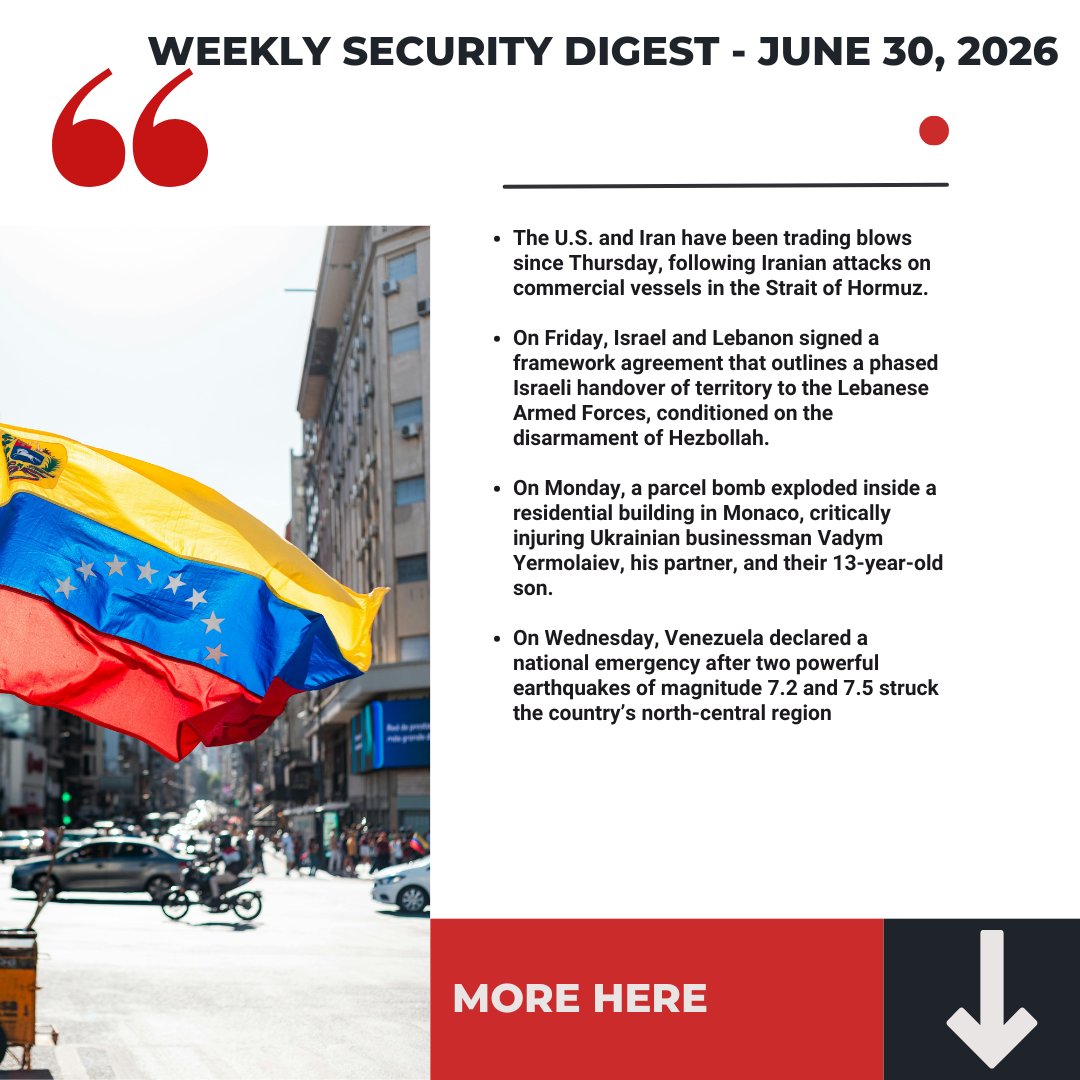
Interfor International‘s Weekly Security Digest - June 30, 2026
The U.S. and Iran have been trading blows since Thursday, following Iranian attacks on commercial vessels in the Strait of Hormuz
On Friday, Israel and Lebanon signed a framework agreement that outlines a phased Israeli handover of territory to the Lebanese Armed Forces, conditioned on the disarmament of Hezbollah
On Wednesday, Venezuela declared a national emergency after two powerful earthquakes of magnitude 7.2 and 7.5 struck the country’s north-central region
#geopolitics #iran #hormuz #lebanon #venezuela
https://t.co/cuxShxN7MO
Iran will never follow through on any MOU.
Iran will never agree to a deal.
Iran will never give up its nuclear ambitions.
Iran will never voluntarily give up control of the Strait.
Iran will never stop supporting terrorists proxies.
Iran will never be a normal country under this regime.
Iran says President Trump’s Hormuz deal gives it sole authority over the Strait of Hormuz, warning challenges could trigger more violence https://t.co/CGXUEKZWtl
TONIGHT: U.S. strikes targeted Iranian missile and drone storage facilities, along with coastal radar systems, in response to Iranian drone attacks toward commercial shipping vessels.
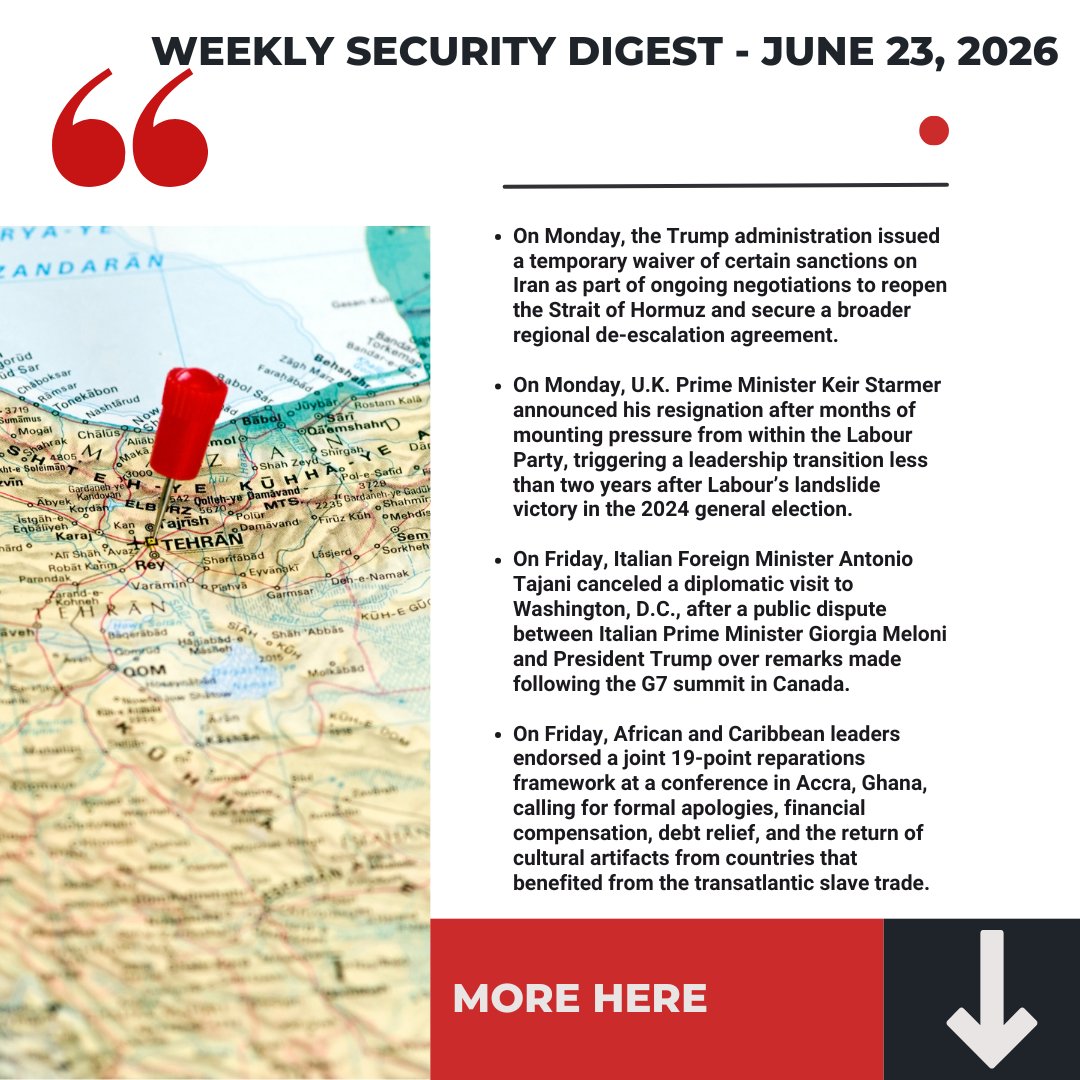
Interfor International‘s Weekly Security Digest - June 23, 2026
→ On Monday, the Trump administration issued a temporary waiver of certain sanctions on Iran as part of ongoing negotiations to reopen the Strait of Hormuz and secure a broader regional de-escalation agreement.
International Affairs
→ On Monday, U.K. Prime Minister Keir Starmer announced his resignation after months of mounting pressure from within the Labour Party, triggering a leadership transition less than two years after Labour’s landslide victory in the 2024 general election.
#safety #security #Geopolitics #HormuzStrait #iran #MiddleEast
https://t.co/mH0GXeHtNP
During a recent presentation to @ASIS_Intl International's Extremism & Political Instability Community, I shared a perspective on why AI is becoming a target of growing hostility.
The biggest threat to AI might not be AI itself.
It might be the fear that surrounds it.
Throughout history, people have struggled with emerging technologies. Not necessarily because the technologies were dangerous, but because they were unfamiliar. What we don't understand creates uncertainty. And uncertainty has a way of making people uncomfortable.
We're seeing that play out with AI today.
The resistance comes from many different places. For some, it's concern about jobs. For others, it's distrust of large corporations. Some worry about environmental impact. Others simply don't know what AI means for their future. The motivations may differ, but the underlying emotion is often the same.
Fear of the unknown.
When people feel threatened by change, they don't always engage with it. Sometimes they fight it. Sometimes they reject it. Sometimes they work to slow it down or push it away entirely.
That's a very human response.
And that human reaction is part of what makes this issue so important to understand. Watch the full discussion below for more on the growing intersection of #AI, #extremism, and #security risk
The war may be slowing down.
The uncertainty is not.
The United States and Iran have agreed to a Memorandum of Understanding that would reopen the Strait of Hormuz and begin a 60-day period of negotiations around Iran's nuclear program.
On the surface, the agreement reduces the immediate risk of escalation.
Underneath, significant questions remain unanswered.
Three issues stand out.
First, Israel's response.
⤷ If the agreement is ultimately viewed as offering limited concessions from Iran, frustration in Israel is likely to grow. Prime Minister Netanyahu has spent years arguing that Iran represents the central security challenge facing the country. Any deal perceived as falling short of that objective could create political and strategic tensions in the months ahead.
Second, the future of the Strait of Hormuz.
⤷ While both sides have agreed to reopen the waterway, it remains unclear whether Washington and Tehran share the same understanding of how that process will work in practice. Even small disagreements around enforcement, inspections, or coordination could create renewed friction.
Third, the nuclear negotiations themselves.
⤷ A comprehensive agreement within 60 days appears unlikely. Extensions are more probable. At the same time, history suggests that negotiations of this scale remain vulnerable to political pressure, changing regional dynamics, and breakdowns in trust.
The Middle East was not the only source of geopolitical risk this week.
Elsewhere:
⤷ Riots broke out across parts of Northern Ireland and Scotland following a knife attack in Belfast, highlighting growing tensions around immigration, public security, and community relations.
⤷ Russia launched another major wave of missile and drone strikes across Ukraine, including damage to Kyiv's historic Pechersk Lavra monastery, a UNESCO World Heritage Site.
⤷ The United Kingdom announced new sanctions targeting Russia's shadow fleet, financial institutions, and military procurement networks as Western governments continue efforts to constrain Moscow's ability to finance the war.
⤷ South Korea's former President Yoon Suk Yeol was sentenced to 30 years in prison, adding to one of the country's most significant political crises in decades.
The war between Israel, Iran, and the United States may be entering a new phase.
But uncertainty remains the defining feature of the region's security environment.
To stay ahead of the #geopolitical, #security, and business #risks shaping today's world, follow the @InterforInt Company Page.
In trying and failing to contain Iran, the US may have destabilized the entire region and set even its most stable allies on a perilous path, argues @InterforInt’s @DonAviv. https://t.co/WK6OmtT7hW
The longer the Iran war remains unresolved, the more likely Gulf governments are to distance themselves from the US and pursue independent foreign policies, notes @InterforInt’s @DonAviv. https://t.co/WK6OmtT7hW
Interfor International‘s Weekly Security Digest - June 16, 2026
Middle East
→ On Sunday, the U.S. and Iran agreed to a Memorandum of Understanding (M.O.U.) to reopen the Strait of Hormuz and cease hostilities. The official signing is scheduled for Friday in Geneva, initiating a 60-day period for negotiations on the nuclear issue.
#iran #HormuzStrait #middleeast #war #Geopolitics
https://t.co/JjDmNw9M0R
With neither a decisive military victory over Iran nor a comprehensive diplomatic settlement in sight, the Middle East is entering a prolonged period of strategic uncertainty, writes @InterforInt’s @DonAviv. https://t.co/WK6OmtT7hW
What will the post-war Middle East look like?
Much of today's discussion focuses on #ceasefires, #military operations, #oil prices, and the next round of negotiations between the United States and Iran.
But even if the fighting ends tomorrow, the strategic #uncertainty will not.
The most likely outcome is neither a decisive victory for either side nor a comprehensive diplomatic settlement. Instead, we are likely heading toward an uneasy ceasefire that pauses the conflict without resolving the underlying issues that caused it.
That uncertainty will have consequences across the region.
Gulf states will be forced to make economic and foreign policy decisions without clear answers about America's long-term role, Iran's future intentions, or the durability of regional security arrangements.
As a result, we may see countries increasingly pursue independent strategies, balancing relationships with the United States, Iran, China, Europe, and Russia according to their own interests.
For the United States, the challenge goes well beyond ending the current conflict.
What is ultimately at stake is the future regional order and America's role within it.
The post-war Middle East may prove more consequential than the war itself.
To read the full article, click here: https://t.co/aFimVKM0qw
The most likely outcome remains an unsatisfying ceasefire that ends the current phase of the war without resolving the underlying issues that caused it - By @DonAviv https://t.co/uLHXG7O64i
#IranWar@ProSyn#MiddleEast
Sam Worby and @Mpolymer Marc Polymeropoulos have spent decades analyzing the forces shaping the Middle East. This Tuesday, they'll help us make sense of what comes next as the U.S. and #Iran explore diplomatic off-ramps while violence continues across the region.
For businesses, governments, and security leaders, the months ahead remain highly uncertain.
During this briefing they'll discuss:
𖧹 Shifting Gulf security dynamics
𖧹 Evolving regional alliances
𖧹 Israel's strategic calculations
𖧹 What the months ahead could mean for businesses, governments, and regional stability
The conversation will be moderated by Interfor Academy's @Selllikeaspy Jeremy Hurewitz and followed by a live audience Q&A.
June 9 | 12:00 PM ET
Join the conversation:
https://t.co/Ei9Wb8RuAw
Interfor International‘s Weekly Security Digest - June 2, 2026
Middle East
→ On Sunday, an advisor to Lebanese parliamentary speaker Nabih Berri told the Trump administration that Hezbollah “will be ready to totally commit to a comprehensive ceasefire.” According to Berri’s office, the proposed deal put forward by Secretary Rubio includes an initial halt to strikes on Israel’s north and Beirut, before gradually expanding the ceasefire.
International Affairs
→ On Friday, a Russian drone struck a residential apartment block in the Romanian city of Galați in one of the most serious direct implications for a N.A.T.O. state since the start of the war in 2022.
Cyber
→ On Monday, Nvidia unveiled its RTX Spark superchip for personal computers at the Computex technology conference in Taiwan, marking a significant expansion into the market for A.I.-integrated consumer devices.
#middleeast #iran #lebanon #russia #geopolitics #security #internationalrelations
https://t.co/vR5y26k6RG
McKinsey is “under pressure from clients” to change its business model due to AI.
Instead of tying fees to hours worked —AI can do analysis, diagnosis and reports in minutes — clients want “to tie its fees to outcomes achieved” (eg. lower costs, higher revenues, increased market share).
One consulting examples is Rolls-Royce: since 2018, the engine maker charges does a “power-by-the-hour” programme, which charges *fixed* fee for every hour an engine is in the air (fee covers maintenance, repairs and replacements costs).
Many SaaS firms have also pivoted to outcomes based. Fin’s AI chatbot charges $1 per customer case resolved. iDenfy bills £1 per ID verification. Salesforce now lets users pay per task.
AI is no longer just a technology story.
It’s becoming one of the biggest forces shaping the future of the global economy and the M&A landscape.
During Interfor Academy’s recent discussion on the future of M&A and global markets, Kevin Stichter of @KLGates LLP and Ryan Breen of @KPMG joined moderator Jeremy Hurewitz @Selllikeaspy to discuss how AI, geopolitics, and market volatility are reshaping the deal environment heading into 2026.
Key themes from the discussion included:
→ The growing importance of AI governance and diligence during transactions
→ Why infrastructure tied to AI growth continues to attract attention across the market
→ How technology is changing workforce dynamics, operations, and long-term company value
As AI adoption accelerates, understanding the intersection of technology, risk, and global business strategy is becoming increasingly critical for investors, executives, and dealmakers alike.
Follow the @InterforInt International Company Page for more insights on global risk, investigations, cybersecurity, and emerging market trends.
To watch the full webinar, click here: https://t.co/Kxjc5JNJhR
Federal prosecutors have charged an Iraqi national accused of plotting at least 20 terror attacks targeting Jewish institutions across the United States.