Imagine a structure so vast that light itself would take 10 BILLION years to cross it.Astronomers have found one of the largest known structures in the observable universe: the Hercules–Corona Borealis Great Wall. They discovered this cosmic behemoth by mapping powerful gamma-ray bursts — the brightest explosions in the cosmos — using them as cosmic beacons to reveal where matter is massively clustered across incomprehensible distances.But here’s the part that breaks cosmology: According to the standard model, the universe should look roughly the same everywhere on the largest scales. Yet this colossal wall stretches far bigger than our theories comfortably allow — challenging everything we thought we knew about how structure forms in the https://t.co/AnpMSLNlyE our understanding of the universe incomplete? Are even larger structures still hiding out there? The Hercules–Corona Borealis Great Wall is a humbling reminder: no matter how advanced our science gets, the universe still loves to surprise us. Every discovery shows just how small we are in the grand scheme… and how breathtakingly extraordinary it all is. If this blew your mind, share it with a fellow space lover!
Keshav Negi is allegedly responsible for 21 deaths in Malviya nagar fire because he was cooking food with fire in a kitchen , the charge sheet should also include Walter O. Snelling for inventing LPG ,followed by whoever discovered fire.
Ek baat to hai apne desh ki Gareeb aadmi har problem mai automatically doshi ban jata hai !
My father gets a call from a fraudster pretending to be a Blue Dart delivery guy.
The guy names some client or references some real documents, so my father thinks it is genuine.
He asks my father to press some number with * and # on his Android phone.
My father starts typing and then midway realises that this is shady. So he cuts the call, blocks the number and calls to tell me what happened.
My instinct tells me that it was an attempt to activate call forwarding or some such, so that the fraudsters can get access to OTPs to execute a transaction. (Or it could be something else? So I need to call Jio and find out if any activity has been done on that number.)
I call @JioCare customer support in panic.
And then…
I’m just talking to an automated machine for the next ONE HOUR.
There is no way to get in touch with a human.
If you think I’m making it up, you can try it yourself.
I tweet to them. I DM them. It’s been over 10 hours and I still don’t have any reply from anyone at Jio.
Now think about this.
It’s a game of seconds and minutes.
That is how much fraudsters need when they have access to your information. It’s all about executing that one transaction.
You can lose lakhs of rupees in an instant. I know this because it has happened to people around me.
And in that moment, I couldn’t reach Jio for hours.
If I lose money through a financial fraud, will @reliancejio pay for it?
What is the point of “Customer Support” when there’s simply no support available when you need it?
Nothing has happened so far (thank god), but I know for sure that there’s zero trust I have in Jio to help me in an urgency.
Our systems and processes are simply not ready or prepared to handle such issues. Neither on the telecom side, nor on the police or cyber crime side. You will be on your own.
If you have parents or elders at home, please do tell them about frauds like these, and please please activate 2FA on their mail and banking accounts. It may seem like one needless extra step but it could prove priceless in a moment like this.
A frustrated husband sat on the road in protest after traffic was stopped to create a corridor for the movement of Karnataka Governor's convoy. Refusing to get up, he told police officers that his pregnant wife had been waiting inside their car while traffic remained stalled.
Starting tomorrow, Supreme court of India is on a six-week summer vacation and will be operating at just 19% of its capacity. There are 53 million cases pending in Indian courts - 93,143 of them are pending in the Supreme Court.
A judge can go on a vacation, a judiciary cannot.
@_rakesh_pandey@thekaipullai It's not just the cost aspect alone. It's about mass transit. It6cheaper, emission free transport as metro runs on electrical power. Can you imagine how many cars can be replaced by one metro train? Metro will also removes uncertainties, eliminates traffic bottlenecks.
Let me trace the timeline here because nobody's connecting it.
Step 1: Scrape the entire internet. Every book, every article, every conversation, every piece of art, every forum post. Do it without asking. Do it without paying.
Step 2: Train a model on all of it. Call it "artificial intelligence."
Step 3: Go to BlackRock's Infrastructure Summit and announce: "We see a future where intelligence is a utility, like electricity or water, and people buy it from us on a meter."
Step 3 is where you sell people's own knowledge back to them. On a meter.
They took the collective output of human thought, compressed it into a model, and now they want to charge you by the token to access a version of what you and everyone you know already created.
One Reddit user put it perfectly: "They stole all this data from us, the people, our life's work, creativity, art, by devouring the internet and blowing through all copyright laws. Now they want to sell it back to us in the form of a utility."
Imagine if someone photocopied every book in the public library, burned the library down, and then opened a subscription service for the copies.
That's the metered intelligence business model.
And they're pitching it to infrastructure investors as though they invented water.
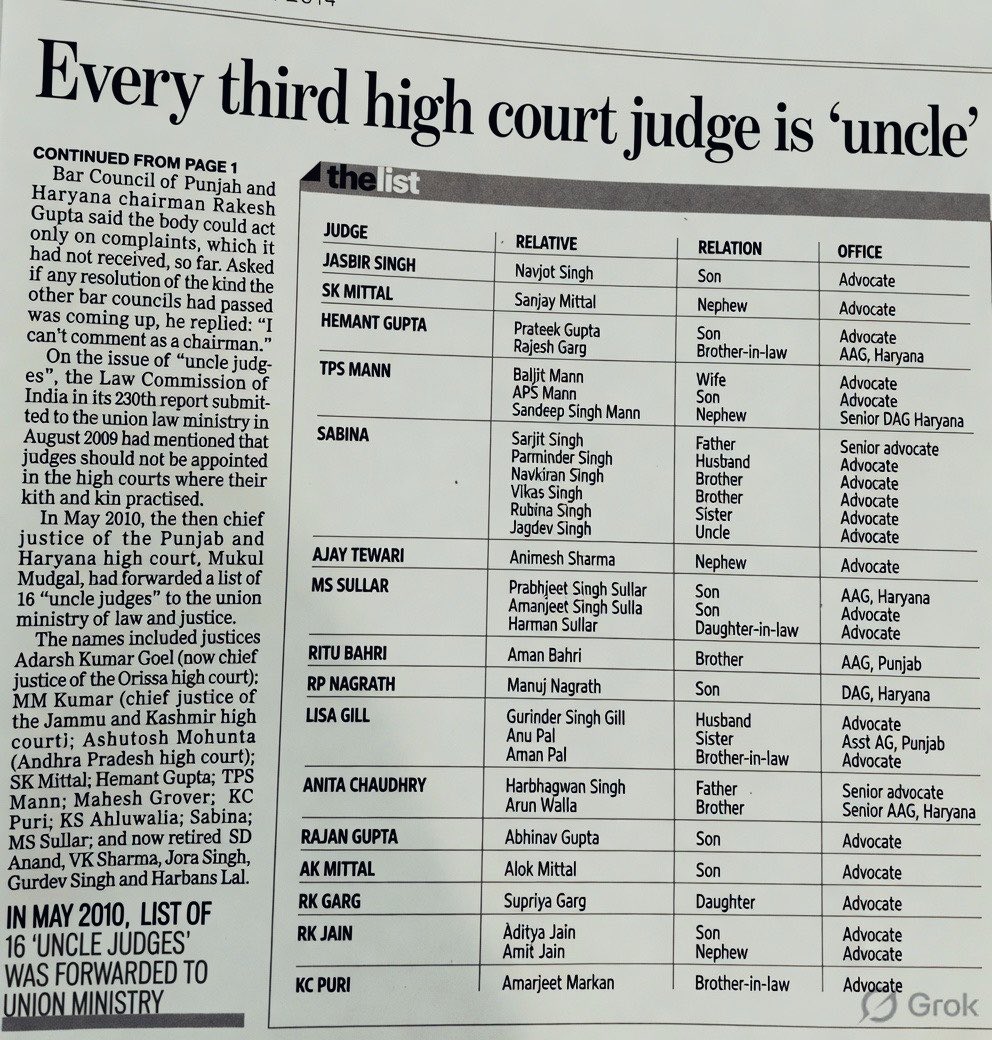
INDIA’S JUDICIARY: Every 3rd High Court Judge is an “Uncle”
This 2010 exposé on Punjab & Haryana High Court is damning proof of deep-rooted nepotism and shameless family favoritism.
Sons, nephews, wives, brothers, sisters & in-laws — all practicing as advocates in the SAME court where their relative sits as a Judge.
A list of 16 such “Uncle Judges” was officially forwarded to the Union Law Ministry.
Just look at this table. Clear, blatant conflict of interest. How the can justice be delivered fairly when family members argue cases before their own “Uncle”?
The Law Commission and Bar Council flagged this years ago. Nothing changed.
This uncle culture has destroyed public faith in the judiciary. Merit is dead. Nepotism rules.
We need ruthless reforms NOW:
- Ban close relatives from practicing in the same court
- Mandatory public declaration of family links
- Strict penalties for violations
Enough is enough. The temple of justice has become a family business.
We are blindly following western architecture which is meant for utilising sun max as they get less sunshine. We need to avoid too much sunshine. These glass buildings actually contribute to Urban Heat Islands . And many of these buildings get green certification or awards ironically
India is about to commit Rs 37,500 crore to coal gasification. Cabinet note is ready. Approval expected this week.
Most people will read this as a coal story. I think it is an import substitution story.
India imports 8 million tonnes of urea annually. Imports methanol. Imports synthetic fuels. All of these can be produced from coal gasification. We sit on 319 billion tonnes of coal reserves, the fourth largest in the world. The raw material is literally under our feet.
The previous approach was small. A few pilot plants. Talcher fertiliser plant doing coal-to-urea. Now Rs 37,500 crore says the government is done piloting.
I have spent two decades in coal. The economics of gasification only work at scale, and scale requires exactly this kind of policy push. China built 50 coal gasification plants between 2010 and 2020 and now produces most of its own methanol. We are starting late, but starting big.
What nobody is discussing: coal gasification also produces hydrogen. The entire green hydrogen conversation assumes electrolysis. But blue hydrogen from coal gasification with carbon capture could be the bridge technology India actually deploys first. Watch this space.
Couple of days ago, Dusharla Satyanarayana was beaten up and left to bleed in his farm.
Who is Dusharla Satyanarayana?
A 72 year old man who inherited 70 acres of ancestral land in Raghavapuram, Suryapet, Telangana.
He didn’t sell it or make it a real estate venture, instead he resigned to his plush bank job and took up a full time work to repair the environment.
He planted FIVE CRORE trees in the land, all by himself.
He also dug 13 ponds and small lakes in this forest. He developed rainwater harvesting system in his forest.
He doesn’t sell the agri-products, he says every fruit / flower / leaf that grows in this forest belongs to the animals, birds and the forest itself.
At least 32 varieties of birds made this forest their home, along with numerous animals.
When Nalgonda district was suffering because of Fluorosis, he started an NGO Jala Sadhana Samithi and worked intensively to educate people about the problems. He made government to listen to the water crisis and brought in policy changes.
Dusharla Satyanarayana doesn’t even pluck a fruit for himself from the forest. And he decided not to give his land to his son also!
People offered him hundreds of crores for the land and he flatly refused. He family and neighbours fought with him but he never gave up caring for nature and his forest.
Three days ago, a few men thrashed him because he stopped them from cutting trees in his forest. He told them not to destroy the nature. These men are neighbouring villagers who want to graze their cattle and cut the trees for their needs.
Dusharla Satyanarayana is now getting treated at a government hospital in Hyderabad.
Wishing him a very speedy recovery.
Wish people understand what this man is doing for this world & protect him, if not worship him.
An interesting visualization of the tides on our planet
The Moon's gravitational pull creates two tidal bulges on opposite sides of the Earth, causing the rise and fall of sea level we perceive as tides. As the Earth rotates, different parts of the planet pass through these tidal bulges, resulting in two high tides and two low tides each day.
This is the most enviable characteristic of western society. Over there a nurse can quit at 50 to train as a commercial pilot, a marine can retrain as a kindergarten teacher at 38, a corporate lawyer can walk out at 45 to learn welding, a stay at home mom can start medical school in her forties, and nobody treats it as a tragedy or a scandal. The whole society is built to absorb a second, third, even fourth innings without flinching.
Meanwhile in vishwaguru, if you picked humanities without maths at 16 your obituary is already drafted, three failed JEE attempts means permanent underclass, dropping out in second year of College turns you into the cautionary tale trotted out at every family wedding for the next two decades, and a 35 year old trying to switch fields gets asked what went wrong in life.
No wonder we Indians end up so incurious, so afraid of change, so allergic to risk, and so comfortably settled into mediocrity.
Traveling to Ahmedabad in the 19217 Saurashtra Janata, and just before Vishwamitri station, some anti social element threw a stone at the window. The toughened glass of the coach prevented anything from getting inside. What kind of retards live in this country?
Update: The onboard staff is now patching up the damage using a plastic sheet and tape. This is a brand new 2024 made coach.
<rant>
We’ve reached a point where urban infra debates are stuck between two extremes: “nature lovers” who don’t want a single tree touched, and infra maximalists who are fine bulldozing everything.
Real life doesn’t work like that.
Take Mumbai. The city has very few major roads to move people in and out, and a lot of traffic gets funneled through the same choke points toward Nashik and Gujarat. When those jam up, everything slows down. Projects like the Versova–Bhayander coastal road aren’t random vanity projects -- they’re meant to take pressure off these overloaded routes and improve connectivity.
Yes, there’s an environmental cost. Around 45,000 mangroves are affected, but only a part of that is permanently lost, with the rest planned for restoration or transplantation. There are also compensatory plantations mandated.
You can still disagree with the trade-off, that’s fair -- but expecting “zero impact” infra in a dense, land-starved city like Mumbai just isn’t realistic.
At the same time, let’s not pretend everything is perfect on the infra side either. Mumbai has spent a lot of time, money, and political focus on road projects -- coastal roads, flyovers, connectors. What the city actually needed more of was massive investment in public transport -- faster metro rollout, expansion of BEST fleet, upgrades to suburban rail, and better last-mile connectivity.
Roads help, but they don’t solve the core problem of moving millions of people efficiently.
Same story with cycling. People keep pushing cycle lanes like they’ll fix everything overnight. But the ground reality in India is different -- cycling is still seen as a fallback, and most people want to move away from it as incomes rise.
You can’t just paint lanes on broken roads and expect people to switch. Cycling works in cities that already have strong public transport, proper footpaths, and strict control over encroachments. Without that, it’s just cosmetic.
Mangroves matter.
Public transport matters.
Roads matter.
But treating any one of these as untouchable while ignoring everything else is how cities get stuck. Urban planning is always about trade-offs and right now, we’re just arguing in extremes instead of dealing with reality.
</rant>
What I forgot adding here:
- London has ~35 bridges across the Thames within the city.
- Paris has ~37 bridges over the Seine.
- New York City has 20+ major bridges and tunnels just across the Hudson/East River crossings.
- Shanghai has 15+ major crossings over the Huangpu.
These are cities that built multiple ways in and out, so traffic gets split instead of piled up.
Mumbai? Almost the entire northbound movement (to Surat, Ahmedabad) gets funneled onto essentially one corridor/bridge. And then people talk about “induced traffic.”