@vinceflibustier Tout mon soutien Vincent, tu ne rentres pas dans les codes d'une époque où tout doit binaire. Les débats, les questions de sociétés, les faits divers se règlent comme peuvent le faire des supporters de foot avinés. Mais au milieu de tout ça il y a de véritable amoureux du jeux.🤝
🟡🧬 BIOLOGIE / En seulement 16 heures, un embryon humain façonne les premières fondations de son système nerveux dans un fascinant time-lapse.
Et ce n'est que le début d'une transformation vertigineuse.
Chez l'être humain, tout commence par une seule cellule. Celle-ci se divise en 2, puis 4, 8, 16 jusqu'à donner naissance, neuf mois plus tard, à un organisme constitué de plusieurs milliers de milliards de cellules, organisées en centaines de types cellulaires différents.
Le cœur commence à se former extrêmement tôt et son activité débute autour de la 5ᵉ semaine de grossesse (en comptant depuis les dernières règles). Le tube neural, à l'origine du cerveau et de la moelle épinière, se forme et se referme principalement durant les premières semaines du développement.
À la naissance, le cerveau possède déjà de l'ordre de 100 milliards de neurones. Les estimations modernes chez l'adulte tournent autour de 86 milliards.
Et pourtant, toutes ces cellules possèdent essentiellement le même ADN.
Ce qui transforme certaines en neurones, d'autres en cellules musculaires, osseuses ou cutanées, c'est notamment la manière dont différents programmes génétiques sont activés ou désactivés au cours du développement.
📹 Northumbria University
move to china.
if you are young, technical, obsessed with building physical things, china is one of the highest-density environments you can put yourself in. shenzhen for electronics, hardware and robotics. dongguan for factories and supply chains. foshan for industrial manufacturing. guangzhou for trade, engineering and access to the entire pearl river delta.
the greater bay area is basically one enormous distributed machine. design something in the morning, source components in the afternoon, talk to a factory tomorrow, prototype it this week, iterate next week. suppliers, tooling, machining, injection molding, pcb assembly, motors, batteries, sensors, logistics and manufacturing knowledge are concentrated within a few hours of each other.
the internet made information cheap. AI is making intelligence cheap. the remaining bottleneck is increasingly the ability to turn bits into atoms. if your ambition is robotics, drones, energy, electronics, machines or advanced manufacturing, proximity to the world’s deepest hardware ecosystem becomes an enormous advantage.
move where reality has the highest bandwidth.
Let me repeat : this market freakout had NOTHING to do with the FOMC Hold which was almost priced in FFF curve going into today. The market is freaking out because Warsh came across as clueless and incompetent. This is much more serious than a one-off decision freak-out
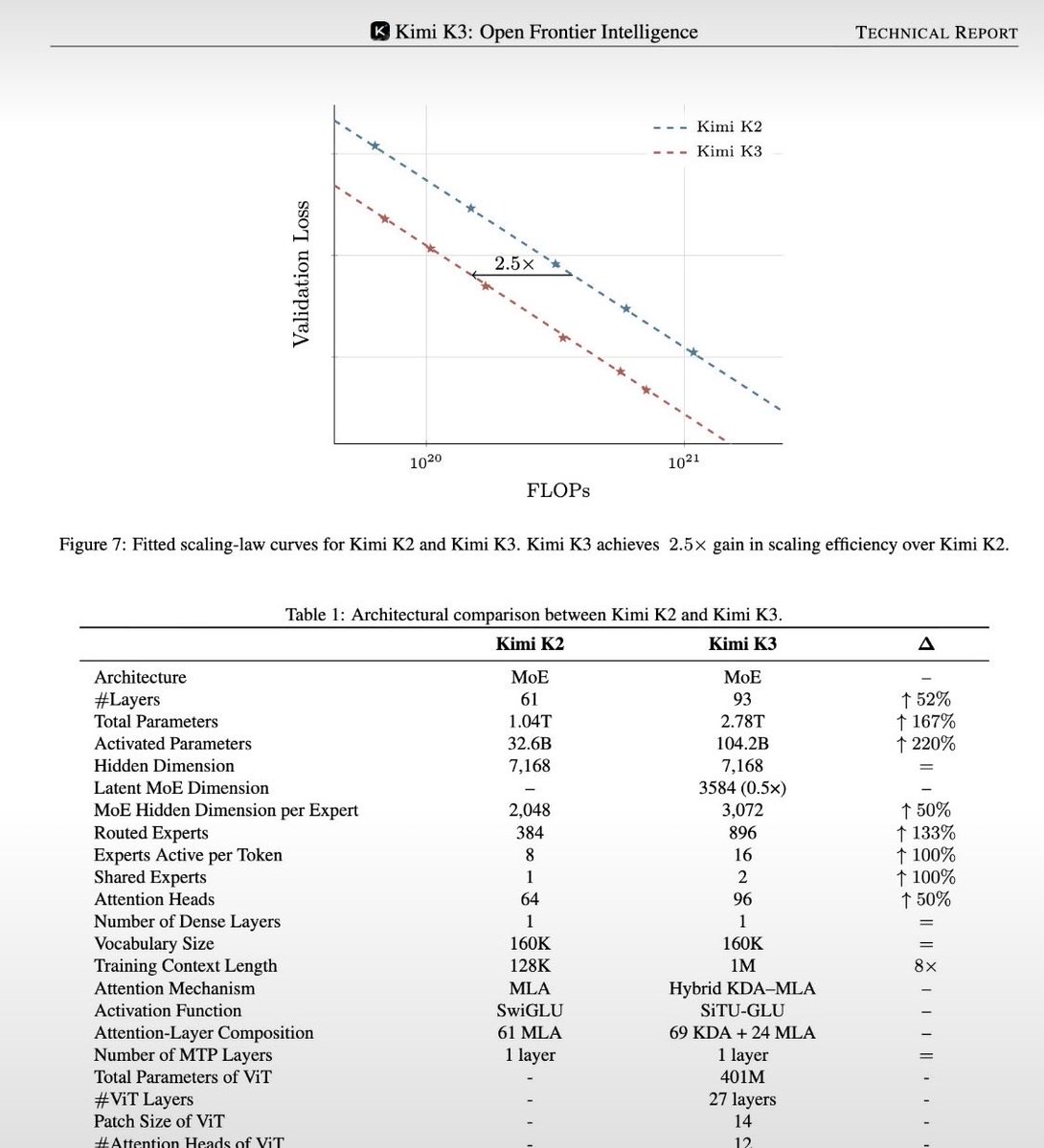
vous pouvez télécharger ce soir un des modèles les plus puissants du monde et le faire tourner chez vous, sans filtre et sans permission
ce qui rend ça possible tient dans l'architecture, 2,8 trillions de paramètres au total et seulement 104 milliards actifs par token, le routeur réveille 16 experts sur 896 et laisse dormir tout le reste donc la facture en calcul ressemble à celle d'un modèle bien + petit et l'attention garde une mémoire compressée de taille fixe sur la plupart des couches, ce qui permet d'avaler un million de tokens sans saturer la mémoire de vos cartes
l'embargo leur a appris à tirer 2,5 fois plus d'intelligence de chaque flop et ils offrent la méthode avec le modèle, les poids voyagent déjà partout et personne peut refermer la route désormais ;)
Google just reported $99 billion in profits it never actually received.
Alphabet posted net income of $112.1 billion for a single quarter. Earnings per share came in at $9.11 against a Wall Street estimate of $2.87.
That is one of the largest profit quarters any company has ever printed.
Yet the stock fell about 7% the same day.
When people read past the headline and opened the earnings release, they found the reason sitting in one footnote...
$99 billion of that profit came from a line called other income. Alphabet describes it as "primarily the result of net unrealized gains on our equity securities."
So Google did not sell anything. It marked up shares it already owned and ran the increase through its income statement.
That single line added $77.1 billion to net income after tax. It accounted for $6.26 of the $9.11 in earnings per share.
Strip it out and adjusted earnings per share were $2.85. Analysts wanted $2.89. The ACTUAL business missed.
Now here is what makes this insane:
Most of that $99 billion came from two holdings, SpaceX and Anthropic.
SpaceX went public on June 12 at roughly $1.77 trillion, up from about $400 billion a year earlier. Alphabet's stake is worth $94.1 billion, and roughly $80 billion of it sits under sale restrictions.
Anthropic went from a $350 billion valuation to $965 billion inside the same quarter. Alphabet's private company holdings were worth about $124.3 billion on June 30, and the vast majority of that is Anthropic.
Google cannot sell either position right now.
Now trace where that valuation came from:
Google started putting money into Anthropic in 2023. A $300 million bet has grown into a $13.3 billion position with commitments of up to $30 billion more.
Anthropic committed to buying at least five gigawatts of computing capacity from Google Cloud.
Google Cloud revenue then grew 82% to about $24.8 billion, the strongest quarter that business has ever had.
That growth is part of the story the market uses to price both companies.
And when Anthropic's valuation jumped, Google booked the jump as its OWN profit.
Google is the investor, the supplier, and the party deciding what the asset is worth. A tax and accounting consultant named Robert Willens flagged this back in April, pointing out that Alphabet is able to influence the value of one of its own assets.
And Alphabet's free cash flow for the quarter was negative $5.9 billion. That is the first negative quarter since Google went public in August 2004.
Capital spending hit $44.9 billion. Operating cash flow was $39.1 billion. Capex now eats about 37.5% of every dollar of revenue, the highest share in the company's public life.
To fund it, Alphabet has taken on roughly $100 billion of debt this year and raised about $85 billion in a June share sale, its first in more than two decades. This is a company that spent years buying its own stock back.
What happens next:
Alphabet raised 2026 capital spending guidance to between $195 billion and $205 billion, the second raise in three months. The finance chief told analysts 2027 spending will rise significantly.
The company also disclosed $811 billion in contracted future spending commitments as of June, up nearly $500 billion from March.
Those commitments are signed contracts that get paid in cash. The profit is an estimate of what a private company might be worth on a given day.
Estimates move in both directions. If Anthropic or SpaceX gets repriced downward, the same line that produced the biggest quarter in Google's history runs backwards, and this quarter produced no free cash flow to absorb it.
Meta, Microsoft and Amazon are all carrying their own private AI stakes into their own earnings reports.
Watch how much of their profit they actually collected in cash...
For my first post, I’m sharing a letter @NVIDIA signed on why open models matter.
AI will transform every industry, power every company, and be built by every country.
Open models strengthen safety and cybersecurity, accelerate innovation and diffusion, and enable sovereignty.
The world needs both frontier closed models and frontier open models.
https://t.co/AUKzoQ5Ikb
OpenAI and Anthropic executives are sounding the alarm about the rise of cheap AI, particularly powerful new models produced in China, suggesting they will lead to a “dystopian” AI future and present unacceptable security risks without regulation. https://t.co/9jKfO3DhDN
MDRRRRRRR LE CULOT DES RICAINS EST JUSTE STRATOSPHÉRIQUE
pour info leurs propres modèles d’IA sont nés exactement du vol qu’ils dénoncent, l’intégralité de l’ia américaine a été entraînée en aspirant la planète sans rien demander à personne, des millions de livres sous copyright, des bibliothèques piratées, github et les textes de gens qui ont jamais donné leur accord, la matière première de leur empire c’est justement le travail non payé de l’humanité entière mdrrrr alors les entendre crier au pillage quand un chinois distille un modèle, c’est le cambrioleur qui porte plainte pour effraction hein mdr
d’ailleurs l’Angleterre a fait pareil au 19e (pour ceux qui ont une culture industrielle) elle a copié les techniques du monde entier pour s'industrialiser m puis interdit l'export de ses machines et de ses ingénieurs une fois en tête, d’ailleurs les US ont ignoré les brevets européens pendant tout leur décollage avant de devenir les gardiens sourcilleux de la propriété intellectuelle mondiale, le protectionnisme est le réflexe de celui qui sent la marche descendre
de manière générale une puissance dominante vit toujours en deux temps, tant qu'elle a de l'avance elle prêche l'ouverture, le libre échange, la circulation des idées parce que la liberté profite à celui qui court déjà devant et dès que l'écart se referme elle redécouvre subitement la propriété, la sécurité nationale et la règle ça marche comme ça aux US malheureusement
Le retraité vit du socialisme, par droit
Le chômeur vit du socialisme, par choix
Le politique vit du socialisme, par carriérisme
Et puis il y a les actifs, qui financent tout, par obligation
Et le plus fort c’est que certains souffrent du syndrome de Stockholm, par ignorance
Mojtaba Khamenei’s funeral message is worth reading carefully. It is not simply an emotional tribute to his father: it offers a first glimpse into the religious and strategic narrative likely to shape the next phase of the Islamic Republic.
- The central theme is unmistakably Karbala. The late Supreme Leader is described as Husayni in every dimension: he thought like Husayn, fought like Husayn, lived like Husayn and ultimately embraced martyrdom like Husayn. This is not only religious symbolism. It embeds his death within the foundational narrative of Shia political identity, transforming a military defeat into a sacred act of sacrifice.
- the second pillar of the message is equally important: revenge. Mojtaba does not portray retaliation as a political choice or a matter of state policy. He defines it as the will of the nation and, above all, as a divine mission. He explicitly says it will not depend on him or on any current official, and that “free people around the world” will each carry out part of this mission.
- This language is significant because it shifts revenge from the realm of immediate military retaliation to that of a long-term religious obligation. In other words, the message suggests that justice for the “martyrs” is not tied to a specific timeline or battlefield but becomes part of a broader ideological project that can be pursued by various different actors over time.
- Whether or not this translates into concrete action is a separate question. But, in my view, as a statement of political theology, the speech is highly revealing: Mojtaba is framing continuity through the twin concepts of Karbala and enduring retribution.
#Iran
biggest claude code secret none of you are using
activate “Claude Code on the web”
admittedly not the best product name. and anthropic seems to be trying really hard to hide it
but it’s the future
getting your codebase to a place where it can run inside a restricted cloud sandbox will require some work. but once you’re done, you’ll no longer need to have an always-on computer running your tasks. you can then truly work from your phone
it’s clear that future anthropic products will be based on this. and openai’s too, they already announced their future agents in chatgpt will run in the cloud. cursor is big on this as well
if you migrate today you can start reaping the benefits now and won’t have to eat glass later when the rest of the world does
https://t.co/dbEiBUXQlP
Entraineurs les plus capés dans l'histoire de la Coupe du Monde :
- Helmut Schön 25 matchs
- DIDIER DESCHAMPS 24 matchs
- Carlos Alberto Parreira 23 matchs #FRAPAR
After reflection, this new narrative by Palantir is probably much more consequential than people may assume.
Palantir is basically being the canary in the coal mine announcing the death of two major assumptions propping up the US economy right now:
1) that AI labs will be able to extract significant economic rent - as opposed to AI models being mere commodities
2) that other countries can accept structural dependency on US technology and services without pushing back on sovereignty concerns
Why are Palantir specifically starting to be vocal about this?
First off, major middle-powers, even US “allies”, are one by one showing them the door. In June, France announced that the DGSI - its domestic intelligence agency, which had relied on Palantir since the 2015 Paris attacks - would replace it with French firm ChapsVision, with Prime Minister Lecornu explaining (https://t.co/SLhEGprBZC) that France “cannot accept new strategic dependencies in the digital sphere” and shouldn't depend on the goodwill of companies “capable of turning off the tap.”
Germany moved even earlier: its domestic intelligence service, the BfV, also selected ChapsVision over Palantir (https://t.co/pDZVj4SYUY), and the German military has said it will no longer use Palantir at all. Then, just this week, Spain instructed state-controlled companies - including strategic firms like Telefónica, Indra and Navantia - to avoid signing any new contracts with Palantir (https://t.co/0ik4UAFrT7).
Even in the UK, Washington's most loyal vassal, the NHS's £330 million data contract with Palantir is under review following parliamentary pressure (https://t.co/uJl6g4BMsW), and London Mayor Sadiq Khan blocked a proposed £50 million Palantir contract with the Metropolitan Police.
Palantir making a lot of noise around them caring about sovereignty makes a lot of sense: it's damage control since they keep being told they're a sovereignty risk.
I doubt it will work - because it's true: they are a sovereignty risk - but the fact that they feel the need to be vocal around this tells you where the wind is blowing: they're not shaping the narrative, they're reacting to one they're losing.
What they're saying against closed-source AI (basically a broadside attack on OpenAI and Anthropic), is again highly self-serving. Palantir's sudden love of open-weight AI models conveniently coincides with them launching 2 days before a partnership with Nvidia to sell exactly that: open models models (NVIDIA's Nemotron) in sovereign environments.
So it's essentially a product launch.
It doesn't make what they're saying wrong: it is factual that the value proposition of closed-source AI labs looks increasingly unsustainable. I mean: you're paying 10X the price of Chinese open-source AI models for something that's not really better (or just marginally) and on top of that you have zero control over your data, or the models themselves.
When Palantir says that "the architecture that maximally preserves sovereignty is one that enables institutions to own their tribal knowledge, and to compound it as alpha," they're right. I'd add that this also means you shouldn't trust Palantir either with that "tribal knowledge"... they obviously left this part out 😉
When you take a step back, these two things have major implications on many other US companies.
SpaceX - which just went public at the largest IPO valuation in history - is one clear example as I describe in my latest article on the new space race with China (https://t.co/JK3ELAyEVO).
If countries like France concluded with Palantir that they couldn't depend on a company “capable of turning off the tap” when it’s merely analyzing their data, what should they conclude about a company that aims to literally control their entire connectivity - at one man's whim, from space?
What percentage of SpaceX's crazy market cap is based on the assumption that foreign governments will not do to Starlink what they're currently doing to Palantir?
And SpaceX - or Palantir - aren't alone: a significant proportion of the top US tech giants, who rose in a world where no one questioned American technological hegemony, now face an environment that's much less conducive to the kind of lock-in their business models - and valuations - depend on.
When you pair this with the fact that it increasingly looks like the US made a wrong bet with closed-source AI - an extremely expensive wrong bet - the picture that emerges is of a country that bet its economic future on two things - proprietary AI and captive allies - and is losing both at the same time.
And to compound the problem, it doesn't help that the official narrative of the US government - via the voice of Jacob Helberg, the Under-Secretary of State (https://t.co/Z1rotPl9Ee) - is to be vocally opposed to "AI Sovereignty": essentially telling everyone "you know what, your worst fears are real, our tech companies are really out to undermine your sovereignty."
Read Helberg's post (the one I linked) and put yourself in the shoes of - say - a European or Asian leader and ask yourself how you'd react to being told that building your own AI capabilities is "marching in perfect formation into the past," that your pursuit of sovereignty is really just "synchronized mediocrity," and that your only path to the future runs through American technology.
If it was me in a position of power, I'd read this as a massive wakeup call: when another country's official position is that your sovereignty is a problem, history says you're about to need it.
So yes, it looks like - unexpectedly - Palantir, of all companies, is being quite the canary in the big tech mine. Yes they obviously do this for self-serving and cynical purpose, and yes they're of course also very much part of the problem and not the solution. But it doesn't make them wrong: sometimes it takes a vulture to tell you something is dying.
Alex Karp vient de dire tout haut ce que beaucoup d’entreprises pensent tout bas : la lune de miel avec les grands laboratoires d’IA touche peut-être à sa fin. Les boîtes paient des tokens mais où est la valeur économique associée ?
Et Karp pose la bonne question : "si votre IA crée vraiment un milliard de dollars de valeur, pourquoi vendre du token au kilo ? Pourquoi ne pas partager directement la valeur créée ?" La réponse est assez brutale : parce qu’une partie des modèles frontières a oublié les règles élémentaires du commerce.
Un client n’est pas une variable d’entraînement. Une entreprise n’est pas un simple canal de distribution. Un marché ne se remplace pas par décret. Pourtant, certains laboratoires semblent moins obsédés par la création de valeur que par la capture réglementaire, avec l’idée de devenir l’infrastructure obligatoire et, à terme, de se substituer aux acteurs économiques eux-mêmes.
Au lieu de faire grandir l’économie main dans la main avec ceux qui la construisent, ils rêvent d’en devenir le péage. Il ne faudrait plus choisir les meilleurs outils, mais les acteurs politiquement conformes, idéologiquement alignés et compatibles avec le récit du moment.
C’est exactement comme ça qu’on tue l’innovation au nom de la souveraineté. La vraie question n��est pas de savoir qui a le meilleur modèle. La vraie question est : qui crée vraiment de la valeur pour les entreprises, et qui cherche juste à les remplacer ? @MistralAI a une carte énorme à jouer sur ce point !
https://t.co/xOR891jyK6