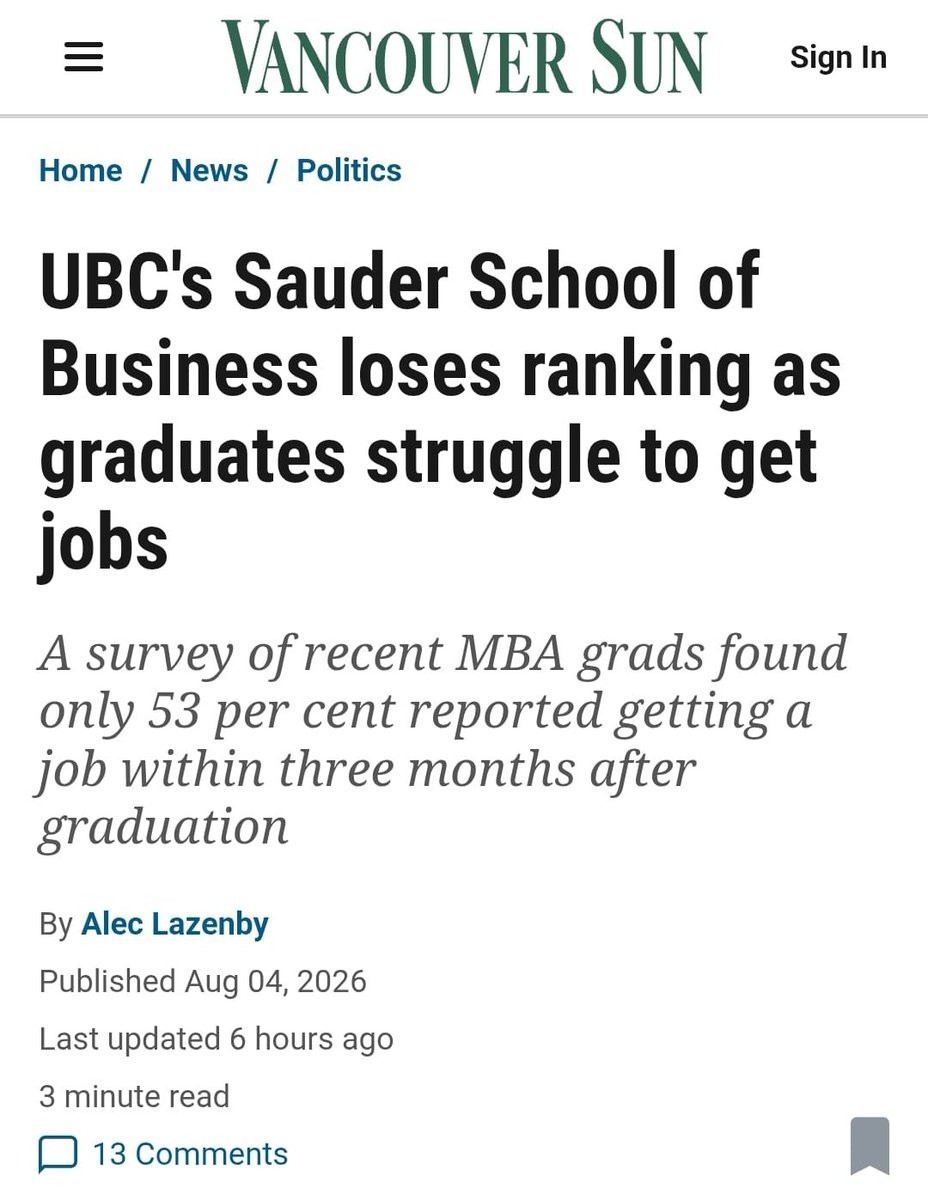
UBC Sauder’s MBA program just ranked second-last in the entire world for a reason: only about half of their 2025 graduates had a job three months after finishing. Seventy-two percent of the class are international students. Meanwhile, local graduates are struggling and businesses keep telling us they can’t find the right people or can’t afford to expand here.
This isn’t a surprise. Under the NDP we’ve seen private-sector job growth stagnate while the government piles on taxes, red tape, and uncertainty. The average home in Metro Vancouver still costs well over a million dollars, with the benchmark price sitting around $1.1 million. Young people finishing an expensive degree can’t get a foothold when housing is that out of reach.
Corporate head offices aren’t coming to Vancouver. In fact, they’re heading the other way. Interfor just announced it’s moving most of its executive and back-office functions from Burnaby down to Georgia. Canadian manufacturers are openly looking at relocating production to the U.S. because of costs and uncertainty here. Our startup scene is under pressure too. Early-stage companies across Canada, including in B.C., are raising less capital and fewer deals are getting done while the money concentrates in a handful of larger rounds.
Universities keep expanding international enrolment because the tuition dollars are easy, but the jobs for those graduates and for our own kids just aren’t there. British Columbians deserve post-secondary programs that actually lead to good-paying work in a growing economy. That means getting serious about private-sector job creation, cutting the barriers that drive investment and talent away, and taking control of immigration so it serves our communities instead of overwhelming them.
Hey Dodger haters: what were they supposed to do? Not try their hardest to three-peat? Not take advantage of having the best farm system in the bigs? Apologize for having one of the best organizations in all of sports? Just stop. #dodgers
“Netflix star” is such an absurd way to describe one of the greatest climbers of all time. He scaled the 14 tallest peaks on earth in 189 days. Then he did it all over again without supplemental oxygen. And he served in the British special forces.
The man was a legend and proof that with the right mindset, you can conquer anything.
If you live in North Vancouver-Capilano, you already know this feeling. A detached home on the North Shore is still sitting around two million dollars. Rent for a one bedroom is pushing twenty six hundred a month. And then there’s the sewage plant. This started as a seven hundred million dollar project. Today it’s three point eight six billion. Five and a half times the original price tag. North Shore households make up about eight percent of the region’s population but are covering thirty seven percent of that bill, an extra five hundred ninety dollars a year on your utility bill, for the next thirty years. The original contractor got fired after more than fifteen hundred construction defects were found. Regular families are the ones stuck paying for that mess.
Stephen Curran isn’t an outsider parachuted in for a campaign. He’s lived in Central Lonsdale since 2014, right in this riding. He pays a mortgage here, sends his kids to school here, walks his dog on the same trails you do. Twenty years as a lawyer, now running a local practice helping North Shore small businesses stay afloat. In 2025, he pulled nearly thirty four percent of the vote here, the best Conservative result in this riding in over a decade.
Compare that to who the Liberals just handed their nomination to. Braeden Caley, Carney’s former deputy chief of staff, an Ottawa insider who got the nod without even running a local nomination race. He doesn’t pay a mortgage here. He’s not sitting in North Shore traffic every morning.
Plenty of people who vote Liberal or NDP genuinely care about the environment and about helping people who are struggling. That’s a real value. But good intentions don’t pay your utility bill. If a basic infrastructure project balloons to five times its budget, at some point you have to ask who these policies are actually working for.
Curran’s platform is specific. Exempt new homes under one point three million from GST, saving buyers around sixty thousand dollars. Mandatory disclosure and independent audits when infrastructure projects blow their budget. Lower taxes and red tape so families and small businesses can breathe. And someone in Ottawa who actually lives with the consequences of the votes he casts.
Do you want someone in Ottawa who reads about your bills in a report, or someone who’s already paying them right alongside you?
@specurran
Last month, the Liberals announced $230 million of new funding for Nunavut, or about $6,000 per person in the territory.
Now Nunavut’s NDP MP, Lori Idlout, is crossing the floor to join the Liberals.
Funny how life works.
B.C.’s budget plans to eliminate about 15,000 positions — that’s less than 3% of the overall taxpayer funded FTEs.
Meanwhile the cost B.C.’s overall public sector has increased by nearly 30% over the past three years.
It’s like trying to fight a forest fire with a water gun
Holy yackamo.
@globeandmail editorial board pretty much calls BC's finance minister a liar multiple times in a searing op-ed that napalms the Eby administration.
This is an absolutely brilliant opinion piece. All is spot on and explains why I have been publicly criticizing @Dave_Eby' fiscal irresponsibly ever since he took over. We are heading for a 2001 style wipeout of the @bcndp and that's on him. #bcpoli
https://t.co/HcO1T4rsvb via @VancouverSun
Blaming others distracts from the utterly irresponsible approach @bcndp have taken to provincial financing under @Dave_Eby. Neither @SelinaMRobinson, @carolejames nor @jjhorgan would have ever put BC in this position. I worked with them all and know how committed they were to the collective, rather than themselves.
@Dave_Eby was responsible for a ~$2billion addition to provincial debt as he allowed carbon tax revenue to become general revenue for his pet projects, instead of being at or near revenue neutrality. He needs to go, whether it be from within or from the outside. But IMHO, he is the most destructive Premier BC has ever had in place to the overall well being of British Columbians.
This post will clearly have partisan consequences for me. But it needs to be said as BC is in a dire fiscal situation because of his ideology @VaughnPalmer
https://t.co/G7X182itZY @VaughnPalmer #bcpoli #cdnpoli
“Having the two most important ports in B.C. rank amongst the least productive in the world isn’t only embarrassing. It’s a measure of indifference Mr. Carney and Canadians simply can’t abide.”
https://t.co/mkd9Ysy6Iy
Margaret Thatcher said that when you have too many people working for the public sector they start to have a vested interest in consolidating power into the government.
I think that perfectly describes Canada currently.
We need massive cuts and reform to government.
A Wake up call!
Canada has seen this movie before. and it did not end well.
In the 1980s, when the United States under Ronald Reagan pivoted decisively toward supply-side economics and pro-growth reform, Canada chose the opposite path. Rather than adapting to the new North American reality, the Liberal Party and Pierre Elliott Trudeau leaned into a narrative that cast the U.S. as the villain and used that resentment to justify doubling down on progressive, interventionist policy. And unfortunately, the Canadian electorate bought it.
The result was not moral victory, but national decline. Of historic proportions!
As the U.S. unleashed investment, cut taxes, and reoriented its economy toward competitiveness and productivity, Canada sank deeper into high-tax, high-spend, anti-growth orthodoxy. By the early 1990s, the country was widely regarded as a fiscal basket case, an honorary member of the Third World in the eyes of global markets and institutions. Sovereignty rhetoric did not protect Canada from the brutal reality of debt, stagnation, and lost credibility.
Global Capital markets are unforgiving, and will not buy the Proformative policy’s and moral virtue signalling that many Canadians are apt to fall for.
At the same time, today’s Bank of Canada governor Tiff Macklem appears to be following in the footsteps of John Crow, reprising a hardline, backward-looking central banking mindset just as the global regime is shifting under his feet.
Today, the script is being dusted off. Mark Carney and the current Liberal establishment appear intent on replaying the PET playbook: demonize a resurgent, supply-side America; cling to progressive dogma; and subordinate growth to ideological vanity. It is a dangerous delusion. In an era of deglobalization, reindustrialization, and strategic competition, a Canada that chooses post-national lectures over hard-nosed economic alignment will not be admired, it will be marginalized.
The warning is stark: if Canada insists on repeating the 1980s error in a far less forgiving world, it should expect a harsher verdict than “honorary Third World.” This time, there may be no easy way back.