Tired of slow sites and bot traffic? I’ve spent the last year building and refining the tools that power my own news platforms.
🛡️ BotFend Anti-Bot Firewall: Stop malicious bots.
https://t.co/emWhfnmFvw
💰 Rankwell Ad Manager: Monetize securely.
I have followed with deep concern the developments surrounding the reported freezing of the bank accounts of the Osun State Government by the Economic and Financial Crimes Commission (EFCC), coming just days before the governorship election.
Let me reiterate that I have always supported a relentless fight against corruption. However, that fight must never become a tool for political intimidation or the suppression of democracy. No institution, however important, should be used in a manner that creates the impression of influencing the electoral process.
The timing of this action raises legitimate questions. If investigations had been ongoing for months, why take such a drastic step on the eve of an election? In a democracy, institutions must not only be impartial but must also be seen to be impartial.
What is increasingly troubling is the growing perception that state institutions are being deployed to achieve political ends and secure power at all costs. This is dangerous for our democracy. Governments come and go, but once institutions lose their independence and credibility, the nation suffers.
If there is evidence of wrongdoing, the Constitution provides a clear path: seek the appropriate orders from a competent court. Due process is the foundation of justice. No agency should exercise powers beyond those granted by law.
I call on all relevant authorities to act strictly within the Constitution and ensure that nothing undermines the credibility of the Osun Governorship Election. The people of Osun must be allowed to freely determine their future through the ballot, without intimidation or institutional interference.
Nigeria’s democracy was built on sacrifice. We must not allow it to be weakened by the misuse of institutions or the pursuit of political advantage.
A New Nigeria is POssible. -PO
Breaking News!
Was Soludo drunk when he said this?
Thank God for social media. If it was in 2003, he will deny he never said this.
We will be using the video of Peter enemies to campaign for him.
The time has come for the President to unleash the Armed Forces of the United States, strike the remaining military facilities in Iran, take down and degrade their ability to project force, not only in the Strait but across the region and finish the job 🇺🇸
📺 @AmericaNewsroom
In 2023 they bragged that Tinubu worked with Deloite and earned millions of dollars.
Obidients went to work and brought out receipt showing Tinubu did not work with Deloite. In fact Deloite issued a disclaimer.
INEC has removed Deloite from his work experience in his personal data released.
Obidients, take your flowers 💐
Tinubu is a fraud.
Destroy their farms.
Make them feel unsecured.
Make their income insignificant.
Steal their dignity.
Make them extremely poor.
Then give them rice.
Saving Nigeria from APC is the responsibility of everyone who understands the above. There is so much work to be done.
Ire o✌🏾
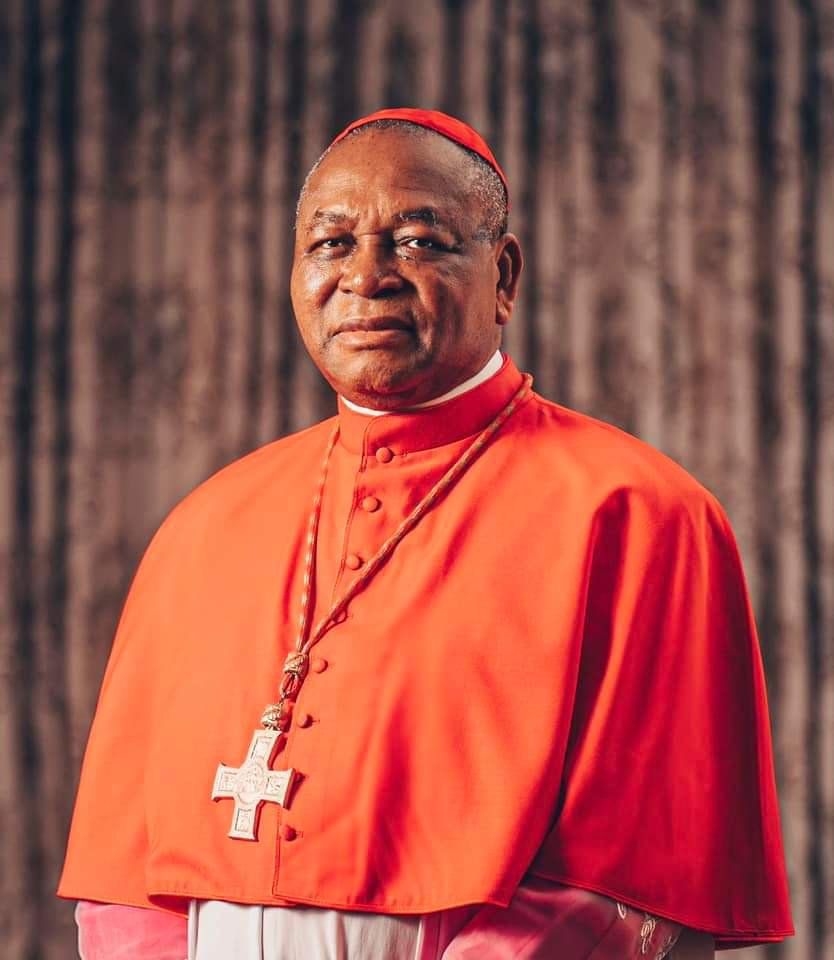
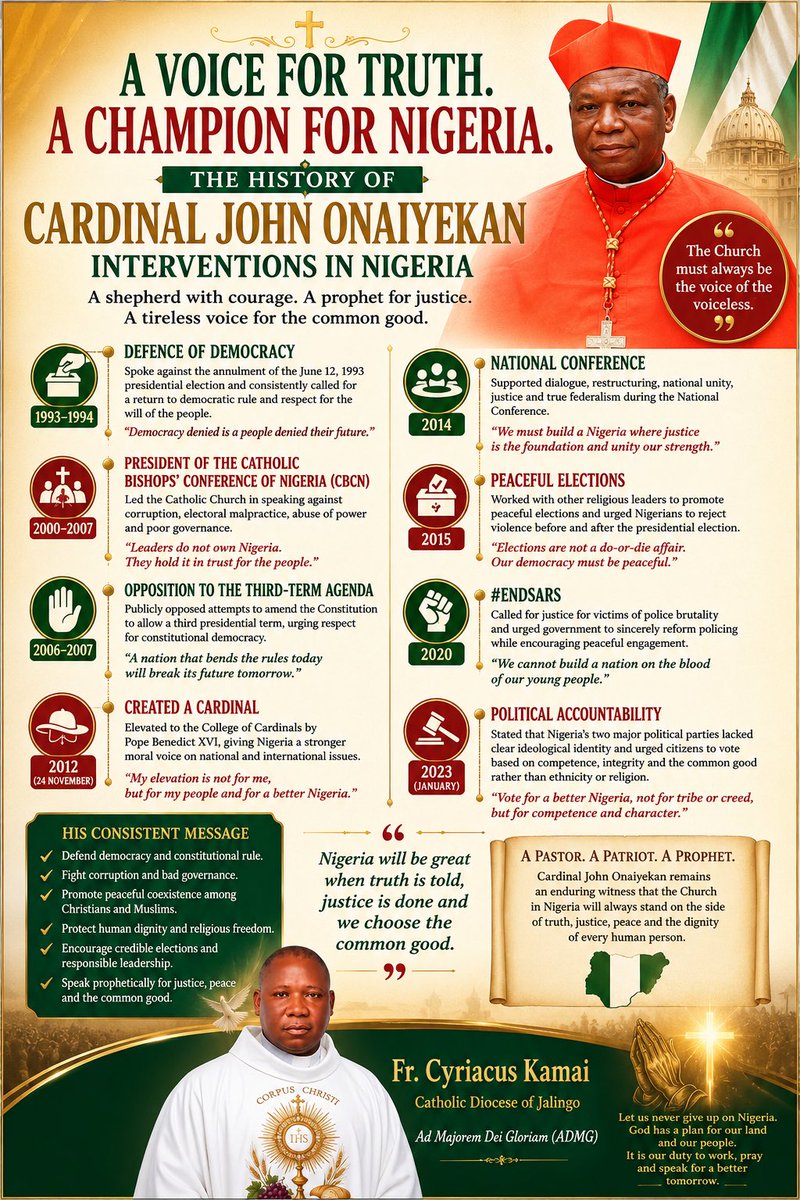
Happy 57th priestly ordination anniversary to Cardinal John Onaiyekan!
Cardinal John Olorunfemi Onaiyekan was ordained a priest in 1969 at the age of 25.
In 1982, 13 years after his priestly ordination, Pope St. John Paul II appointed him Titular Bishop of Thunusuda and Auxiliary Bishop of Ilorin at the age of 38. He was ordained a bishop on 6 January 1983.
In 1984, he was appointed the Bishop of Ilorin at the age of 40.
In 1990, he was appointed Coadjutor Bishop of Abuja at the age of 46, and in 1992, he succeeded as Bishop of Abuja at the age of 48.
In 1994, following the establishment of Abuja as a Metropolitan See, he became the first Archbishop of Abuja at the age of 50.
From 1999 to 2006, he served as President of the Catholic Bishops' Conference of Nigeria (CBCN).
In 2012, Pope Benedict XVI created him a Cardinal at the age of 68.
On November 9, 2019, he retired as the Archbishop of Abuja, Nigeria after reaching the canonical retirement age of 75.
Cardinal John Onaiyekan has remained one of the most respected voices of the Catholic Church in Africa, distinguished by his commitment to the Gospel, justice, peace, interreligious dialogue, good governance, and the common good. May God continue to bless and strengthen him.
When he left high school in 1962, John Cardinal Onaiyekan was 18.
His grades were so outstanding, the Premier of the Northern Region, Sir Ahmadu Bello, asked to see him & offered him a free cheque to the best anywhere in the world.
The man said #ThankYou & headed off to priestly formation.
64 yrs later, an #OrganizedCrime ring - led by a man with no verifiable record of having gone to school - wants to do a #RoyalRumble with a man who gave up on worldly things as a teenager.
There can be only one winner & it will not be the criminals!
A Response to Tope Ajayi’s Article "Cardinal Onaiyekan’s Abuse of Clerical Privilege"
I read the article titled “Cardinal Onaiyekan's Abuse of Clerical Privilege” by Temitope Ajayi with great interest. Surely, the article raises important questions about the relationship between the Church and the State. However, I believe some of its conclusions, particularly from the perspectives of constitutional democracy and the Church’s public mission, deserve a respectful and balanced response and clarifications.
Here is my point to point response to each of the concerns raised.
1. Was it improper for Cardinal Onaiyekan to speak publicly on Arise News?
Not necessarily. The meeting between President Tinubu and the Catholic Bishops of Nigeria was not a sacramental confession that requires utmost secrecy, a diplomatic negotiation under secrecy, or a legally confidential proceeding. Unless the participants expressly agreed to confidentiality, there is no legal or moral principle that absolutely prevents either party from commenting on the discussion afterward.
2. The Church has both the right and the duty to speak.
Catholic bishops are not merely private citizens expressing personal opinions. By virtue of their pastoral office, they have a responsibility to teach on moral and social issues. Catholic social teaching consistently affirms that the Church must speak whenever human dignity, justice, security, and the common good are at stake. That is exactly what the bishops did.
3. Speaking after a meeting is not necessarily a breach of trust.
Providing one’s understanding of a discussion is different from revealing confidential state secrets. Democratic engagement often includes explaining to the faithful what was discussed, particularly when the meeting like theirs concerns issues affecting millions of citizens.
4. Criticism of government is not a denial of progress.
One may acknowledge improvements while still concluding that much more remains to be done. Recognizing government achievements and identifying persistent failures are not mutually exclusive positions.
5. “Truth to power” remains relevant.
The fact that a president receives intelligence briefings does not eliminate the value of independent voices. Security reports, economic data, religious leaders, civil society, academics, journalists, and ordinary citizens each offer different perspectives. No single source possesses the whole truth.
6. Access to privileged information does not settle public debate.
The President undoubtedly possesses information unavailable to the public. However, democratic accountability also requires that government decisions remain open to public scrutiny and legitimate criticism.
7. Confidentiality should not become silence.
If public officials may explain their side of a meeting, religious leaders should not automatically be denied the same opportunity, provided they do so truthfully, respectfully, and without disclosing genuinely confidential matters.
8. Clerical office does not diminish civic responsibility.
The virtues expected of bishops such as prudence, temperance, and wisdom, do not require silence in the face of national concerns. History remembers many bishops who respectfully challenged civil authorities while remaining faithful to both the Gospel and legitimate constitutional order.
In all, the real issue is not whether Cardinal Onaiyekan spoke, but whether what he said was truthful, fair, and served the common good. I believe that in a constitutional democracy, respectful dialogue between religious leaders and civil authorities should continue not only behind closed doors but, when appropriate, also in the public square, just as Cardinal Onaiyekan did.
Fr. Ugochukwu Ugwoke, ISch
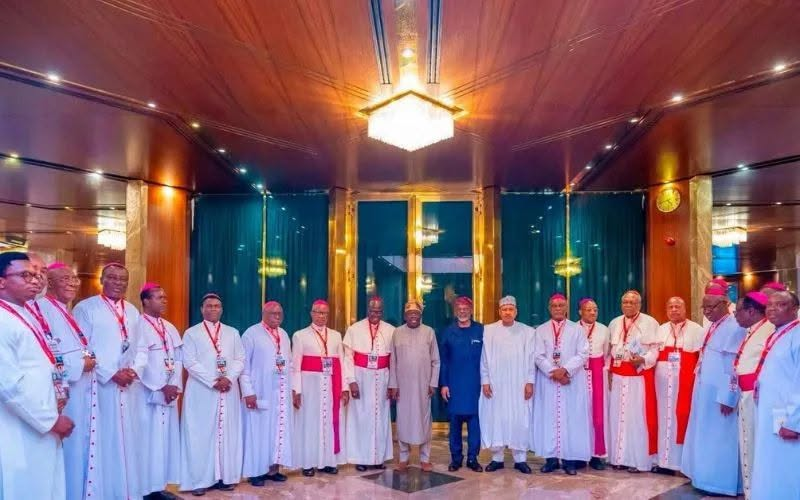
Had the Catholic Bishops’ visit gone differently, Bayo Onanuga’s press release would have read:
"Catholic Bishops Applaud President Tinubu’s Reforms; Pledge Loyalty to Mr. President."
They anticipated lies. Unfortunately for them, they got the hard truth. God bless the CBCN.
They did not go there to seek financial support for building cathedrals.
They did not go there to request land allocations.
They did not go there to extend invitations to church conferences.
They went there to speak on behalf of the masses.
They went there to give a voice to the downtrodden.
They went there to draw attention to the crushing poverty, hardship, and suffering confronting millions of Nigerians.
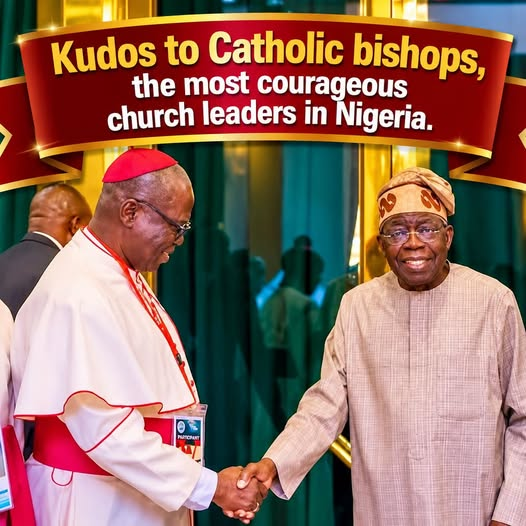
For this courage and sense of responsibility, I commend the Catholic bishops of Nigeria. Their willingness to speak truth to power and advocate for the welfare of ordinary citizens is worthy of recognition and respect.
May God continue to bless and strengthen the Catholic Church in Nigeria. May He grant its leaders greater wisdom, courage, and perseverance in the pursuit of justice, truth, and the common good. And may other religious and civic leaders draw inspiration from this example of courageous leadership.
Copied
This is what Nigerians are faced with today, the thieves have become so emboldened that they now confront, intimidate, and threaten the very people they have robbed. #TinubuMustGo