The International Criminal Court seeks to become the unaccountable arbiter of a new global law — empowered to prosecute and arrest our citizens at will and existentially threaten American sovereignty.
We will teach the ICC the full meaning of American resolve.
NEW 🚨: El Salvador’s President Just Issued a Challenge to Trump—“You Have 350 Million People to Liberate.”
This wasn’t a photo op. It was a mission briefing.
At the White House, El Salvador’s President Nayib Bukele looked President Trump dead in the eye and said:
“You have 350 million people to liberate.”
Bukele isn’t just talking tough—he has the results to prove that it can be done.
“We turned the murder capital of the world—that’s what the journalists called it—into the safest country in the western hemisphere,” he said.
Critics complain about mass arrests.
Bukele fired back:
“Sometimes they say we imprisoned thousands. I like to say we liberated millions.”
Trump grinned: “That’s very good! Who gave him that line? Do you think I can use that?”
Then Bukele hit the heart of the problem:
“To liberate 350 million people, you have to imprison some. That’s the way it works, right? You can’t just free the criminals and think crime’s going to go down magically. You have to imprison them—so you can liberate 350 million Americans asking for the end of crime and the end of terrorism.”
No fluff. No fantasy. Just facts.
This is what happens when real leaders speak truth.
America is finally ready to listen.
Europeans and American patriots!
Tomorrow, the courts of my country, France, may decide to send me to prison for daring to say on television that “the main danger to women in France is Black African and Arab immigrant men.”
Meanwhile, my own attacker, a Tunisian migrant, is still at large.
I need your help to generate media pressure and hope to be acquitted.
They cannot silence the truth!
Thank you for your support 💪🏻🇫🇷
The Philippines shares a brutal history with Japan, marked by the slaughter of civilians and the rape of women. America inflicted similar atrocities, massacring nearly a million of our ancestors. Yet, our country continues to bootlick both nations. China, by contrast, never inflicted such historical savagery on us, choosing instead to share its culture and cuisine. The Philippines is suffering from a case of Stockholm syndrome.
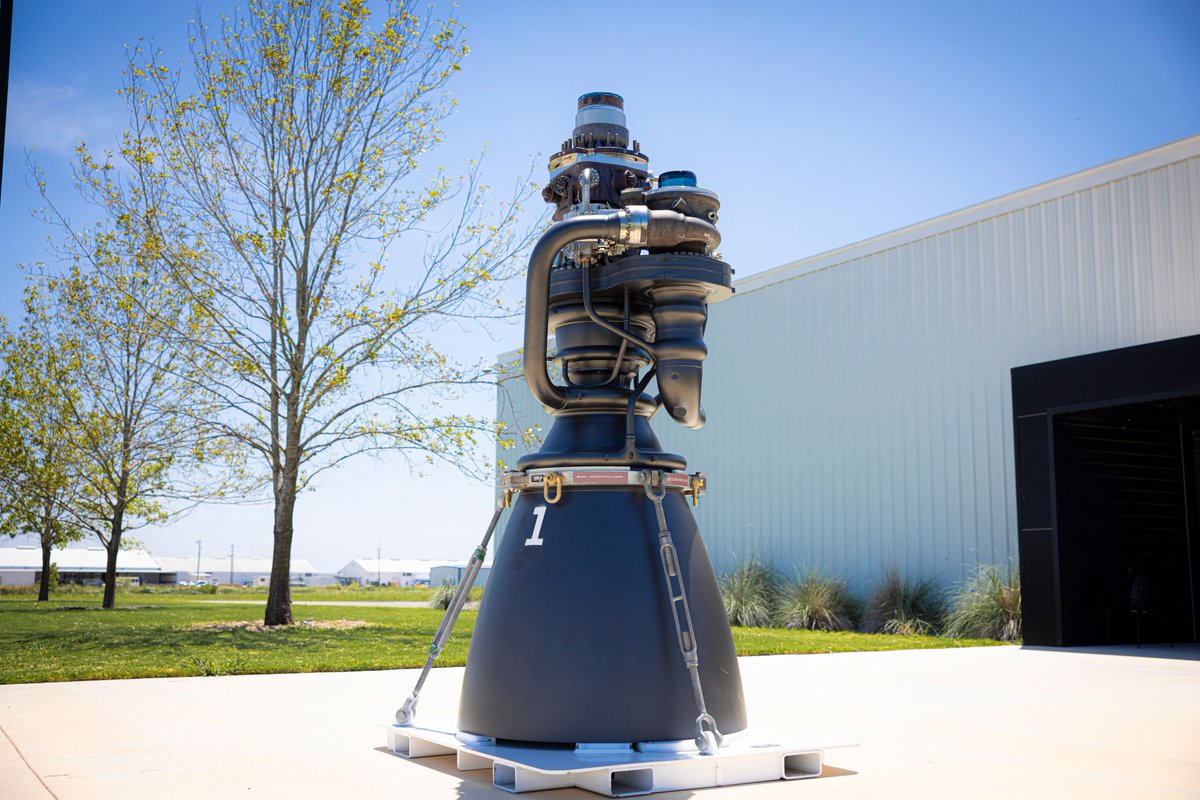
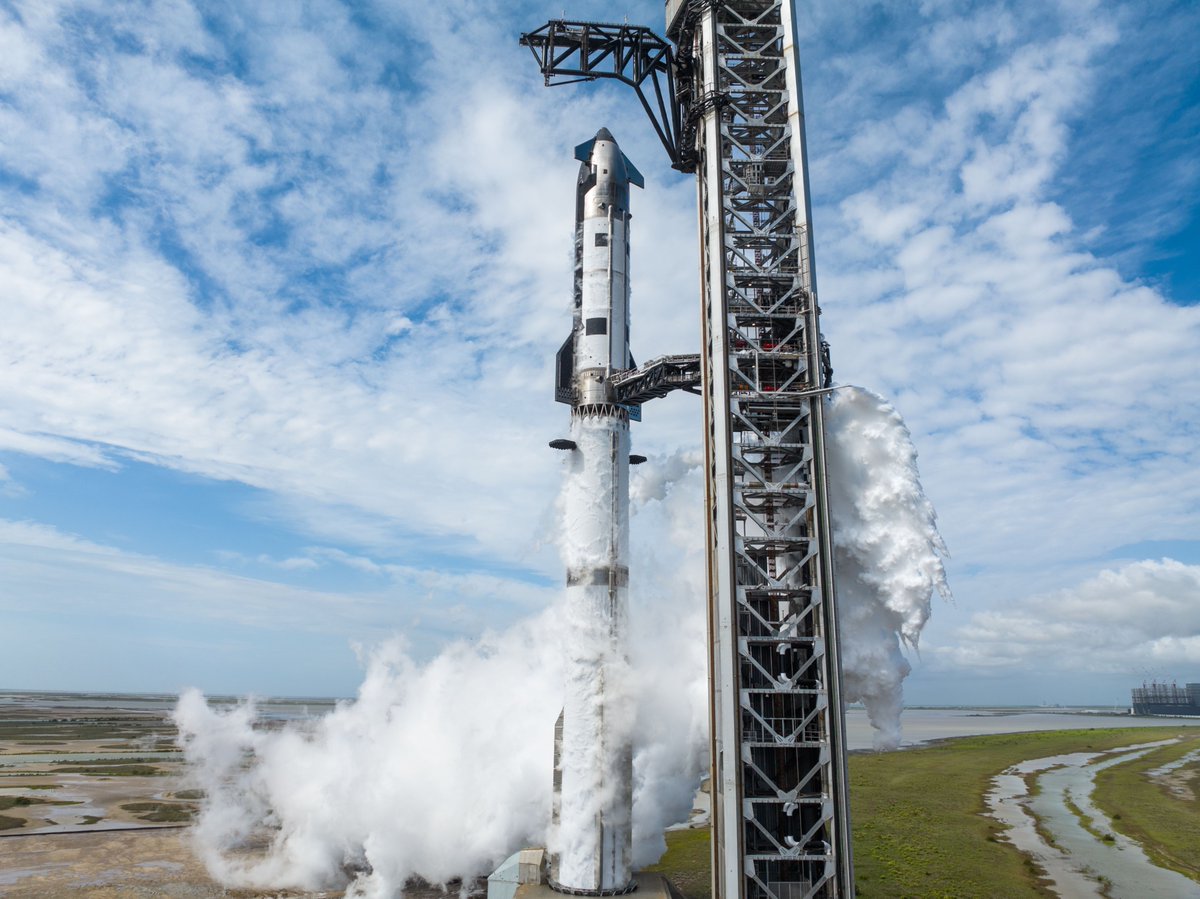
SpaceX has just released a massive new list of changes in Starship V3, which is now scheduled to launch on May 19th:
Super Heavy V3 Changes
Grid Fin Redesign:
• Reduced from 4 fins to 3
• Each fin is now: 50% larger, stronger, repositioned for better catching/lifting
• Lowered on booster to reduce heat exposure during hot staging
• Fin hardware moved inside fuel tank for protection
Integrated Hot Stage:
• Removes the old disposable interstage shield
• Booster dome now directly exposed to upper-stage engine ignition
• Tank pressure + steel shielding protect structure
• Interstage actuators retract after separation for protection
New Fuel Transfer System:
• Massive redesign of fuel transfer tube
• Roughly the size of a Falcon 9 first stage
• Allows: simultaneous startup of all 33 Raptors, faster and more reliable flip maneuvers
Engine Bay / Thermal Protection Changes:
• Engine shrouds removed entirely
• New shielding added between engines
• Propulsion + avionics more tightly integrated
• CO₂ fire suppression system removed
• Simpler and lighter aft section
Propellant Loading Improvements:
• Moved from 1 quick disconnect to 2 separate systems
• Adds redundancy
• Reduces complexity of pad interfaces
Starship V3 Changes
Completely Redesigned Propulsion System:
• Clean-sheet redesign
• Supports: new Raptor startup method, larger propellant volume and improved reaction control system
• Reduces trapped/leaked propellant risk
Aft Section Simplification:
• Fluid + electrical systems rerouted
• Engine shrouds deleted
• Large aft cavity removed
Flap Actuation Upgrade:
• Changed from: 2 actuators per flap to 1 actuator with 3 motors
• Improves:, redundancy, mass efficiency, cost
Faster Starlink Deployment:
• Upgraded PEZ dispenser
• Faster satellite deployment speeds
Long-Duration Spaceflight Capability:
• New systems added for: long orbital coasts, orbital refueling, cryogenic fluid management, vacuum, insulated header systems and high-voltage cryogenic recirculation
Ship-to-Ship Docking + Refueling:
• Added 4 docking drogues
• Added propellant transfer connections
• Directly supports in-space refueling architecture
Avionics Upgrades
Massive Electrical System Upgrade:
• ~60 custom avionics units
• Batteries/inverters/high-voltage systems integrated together
• ~9 MW peak power capability
Better Navigation + Redundancy:
• New multi-sensor navigation system
•��Designed for precision autonomous flight
Propellant Monitoring in Space:
• New RF sensors measure propellant levels in microgravity
• Important for orbital refueling missions
Camera + Connectivity Upgrades:
• ~50 onboard camera views
• 480 Mbps Starlink connectivity onboard
• Low-latency redundant communications
Raptor 3 Engine Changes
Higher Thrust:
• Sea-level Raptors:
• Increased from:
230 tf → 250 tf
507k lbf → 551k lbf
Vacuum Raptors:
Increased from:
258 tf → 275 tf
568k lbf → 606k lbf
Lower Mass:
• Sea-level engine mass reduced: 1630 kg → 1525 kg
Simpler Design:
• Sensors/controllers integrated into engine body
• Removes need for engine shrouds
• New ignition system for all variants
• Huge Vehicle-Level Weight Savings
• ~1 ton saved per engine across vehicle systems
Launch Pad 2 Upgrades (Starbase)
Faster Propellant Loading:
• Larger propellant farm
• More pumps
• Faster fueling operations
Chopstick Improvements:
• Shorter arms for faster movement
• Switched from hydraulic → electromechanical actuators
• Better reliability + redundancy
Stronger Quick Disconnect Arm:
• Reinforced and redesigned
• Swings farther away during launch
Launch Mount Redesign:
• Better load handling
• Improved launch protection
• Improved throwback reliability
New Flame Diverter System:
• Bidirectional flame diverter
• Designed to eliminate ablation/refurbishment after launch
Hardened Propellant Systems:
• Methane and oxygen systems separated
• Valves/filters moved into protected bunker
• Improves safety and reliability
SpaceX: "Together, these new elements are designed to enable a step-change in Starship capabilities and aim to unlock the vehicle’s core functions, including full and rapid reuse, in-space propellant transfer, deployment of Starlink satellites and orbital data centers, and the ability to send people and cargo to the Moon and Mars."
This is going to be an epic flight! 🚀
While the world’s two superpowers, China and the United States are talking, negotiating, recalibrating, and managing their differences like rational states, and it's happening at this very moment, the Philippines under Marcos Jr. continues to behave like a RECKLESS geopolitical cheerleader trapped in a Cold War fantasy.
Washington and Beijing may compete and disagree with each other on many fronts, —both still understand one fundamental truth: dialogue is necessary because conflict and instability are bad for business, bad for their economies, bad for their survival as countries, and most importantly, bad for the global economy, and bad for everyone.
Meanwhile, what has Marcos Jr.’s foreign policy produced?
A Philippines turned into a frontline pawn by the United States and its allies, Japan and Australia included and the rest.
A country drowning in domestic political chaos while recklessly inserting itself into great-power confrontation.
A government loudly posturing against China while depending economically on the very same region it keeps antagonizing.
The irony is almost painful: Even the superpowers know how to talk to each other.
But Marcos Jr.’s foreign policy seems allergic to balance, diplomacy, and strategic independence.
Foreign policy is NOT supposed to be emotional theater, ideological fanaticism, or blind obedience to another country’s strategic agenda.
It is supposed to protect Philippine sovereignty, economic stability, national dignity, and the welfare of Filipinos.
At this point, one has to ask: Is this really an “independent foreign policy” as Marcos Jr. Claims, or merely subcontracted geopolitics wearing a Philippine flag?
ICC as Political Theater: When Justice Becomes a Prop in Manila’s Political Circus
By: Anna Malindog-Uy
May 12, 2026
The latest International Criminal Court (ICC) drama in the Philippines is being sold, predictably, as a grand morality play about accountability, justice, and the rule of law. But scratch the surface, and the performance begins to look less like principled legal action and more like domestic political theater with international costumes.
At the heart of this spectacle are two legal questions that cannot be brushed aside by press statements, political noise, or sanctimonious slogans.
First, if the National Bureau of Investigation (NBI) acted against a sitting senator, did it fully respect Article 145 of the Revised Penal Code, which deals with parliamentary immunity? Or are legal shortcuts now the new fashion accessory in the country’s “rule of law” department? In a democracy, the law is NOT supposed to be applied like mood lighting — bright when useful, dim when inconvenient.
Second, if the CIDG has already issued a subpoena involving alleged extrajudicial killing (EJK) matters, does that not indicate an active domestic proceeding? And if there is an active domestic proceeding, how does this square with the ICC’s principle of complementarity under the Rome Statute?
Complementarity is not a minor technicality. It is the core logic of the ICC system. The ICC is supposed to be a COURT OF LAST RESORT, NOT a court of first political convenience.
Under Article 17 of the Rome Statute, a case may be inadmissible if a state is genuinely investigating or prosecuting the matter. Under Article 19, states and accused persons may challenge the Court’s jurisdiction or admissibility precisely on that ground.
So the question becomes unavoidable: Is the Philippines unwilling and unable to act — or is it already acting, but selectively, chaotically, and politically?
The Rome Statute is clear on the architecture of ICC arrest warrants. Article 58 allows the Pre-Trial Chamber to issue a warrant when there are reasonable grounds to believe a person committed a crime within ICC jurisdiction and when arrest is necessary to ensure appearance, prevent obstruction, or stop continuation of the crime.
Article 59 requires the custodial state to bring the person before a competent judicial authority (a court) to verify identity, the warrant’s validity, and the rights of the arrested person.
Article 89 governs surrender to the Court, while Articles 86 and 91 address cooperation and the contents required in arrest-and-surrender requests.
But here is the inconvenient legal reality: the ICC has no police force. It depends on state cooperation, domestic courts, executive action, and political will. That is precisely why ICC warrants are often politically explosive. They do not float above politics; they land directly in the middle of it. And in the Philippines, that middle is already chaotic.
The ICC issue is no longer merely about international criminal justice. It is now tied to the combustible domestic politics of survival, vengeance, alliances, and warfare among the political elite. The danger is that law becomes less about justice and more about sequencing: who gets targeted, when, by whom, and for whose political benefit.
If institutions are truly pursuing justice, then due process must be respected even for the politically inconvenient. But if institutions are merely performing legal theater, then the ICC becomes another prop in the long-running circus of Philippine power politics.
Because in a democracy, due process is NOT a political accessory. It is a constitutional safeguard. It should NOT be worn when convenient and discarded when inconvenient.
Justice must not look like revenge wearing a robe.
To end: the last time I checked, the Philippines is NOT a failed state. It is a sovereign republic with a functioning—though imperfect—judicial system.
So the real question is this: when domestic institutions are still operating, who gave an international tribunal the license to barge in and act as if Philippine sovereignty is merely a procedural inconvenience?
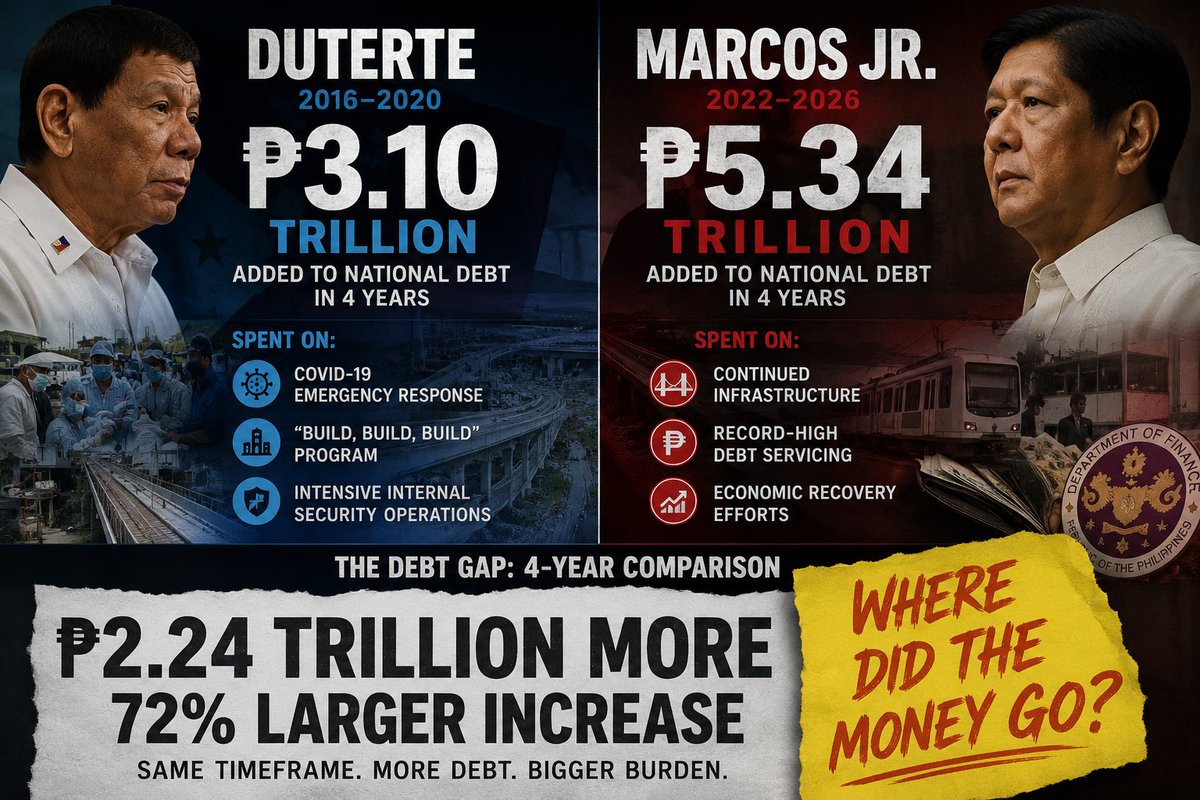
While Rodrigo Duterte added ₱3.10 trillion to the national debt over four years while battling a global pandemic and funding a massive infrastructure overhaul and WOD, the Marcos Jr. administration has added ₱5.34 trillion in the same timeframe, a 72% larger increase.
The Debt Gap: 4-Year Comparison
Duterte (2016–2020): Added ₱3.10T
Spent on: COVID-19 emergency response, the "Build, Build, Build" program, and intensive internal security operations.
Marcos Jr. (2022–2026): Added ₱5.34T
Spent on: ❓❓❓❓
Pax Silica, 4,000 Acres, U.S. Rules: Development, Strategic Surrender or Capitulation?
By: Anna Malindog-Uy
The Manila Times
May 2, 2026
BY now, Filipinos are being told to celebrate. Another “milestone.” Another “strategic partnership.” Another shiny promise of investment, jobs, and technological upgrading, this time wrapped in the sleek branding of “Pax Silica” or, more poetically, the so-called Silicon Peace initiative. Peace, apparently, now comes with semiconductors, artificial intelligence supply chains, and a generous helping of geopolitical baggage.
But strip away the diplomatic language, and the question becomes uncomfortably simple: Whose peace, whose security, and whose future is really being secured?
The decision of Ferdinand Marcos Jr.’s administration to join this United States-led framework and host a 4,000-acre “Economic Security Zone” in Luzon has been marketed as a bold leap into the future. The pitch is familiar: integration into global value chains, industrial acceleration, and a seat at the table of advanced economies. Yet what is being quietly glossed over is that this is not merely an economic project. It is geo-economics in full display, and an industrial policy weaponized for strategic competition.
Let’s not pretend otherwise. Pax Silica is explicitly designed to “shore up supply chains” and reduce reliance on so-called rival nations. Translation: This is part of Washington’s broader effort to restructure global production away from China. The Philippines, conveniently located and resource-rich, is being inserted into that architecture not as an equal partner, but as a node. Or more bluntly: a platform. And, in geopolitics, platforms are rarely neutral.
To continue reading, click the link below:
TMT Link: https://t.co/KNhNJyNFVh