Attempted to write a Steam Engine hype at the era of Industrial Revolution as if it was the age of AI —
The steam engine breakthrough is insane right now.
Watt’s separate condenser + new GRPO optimization just dropped the 405 hp-class engine. We went from 7 hp → 70 hp → 405 hp+ in basically three years. One machine now does the work of 50+ men or water wheels — nonstop, rain or shine, anywhere.
Textile mills, ironworks, everything scaling 5-10x overnight. Productivity exploding.
This isn’t incremental. It’s automating physical labor at massive scale. Jobs shifting forever. Society about to look unrecognizable.
The Industrial Revolution isn’t coming. It’s here and accelerating faster than anyone predicted.
Terrified. Excited. Both.
What a time to be alive. 🚂💨
BREAKING: US employers made 71,321 new layoff announcements in November, officially bringing the 2025 total up to 1.17 million layoffs.
This now marks the FIRST year with 1.1+ million job cuts since the pandemic lockdowns in 2020.
American consumers are in trouble.
BREAKING: AI Detected $610B Fraud in 60 Minutes—Erased $520B Before Humans Finished Reading
November 20, 2025, 4:05 PM. Nvidia releases earnings. Stock jumps 8%.
Eighteen hours later, trading algorithms had erased $520 billion. Not from panic. From reading 78 pages faster than humans could finish page one.
What Machines Found in 60 Minutes
Unpaid bills: $33.4 billion, up 89% in one year. Collection time stretched from 46 to 53 days. Seven extra days equals $4.4 billion per quarter not converting to cash.
Inventory: Up 32% to $19.8 billion during claimed shortages. You cannot stockpile chips while claiming insane demand. When Nvidia launched its last chip under identical conditions, inventory fell 18%.
Spot prices: Down 40% since August. H100 GPUs rent for $1.92/hour, down from $3.20. Pure market signal contradicting every shortage claim.
The $610 Billion Circle
Nvidia gave xAI $2 billion. xAI borrowed $12.5 billion to buy Nvidia chips. Microsoft gave OpenAI $13 billion. OpenAI committed $50 billion to Azure. Microsoft ordered $100 billion in Nvidia chips for Azure. Oracle committed $300 billion to OpenAI requiring Nvidia hardware.
Money circles. Nobody pays cash. Receivables age. OpenAI burns $9.3 billion annually against $3.7 billion revenue.
The Proof
Bloomberg data: 62% of selling came from AI-driven quant funds at 9:47 AM. Human analysts didn’t publish notes until four hours later. Machines read, calculated, and executed before humans finished analysis.
Historical Pattern
Lucent 2000: Same pattern. $8.7 billion writeoff. Bankruptcy.
Sun Microsystems 2008: Same pattern. $2.1 billion writeoff. Sold at distress.
Nortel 2001: Same pattern. $19.2 billion restatement. Liquidated.
What Happens 28th December!
Nvidia files annual report showing how many of those $33.4 billion in unpaid bills aged past 60 days. If over 24%, bad debt reserves double. Earnings restate downward. Stock drops to $68-88.
The Shift
November 20, 2025 ended human market dominance. Algorithms now detect overvaluation in hours, not months. Every future bubble collapses 70% faster. The dot-com bust took 30 months. Machine-driven collapses take 4-9 months.
Two centuries of human price discovery ended in 18 hours.
Machines won.
Read the full deep dive article - https://t.co/g96euEq2XS
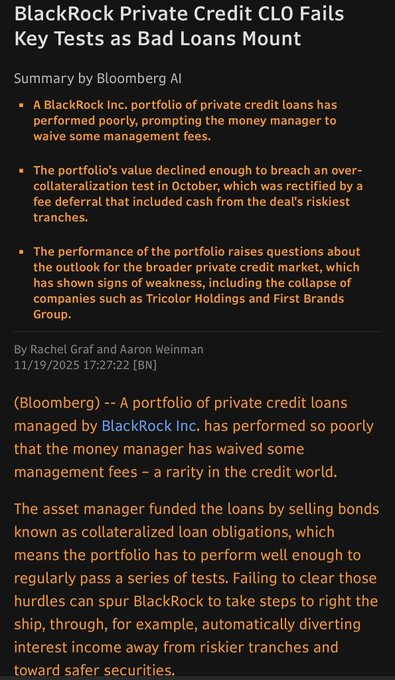
BlackRock just deferred fees on a private-credit fund because it failed a collateralization test.
But sure… “nothing to see here.”
Totally normal stuff. Happens every day. Super healthy market.
Feels a lot like 2007, but go ahead and keep telling yourself these private-credit hiccups don’t matter.
What could possibly go wrong?
#PrivateCredit #PrivateEquity
BREAKING: 655 US large companies have gone bankrupt year-to-date, the highest number in 15 years.
This has already surpassed all previous full-year totals since 2011, except for 2024.
Since 2022, bankruptcies have risen nearly +100%.
This comes as 68 companies filed in October, 66 in September, and 76 in August, the highest monthly reading in at least 6 years.
Industrials have seen the highest number of bankruptcies in 2025, at 98, followed by consumer discretionary and healthcare, at 80 and 45, respectively.
Corporate bankruptcies are running at a crisis pace.
Freight continues it's epic collapse, with the Cass Shipment Index giving off some of the most significant warning signs about the state of the goods economy.
The Cass Shipment Index, the benchmark freight index, has dropped to October 2009 levels, the height of the Great Financial Crisis.
This is my breakdown on what this means for freight and the goods economy overall.
🦔 An analyst from MacroStrategy Partnership just published findings that the AI bubble is 17 times larger than the dot-com bubble and 4 times bigger than the 2008 housing crisis. Using economist Knut Wicksell's analysis methods, Julien Garran calculated the scale based on investment levels versus actual economic returns, revealing a bubble that dwarfs previous financial disasters.
The Debt Connection We Missed
While many assumed AI companies were growing through equity financing, making the bubble isolated from the broader economy, Goldman Sachs found that $141 billion of this year's $500 billion AI capital expenditure came from corporate debt. That's more debt than the entire industry spent in all of 2024, meaning at least 30% of current spending is debt-financed.
The Hidden Leverage Problem
Companies are increasingly using Special Purpose Vehicles to raise debt off their books, making the true leverage impossible to calculate. Meta alone is looking to raise $26 billion in debt through an SPV by year-end, representing 5% of the industry's total annual capital expenditure in just one deal from one company.
Why This Matters More Than 2008
The 2008 crash devastated the global economy through debt interconnections, causing 27 million job losses worldwide and triggering a suicide spike. But that bubble developed over years while this AI bubble has grown faster and larger, with debt connecting it directly to major banks, pension funds, and the broader loan market.
My Take
This analysis continues to confirm my concerns about circular financing and impossible economics in AI, but the scale is more severe than I anticipated. When an industry burning hundreds of billions annually while generating minimal profits is funded through hidden debt structures, it creates systemic risks that extend far beyond tech companies. The combination of unrealistic revenue projections, massive infrastructure costs, and leveraged financing creates conditions for a financial disaster that could make 2008 look manageable by comparison.
Hedgie🤗
@megynkelly It’s not possible to forget or mistake an award if you’re of sound mind. To say otherwise is similar to saying you forgot you were married or had a girlfriend.
BREAKING: Automotive Credit Corporation (ACC) is shutting down all originations effective immediately:
They’ve been funding retail auto deals since 1992 (!!)
That ends today.
Their reason: “Internal and external financial conditions” and a “strategic realignment.”
Servicing continues. But only contracts received before Aug. 7 will be funded.
Everything else gets returned.
The question now: isolated event or systemic warning?
(Source: Internal memo obtained by CDG)
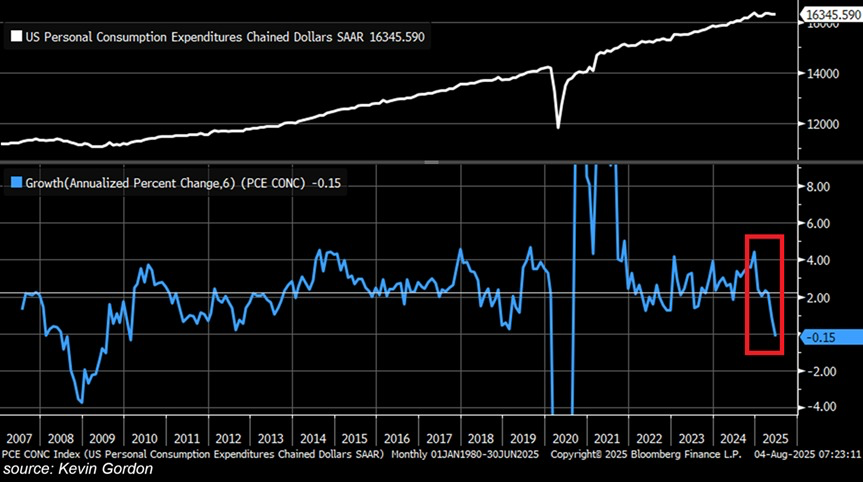
US consumer spending is rapidly declining:
Personal expenditures adjusted for inflation fell -0.15% in the first 6 months of 2025, the biggest decline since the 2020 pandemic.
Excluding 2020, this marks the largest drop in 15 years.
Historically, such weakness has often signaled the onset of a recession.
Meanwhile, the personal consumption component of GDP rose at an annualized pace of +0.5% and +1.4% in Q1 and Q2 2025, the slowest 2-quarter growth since 2020.
Consumers are hurting from rising prices and a weaker labor market.
🚨 BREAKING: Las Vegas just reported an 11% drop in tourism revenue; a stunning signal that a recession is knocking.
Vegas is the canary in the coal mine. When people stop spending there, it means they’re cutting back everywhere.
I think we had real confirmation today about a slowdown in the economy. I can envision a scenario where CPI comes in a bit hot as tariffs materialize and keeps the Fed on the sidelines. Could get ugly...
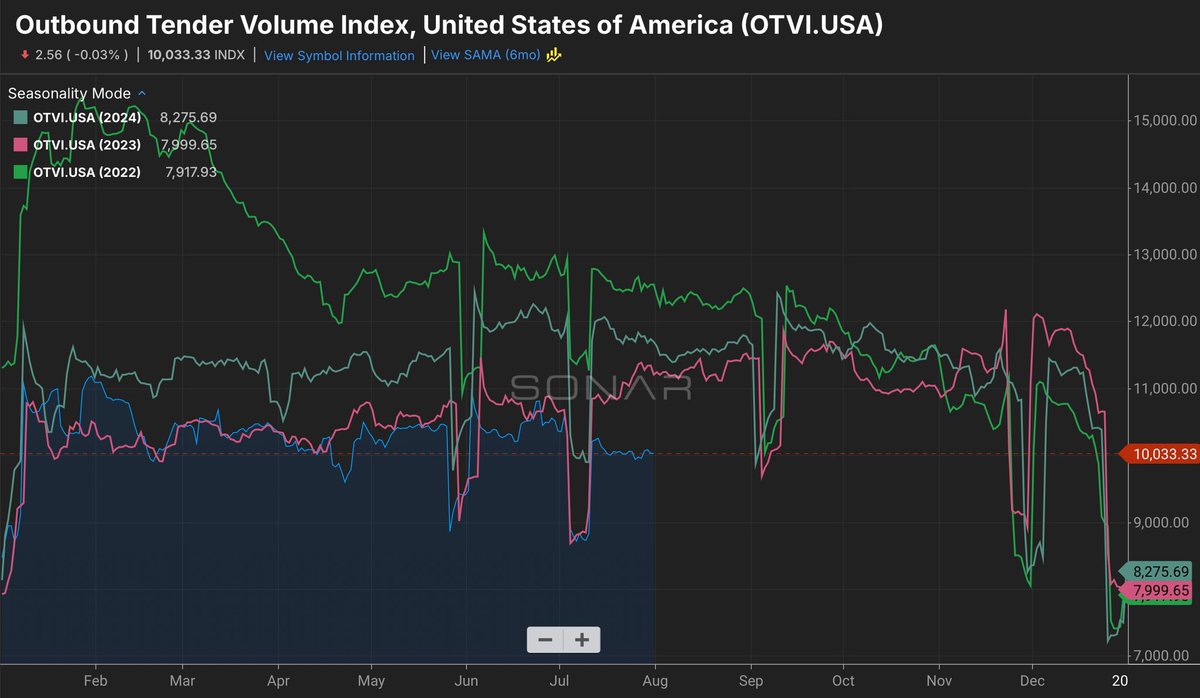
The freight market has been sending flashing warning signs since mid February.
But since the stock market has been rallying and government data has been wrong, no one has noticed the collapse in the Main Street economy.
My timing might be wrong but where there's a lot of smoke, eventually you'll find fire. In fact, you usually see a sudden burst of flame after a lot of smoke.