A billionaire sat in a room for 42 minutes and listed every psychological trick that makes people lose money. for free. the finance industry has spent thirty years pretending this recording does not exist.
he didn't sell a course. he didn't write a newsletter. he sat in a chair at 96 years old and explained why brilliant people do the dumbest things with their money. then he explained why they will keep doing it.
MBA programs charge $200,000 to teach behavioral finance. he covered 25 biases in one sitting. some of them are still not in any curriculum. he gave the entire framework away on camera.
the part nobody talks about: he called crypto antisocial. he said index funds will crush most managers. he said private equity is full of wretched excess. he said all of this in a room full of people who manage money for a living. nobody argued.
a hedge fund analyst at a top firm told me this is the first thing they send to anyone who joins the desk. not a book. not a model. a 42-minute video of a 96-year-old man explaining why you will be wrong and how to recognize it before it costs you everything.
40 million people have heard his name. almost none of them have watched him explain the 25 ways their own brain is working against them.
the lecture is free. he died the following year. it is in the video.
Anthropic S1 risk factors:
1. We may never turn a strong profit
2. Our stock may go down
3. There’s a 10%ish chance we kill everyone
4. Competition might take market share
5. Future models may not remain best-in-class
On September 18, 1873, Jay Cooke & Company, the most trusted bank in the United States, stopped paying its depositors and closed. Two days later the New York Stock Exchange suspended trading for the first time in its history and stayed closed for ten days. The contraction that followed ran 65 months, which is still the longest in American history. I've spent a lot of time on what caused it, and the conditions that produced it are being rebuilt right now in the AI infrastructure buildout.
The 1873 panic came out of a railroad boom. Between 1865 and 1873 the US doubled its track mileage, and capital invested in railroads went from about $1.2 billion to $3.8 billion, which works out to roughly 3 to 4 percent of GDP a year for eight straight years. The five largest hyperscalers have committed somewhere between $660 and $800 billion to AI infrastructure in 2026, depending on which quarter's guidance you use, and the number has been revised upward at every earnings call. That's 2 to 2.5 percent of GDP. On the current trajectory the AI buildout matches the rail boom's share of the economy within a year or two.
What makes this different from a normal capex cycle is who is doing the spending. A decade ago Microsoft, Alphabet, Meta and Amazon spent 10 to 15 percent of revenue on capital expenditure. The whole investment case for these companies was that software scaled without physical assets. Capex is now 45 to 57 percent of revenue across the group. These are ratios you'd expect from a utility or a steel producer, and the businesses are still valued by most of the market as if the transition hadn't happened.
The overbuilding dynamic is the same one that appeared in the 1870s. By 1873 several competing railroads had been built between the same cities, each financed on projections that assumed it would carry most of the traffic. Today five hyperscalers, OpenAI's Stargate project, Anthropic, xAI and a group of smaller GPU cloud providers are each building capacity against forecasts that, added together, assume more demand than can exist. Each company's decision makes sense on its own. The aggregate doesn't, and it never does in these cycles.
Then there's the mismatch between how fast the assets wear out and how long the debt lasts. Railroad bonds in 1870 ran 30 years; rails and rolling stock needed replacing in 10 to 15. Hyperscalers depreciate GPUs over five or six years, and a number of analysts think three or four is more realistic given how quickly newer chips make older ones uneconomic to run. The bonds being issued to fund them run 10 to 40 years. The hyperscalers plan to add roughly $2 trillion in AI assets by 2030. At 20 percent annual depreciation that's about $400 billion a year in depreciation expense, which exceeds their combined 2025 profits.
The financing has also become circular in a way that should be familiar to anyone who's read about Cooke. He promoted the Northern Pacific Railroad, underwrote its bonds, sold them to the public through his own network, and advanced his depositors' money to the railroad when the bonds didn't sell. Today the chip vendor takes equity in AI labs that buy its chips, cloud providers take equity in startups that commit to spend on their cloud, and lenders are writing loans collateralized by GPUs whose resale value depends on the same demand the loan is being used to build. Some portion of the demand everyone is pointing to is the same dollar going around more than once.
Every hyperscaler said on its last earnings call that it is supply-constrained rather than demand-constrained. The Northern Pacific said the same thing about land and freight in 1872. It may well be true today. It's also the standard language of a market that hasn't yet found the limit of demand, and the limit is never visible until it's hit.
The change I'd pay the most attention to is the shift from cash to debt. In 2023 and 2024 the AI buildout was funded almost entirely from operating cash flow, and that's what made it safe: a company that doesn't need to borrow can't be cut off. Capex now exceeds cash generation at most of these firms. Hyperscalers raised $108 billion in debt in 2025, another $100 billion in the first weeks of 2026, and Morgan Stanley and JPMorgan project around $1.5 trillion in new issuance over the next few years, spread across investment-grade bonds, private credit, off-balance-sheet leases and GPU-backed loans. Demand for credit default swaps on these names is at record levels. The Panic of 1873 was not caused by a collapse in demand for rail transport; the trains stayed full. It was caused by the railroads' inability to refinance. The more the hyperscalers move from self-funding to borrowing, the closer they come to having the vulnerability that actually mattered in 1873.
The shock that ended the rail boom came from Europe. Germany's indemnity from France after the 1871 war, about a quarter of French GDP, flooded into Berlin and Vienna, fueled a speculative boom there, and blew up in May 1873. European investors, who held roughly a third of American railroad bonds, stopped buying. Cooke, already carrying Northern Pacific paper he couldn't sell, failed four months later. Nobody in New York was watching Vienna.
What followed is worth remembering. Brokerages failed within hours of Cooke. Depositors ran on banks across the country, and banks stopped paying cash and settled among themselves with IOUs. 89 of the nation's 364 railroads went bankrupt. Around 18,000 businesses failed. Unemployment reached an estimated 14 percent and wages fell roughly a quarter. The Great Railroad Strike of 1877 put federal troops on the streets of American cities and left about a hundred people dead. Grant's presidency was finished, Reconstruction was abandoned in part because the North could no longer afford it, and the country spent the next 25 years fighting over the monetary system.
The differences are real and I don't want to skip them. Microsoft and Alphabet hold hundreds of billions in cash and own businesses that generate enormous profit without AI; Cooke had no cushion at all. The debt in this cycle sits mostly with bond investors and private credit funds rather than in the banking system, so a write-down doesn't automatically become a bank run. The Federal Reserve exists, which is the reason Silicon Valley Bank's failure in 2023 was contained over a weekend instead of taking the system down with it. And the historical record from rail, electrification and the fiber overbuild of the late 1990s is consistent: the infrastructure ends up used and valuable. What doesn't survive is the capital that built it or, in most cases, the companies that raised that capital.
The version of 1873 that fits 2026 would look something like this. A shock from a market nobody in the US is pricing. A large, trusted company that borrowed short-term against long-lived, fast-depreciating assets and finds the refinancing window shut. Behind it, more than a trillion dollars of debt secured by chips that lose value every year, held by private credit funds that have never been through a downturn, in an economy where five companies account for roughly 3 percent of GDP in capital spending alone.
The rail network kept operating through the entire 1873 depression. That was never the problem. The problem was the financing, and that's where this cycle is heading.
Today we’re launching Quant, the first AI to build indicators & strategies like a TradingView wizard.
Utilizing 5 years of open-source & proprietary development at LuxAlgo, Quant builds, reverse engineers, and auto-debugs any Pine Script indicator for TradingView imaginable at remarkable quality, every time.
You can start using it for free today.
Venezuela Regime Change & Energy Rebuild Plays
Chevron (CVX) — Only U.S. major still operating in Venezuela with OFAC licenses; positioned to ramp production immediately if sanctions ease.
Valero Energy (VLO) — Gulf Coast refineries optimized for heavy sour crude would benefit from cheaper Venezuelan feedstock and widening margins.
Phillips 66 (PSX) — Similar heavy-crude exposure; lower input costs translate directly into refining profitability.
Halliburton (HAL) — Field rehabilitation, drilling, and maintenance contracts would follow any production restart.
Schlumberger (SLB) — Technical expertise in complex heavy crude reservoirs positions SLB for higher service intensity if output increases.
See more: https://t.co/BXpHOLHoVy
Defense, AI, Drones & Strategic Infrastructure
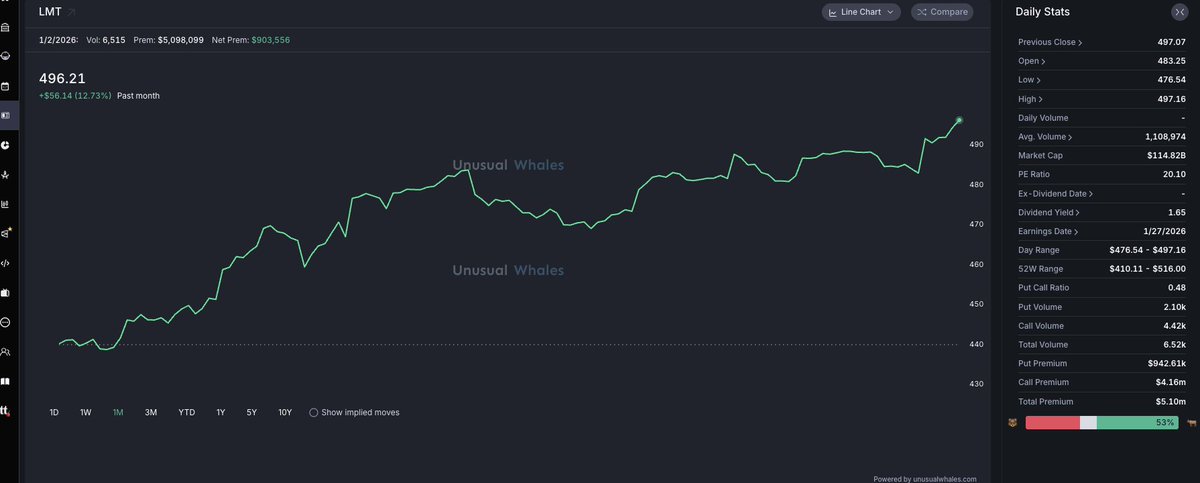
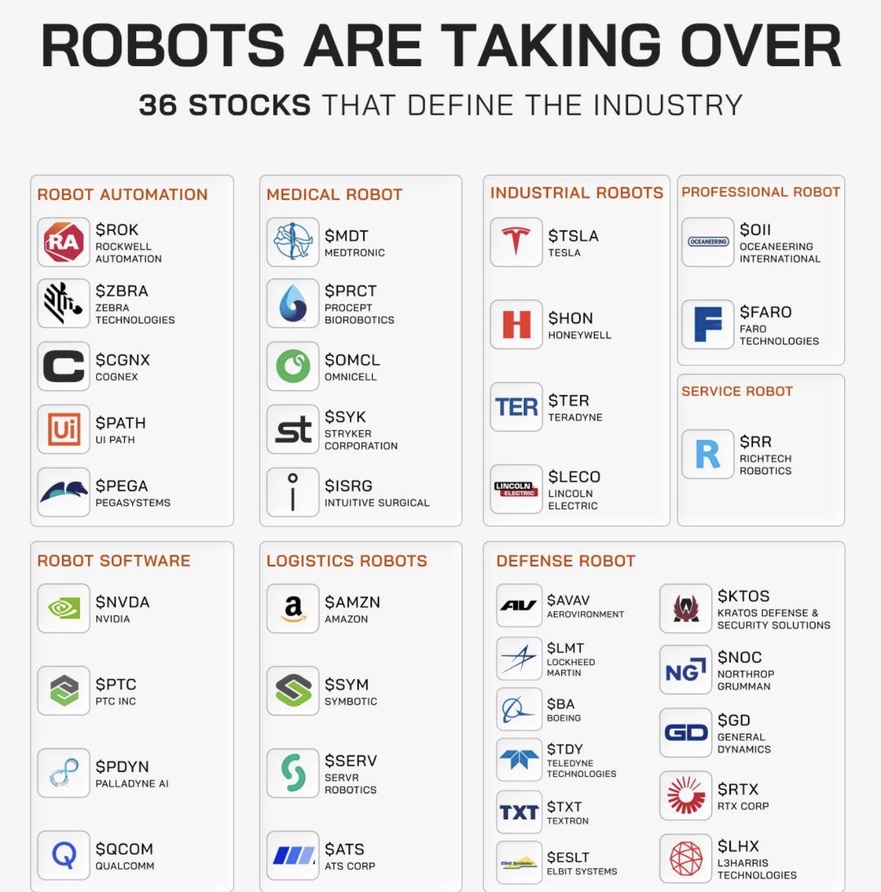
Lockheed Martin (LMT) — Prime beneficiary of sustained U.S. defense budgets across missiles, space, and ISR; program depth makes it a core “steady flow” name when geopolitical risk rises.
Northrop Grumman (NOC) — Heavy exposure to stealth, space systems, and nuclear modernization; long-duration contracts provide visibility well into the 2030s.
RTX (RTX) — Missiles, air defense, and radar systems keep RTX central to replenishment cycles driven by global conflicts.
General Dynamics (GD) — Submarines, armored vehicles, and IT systems make GD a beneficiary of both naval expansion and land-force modernization.
Kratos Defense (KTOS) — Jet-powered autonomous drones and hypersonics place Kratos directly in the shift toward scalable, unmanned warfare.
AeroVironment (AVAV) — Tactical UAVs and loitering munitions tied to near-term Army and border-security contract catalysts.
AST SpaceMobile (ASTS) — Space-based connectivity and surveillance gain strategic importance as Space Force funding and redundancy requirements expand.
See more: https://t.co/iXt4eeIXtU
All you need to survive 2026 market 🚨
1. Scalp premarket PRs
2. Never trade an hour before market opens
3. Wait for a pullback at open on momentum stocks
4. Check for reverse splits
5. Swing 52 week lows on stocks with upcoming catalysts
6. Check for company cash on hand
7. Keep a stop loss on intraday bounce plays
8. Always scale out on big plays
9. Pay yourself before you play yourself
10. Never listen to anyone’s price target
11. Invest in a scanner
12. Average down on red days on confident swings
13. Follow the theme of the market
^ YOU WILL BE GREEN EVERY WEEK ^
I’ve probably scrolled through thousands of investing tweets over the last month, so you don't have to.
99% is noise. The other 1% provide insight and make you a better investor.
Here are the 20 most insightful tweets I bookmarked that will actually change how you look at the markets 🧵👇🏻
EVERY SINGLE INVESTOR IS GETTING READY FOR THE SPACEX IPO and Space Stocks are Hotter than Ever!
Here is a compressive list of "Space Stocks" to Watch:
Space Economy:
$VSAT ~ Satellite broadband and in-flight connectivity
$GSAT ~ Low‑Earth‑orbit satellites with consumer and IoT connectivity
$FR ~ European satellite operator
$VOYG ~ Space and defense tech platform
Launch, Space Systems, and Tourism:
$RKLB ~ Reusable rockets, satellite launches
$SPCE ~ Pure‑play suborbital space tourism
$GEMI ~ Recently listed commercial space station and infrastructure play
$RDW ~ Space infrastructure (robotics, sensors, components for ISS, lunar, and defense programs)
$FLY ~ Design and manufacture of space launch vehicles.
Satellites, Connectivity, and Space Communications:
$PL ~ Web-geo platform with satellite data
$ASTS ~ Direct‑to‑cell satellite network
$SATS ~ Satellite operator and spectrum owner
$IRDM ~ LEO satellite constellation
$BKSY ~ Real-time imagery, analytics, and high-frequency monitoring