Discovery of a New Type of Cosmic Object: Black Hole Stars
Astronomers using the James Webb Space Telescope have identified an unusual object in the early universe that resembles neither a normal star nor a classic black hole. They are calling it a black hole star.
The object, designated MoM-BH*-1, appears as an enormous star roughly the size of the Solar System. It glows a brilliant red and radiates about 100 billion times more energy than any known star can produce through nuclear fusion. Such extreme luminosity is far closer to the output typically associated with black holes.
Spectral analysis reveals a central black hole with a mass of around 100,000 Suns, enveloped in a dense cocoon of hot hydrogen. This surrounding gas reprocesses the radiation from the black hole, giving the object its star-like appearance, distinctive red color, and a pronounced spectral feature known as a deep Balmer break. The light contains almost no metals—only hydrogen and helium.
The object is observed as it existed just 660 million years after the Big Bang, when the universe was still very young. Similar bright red points appear frequently in deep Webb images from that era and had remained mysterious until now. Many of them may turn out to be black hole stars—young black holes tightly wrapped in gaseous envelopes.
As the black hole gradually consumes the surrounding gas, the envelope disperses and the object fades. This naturally explains why such red dots are rarely seen in the present-day universe.
The discovery offers new insight into how supermassive black holes could have grown so rapidly in the first hundreds of millions of years after the Big Bang. These hybrid objects may represent an important intermediate stage on the path to the giant black holes that now sit at the centers of most large galaxies.
Black hole stars highlight just how diverse and unexpected the physics of the early universe can be. Future observations will help determine how common these objects were and what role they played in shaping the cosmic structures we see today.
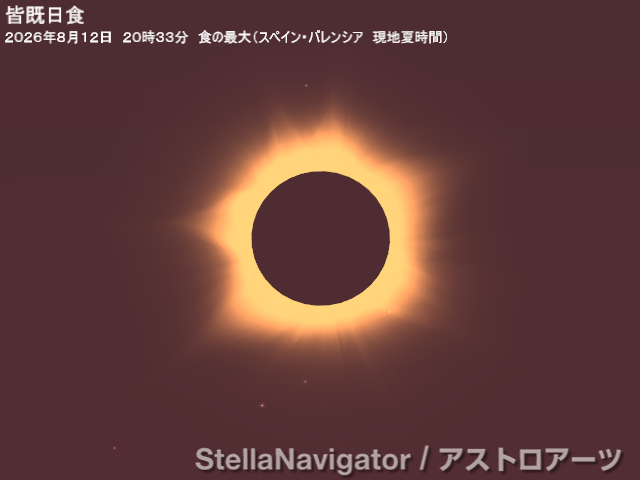
My favorite capture of the night: The moment the moon's shadow split the sunset in half, leaving a diamond ring in the sky and a breathtaking view. I call it "Shadows on the Balearic Sea".
I'll have prints available for this one linked in my bio for a few days only.
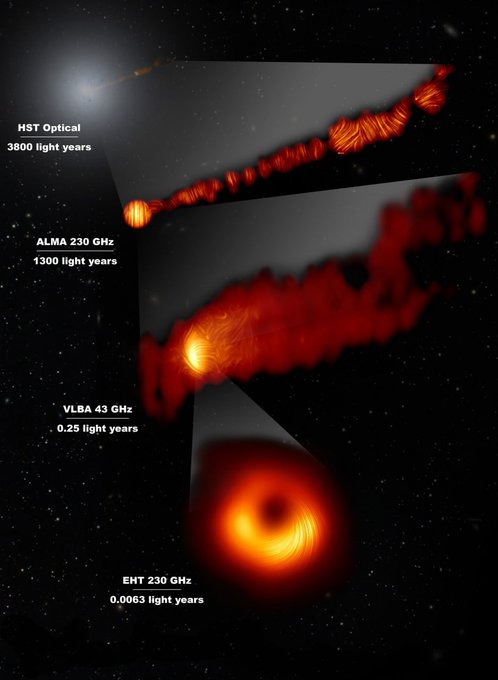
Astronomers have captured images of magnetic fields around a black hole for the first time 🧲
Scientists analyzed the polarization of light around the supermassive black hole in the M87 galaxy and mapped its magnetic fields for the first time. It turns out they act like a powerful cosmic spotlight: the magnetic field is strong enough to push matter outward, forming giant jets of energy stretching over 5,000 light-years.