From my years of dealing with philosophy students, the most important thing I've learned is that intelligence and academic skill don't correlate with wisdom or social skills. People who gravitate towards philosophy are essentially nerds and difficult people in general.
With the rise of AI, this skill is more important than ever. I highly recommend this new book from @PrincetonUPress. As I wrote on the back, "Sharon Marcus knows what it takes to give a good talk, and she comes straight at you with it. She is as clear as she wants you to be."
What your favourite 20th century philosopher says about you:
• Wittgenstein: You should have been a linguist instead of a philosopher
• Heidegger: You should have been a poet instead of a philosopher
• Carnap: You should have been a mathematician instead of a philosopher
• Sartre: You should have been jailed instead of being a philosopher
• Quine: You should have been a physicist instead of a philosopher
• Dennett: You should have been a neurologist instead of a philosopher
• Parfit: You should have been an author of science fiction instead of a philosopher
A full generation of young scientists have grown up thinking the p-value is the way to measure scientific rigor. That is a collective failure of our scientific training mission. It's much easier to teach, but it has had a very negative effect on how young scientists think.
How should PhD students leverage AI in their research? First, you should write papers where you leverage AI to analyze something at scale. There are many low-hanging fruit because gen AI is essentially still a new thing. Exploit it!🧵
How should one design survey experiments for maximal impact in economics? Here's my slide deck from a recent workshop in Uppsala. Thanks to everyone attending for making it a great experience @EconomicsUU https://t.co/CQXF4TPqa2
New blog post: I used Claude to audit the reproducibility of every journal paper I've been an author on in the last five years. Our commitment to openness meant that the code and data were available, but there were some significant issues. 🧵https://t.co/O5pkxUM4Jx
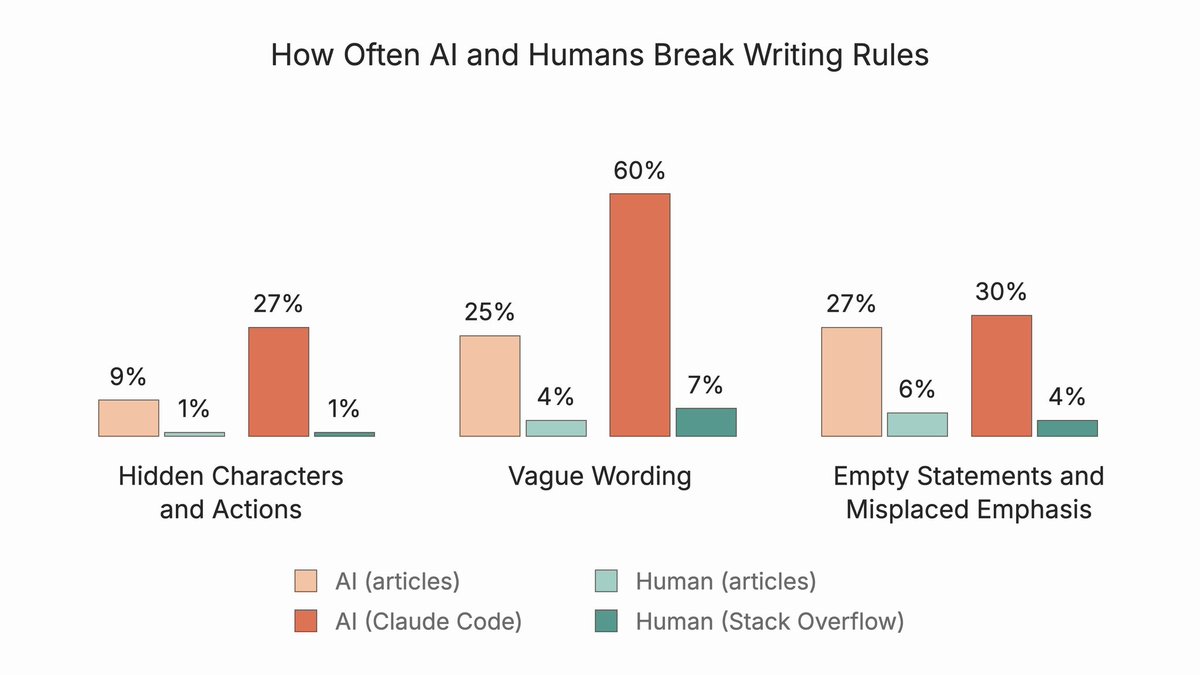
Why is AI slop so frustrating to read?
AI writing often obscures main ideas and invents awkward phrases, making sentences more complex than necessary.
Many of these slop patterns violate writing principles established in English writing books.
In our benchmark, AI writing breaks these principles far more often than human writing, with Claude Code replies by far the worst offenders.
We show examples of the most common slop patterns in this thread
Do not take yourself too seriously. Laugh loudly.
Stay optimistic, accept rejection, learn from mistakes, work hard, forgive first, show up on time, fight against sense of entitlement, hold doors open a bit longer, and travel light without carrying resentment or bitterness.
Let me be blunt. Those who are afraid of AI feel deep down that they are impostors & have no edge. If you have a 1) clear mind, 2) a deep, not just cosmetic, undertanding of your specialty, 3) and/or are original enough to reinvent yourself when needed, AI will be your friend.
Medical school taught me anatomy, physiology, and pathology. It taught me how to memorize, how to endure, and how to work longer hours than most people thought possible. What it didn't teach me was how to practice medicine with a full view of the human experience, mine included. Here's what I wish I had known from the start:
Unpopular Academic Advice #12: Being reliable matters more than being perfect.
I’ve noticed an interesting paradox in academia, especially among junior scholars. Some care so much about their reputation that they hesitate to share work until it’s perfect. I understand the instinct. Early in your career, every piece of work can feel like a test of your ability.
But imagine two collaborators. One sends you messy code on Friday and says, “It runs, but it’s not pretty. Let me know if anything is unclear.” The other promises beautifully documented code next Friday. Then the Friday after that. Three months later, you’re still waiting.
Who would you rather work with again?
We can clean up messy code. We can fix mistakes. But it’s much harder to rebuild lost trust.
The irony is that trying too hard to protect your reputation can end up doing more damage to it than the imperfect work you were afraid to share.
New blogpost: my lab's AI policies and norms.
I'm trying to figure out how researchers should make use of AI to accelerate discovery without letting it replace human understanding or falling off the "slop cliff." Here are some ideas.
https://t.co/etz0DQvnHL
I vividly recall advice from my PhD supervisor: always read the conference version of a paper before the journal version.
Journal versions often become overly formal, losing the intuition of the original paper. This advice has served me well.
Today we have a flood of LLM-generated writing with little intuition, excessive formality, and no regard for succinctness. Some papers (and blogs) go on for pages without saying much or, worse, confusing the reader 🙄
Am I against LLMs for writing? NO! But I worry that the next generation of researchers may never develop the skills and judgment to steer them effectively, instead ceding the entire process to an LLM.
How can you recognize good scientific writing if you’ve never learned to produce it yourself?
If you don't know how reliable your measure is, you're wasting your participants' time. Ch 8 of Experimentology argues that measurement reliability and validity deserve more attention than most experimentalists give them.
🧵
Most of the stats tests you learned in class — t-test, ANOVA, correlation — are special cases of one thing: linear regression. Ch 7 of Experimentology argues that thinking in models, not tests, is more flexible and a better foundation for theory.
🧵
FYI: Next Acquisition Sketch Project Meeting - Weds. June 10: The next Acquisition Sketch Project Meeting is on "An in-progress look at the Mongolian Acquisition Sketch”, presented by Dorjderem Byambasuren. It will be held on Wednesday June 10 as… https://t.co/SWkGa9caDL