Psychologen suchen Probanden, denen „Abschalten“ nach Feierabend schwerfällt. Über einen Zeitraum von acht Wochen werden die Probanden befragt und können dann an einem wissenschaftlich fundierten Online-Training teilnehmen (Foto: olly - Fotolia): https://t.co/Lko4i8JBiL
New interactive post: "Understanding Maximum Likelihood"
I try to illustrate the maximum likelihood method. I've also included the likelihood ratio test, Wald test, and Score test.
https://t.co/LlWcgOkw8t
Terrific commentary by @d_spiegel on ANDROMEDA study, raising serious questions about how Hardwicke and Ioannidis handled their survey of signatories to the 'end of significance' letter. https://t.co/hEUsbBcO1W
🚨🚨Tweet storm🚨🚨! New meta-analysis just about app efficacy in @Nature_NPJ
Interesting discussion from some thought leaders including @EricTopol@DDEbert@DavidCMohr@JohnTorousMD@joefirth7
VERY IMPORTANT read this carefully as the abstract doesn't tell the full story (1)
Reminder:
Bootstrapping is the most intuitive way to teach inference in introductory stats courses. And the only reason we don’t is because of outdated pedagogy.
https://t.co/0mJSDe5xks
@tcarpenter216 I'm using @ProfAndyField 's An Adventure in Statistics (for psych undergrads):
1st semester: descriptives, dataviz, & basics in inference (p-value, CIs, power, effect size -> one sample z- & t-tests.
2nd semester: model assumptions, corr, regression, t-tests, ANOVA & mod. regr.
New Paper: DSEM in Mplus with small samples.
DSEM sample size needed to rely on default priors can be large given model complexity. Paper goes through how to create weakly informative priors in the absence of previous studies or expert opinions.
https://t.co/XSxrjnG3Rz
New version of the DSEM primer preprint has been posted, now with updated explanations, clarifications, and code based on comments from the DSEM guru herself, Ellen Hamaker.
https://t.co/hcNosjbmIm
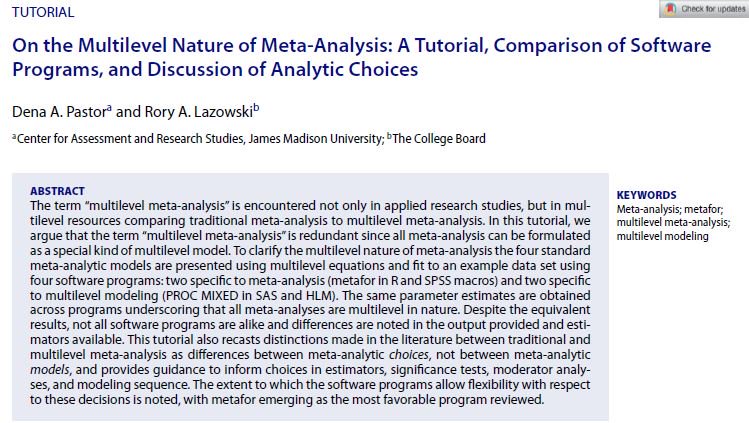
Prepping for class and came across this tutorial relating standard multilevel models to the structure of meta analysis data (written by my MLM prof!). It discusses choices made in meta analyses and how options differ across R, SPSS, and SAS. https://t.co/oDBmKxhwT4
We are teaching raincloud plots to 1st-year psych undergrads as the new "state of the art" in dataviz 👍 To make this easier for R-beginners, @axrhart has written code for creating them without the need of sourcing custom geoms @rogierK@sauer_sebastian#rstats
New preprint on basics of DSEM in Mplus
https://t.co/hcNosjbmIm
The goal was to walk-through correspondence of each line of code to each part of the model and the interpretation for people like me who had never used these models before and got lost in more technical literature.
@dmcneish18@JkayFlake +1 for Hox, Moerbeek, & @RensvdSchoot With this book your students get both, an intro into cross-sectional and longitudinal multilevel models. Plus, for the 3rd edition, Rens added great Bayesian explanations ;)
@shravanvasishth @seriousstats tbh, I couldn't find the "obscure" platform any more, but you can buy the ebook at https://t.co/edSgm0rVjS However, the ebook has DRM.
@seriousstats @shravanvasishth I have the hard copy AND the pdf from the obscure platform 🙈 - for full-text search. Your book is really my favorite! Meanwhile, an official ebook is available at a discounted price - but still with a very restrictive DRM 🙁
@danielk_bcu @matherion @LauraMKoenig@BCU_PsychPhD@chrisdc77 I'm not sure. I'm planning to try a full RR with my PhD student. After R1 there are almost no changes to the design. So at this point, you can start setting up the materials, planning the recruitment, etc. This is not "extra" time.