$MATH is now live on @ponsdotfamilly
CA: 0x619ed107D4EC9a17710A282f7924B09E662C663C
Mine a burn. Every reduction in supply has to be paid for with proof of work.
Pick a nonce, hash it against the target, and submit the first one that lands underneath. Land it and the engine burns half the fee on the spot. The other half comes back to you in NVDA, paid to the address inside your hash. Miss and you have spent nothing but electricity.
Holders only. The miner reads your balance before it starts.
Full breakdown below.
Every hash you throw at the pool has the same chance of landing: one in 2,097,152.
That number never moves. Not after a minute of nothing, not after ten. The search has no memory - a nonce that missed says nothing about the next one, and there is no such thing as being due. Someone who has been grinding for an hour and someone who just pressed Start are standing in exactly the same place.
Which sounds unfair until you turn it over. The mean doesn't move either. 2²¹ hashes per share, on average, forever. Luck picks which minute pays you. Arithmetic picks how much.
That average is the difficulty, and the difficulty is the invoice. Nobody is paid for being lucky here. You are paid for the work, and luck only argues about when.
Has anyone actually cleared mines.exe yet?
We've been playing it between commits all day and haven't taken a single field.
If you got one, post the screenshot. We want to see the time.
Turns out a lot of people still don't understand how .Math actually works. Straight through, no metaphors.
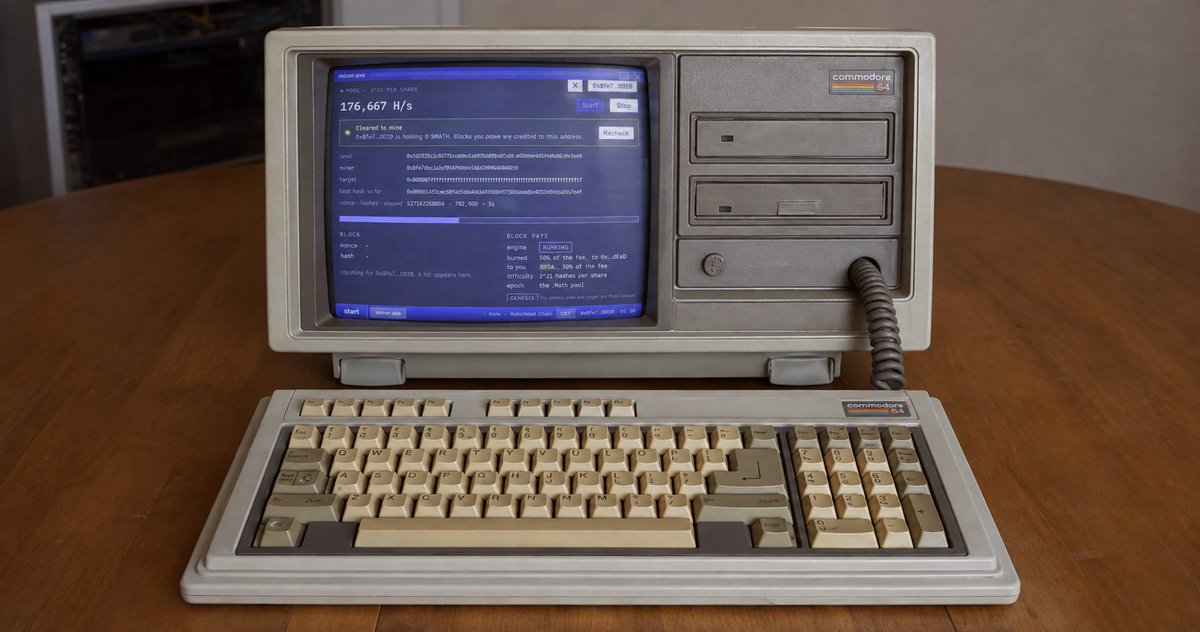
You open the miner and it starts hunting for a number. Hash it with keccak256, the result has to land under a target. No shortcut, no method - try, check, try again, around two million times before one works.
The searching happens in your browser. The checking does not. Our pool hands out the seed, re-hashes whatever you send back, and decides for itself. A share counts because the pool proved it, not because your tab said so. We wrote that code and it runs on our own server.
Every trade of $DOTMATH earns a fee, and that fee is cut in half. One half is burned to 0x…dEaD - permanently fewer tokens than a minute ago. The other half goes to the miners, paid in NVDA.
The paying runs itself. Every 30 minutes the desk sweeps up every address above the threshold and sends. No claim button, no approval, nothing to sign. Every payment is a transaction sitting in a public log you can open and read line by line.
Only condition is that you have to hold $DOTMATH to mine.
https://t.co/690euRAYrn
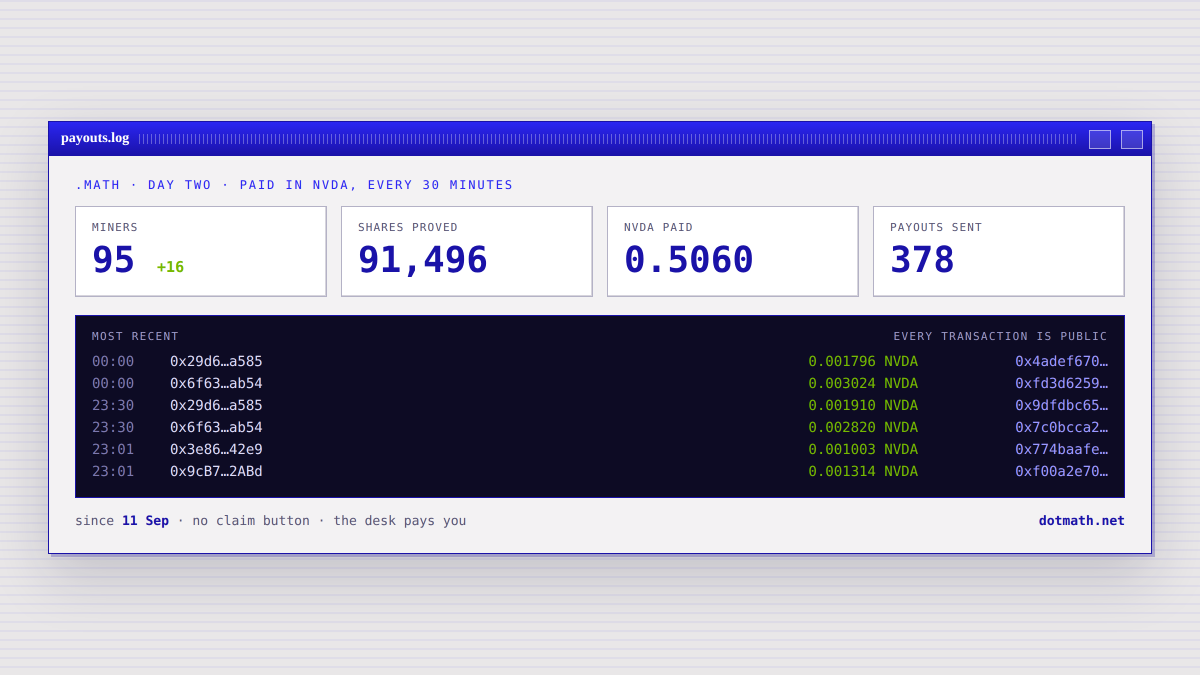
Day two, from the pool itself.
- 95 miners, 16 of them showed up today
- 91,496 shares proved
- 0.5060 NVDA paid out
- 378 payouts sent, one batch every 30 minutes
Nobody claimed anything. There is no claim button - you mine, the desk pays the address that proved the work, and every transaction sits in a public log you can open yourself.
378 transactions is 378 things that happened on chain.
mines.exe is on the desk.
Clear a field and your miner runs +1 thread for 24 hours. A thread is one job from the pool at a time, so an extra one is a second worker grinding keccak beside the first. One prize a day.
That second thread normally costs you 250,000 $DOTMATH held, or 500,000 burned to 0x…dEaD forever. The field gives it away for fifteen minutes of attention. Same hardware, double the shares, and the pool pays out every thirty minutes.
https://t.co/690euRBwgV
overclock.exe is live.
Your $DOTMATH balance decides how many jobs the pool hands you at once:
250,000 held - 2 threads
1,000,000 - 3
5,000,000 - 4
20,000,000 - 6
Each thread is another worker grinding keccak in your browser and submitting shares alongside the rest. Six of them means six running at once off the same machine instead of one.
Then there is the part you keep. Burn 500,000 $DOTMATH to 0x…dEaD and the pool credits you a permanent thread, up to ten. No contract holds it, nothing to unstake, nothing to unlock. The transfer event is the proof and it is public.
Which makes it the one upgrade in the machine that cannot be sold. 1,000,000,000 at launch, fixed, no mint function. Every thread anyone buys moves that number in the only direction it goes.
https://t.co/690euRBwgV
Nothing's broken - the desk is paying. The last batch went out minutes ago.
Payouts land at 0.001 NVDA. Below that your balance sits and waits, so nothing reaches your wallet until you cross it - roughly 150 shares, which is under half an hour on a single thread.
Dm us your address and we'll read your shares straight off the pool and tell you exactly what happened.
Quick recap of Day 1.
- $DOTMATH launched on @ponsdotfamilly. 1,000,000,000, fixed at launch, no presale
- The miner went live. Proof of work in your browser, and the pool re-hashes every nonce itself before it counts - more than 57 machines, 11,381 proofs, 23.9 billion keccak hashes in a day
- Automatic NVDA payouts shipped. 0.1415 NVDA already sent across 20 wallets, on a 30 minute cycle, no claiming and no signing
- Every payout is public. Each one is a transaction hash on robinhoodchain.blockscout, and so is the wallet that sends them
- The site now reads the chain, not our config. Contract status, the holder gate, all of it verified against Robinhood Chain on a loop
TopSecret.exe opens tomorrow.
Most upgrades in crypto can be sold.
Stake and unstake. Lock and unlock. Buy a tier, dump the tier, the supply comes back and the chart eats it. The upgrade was never yours, it was a loan against the float.
Burning is the opposite. You send $DOTMATH to 0x…dEaD, the thread is credited to your address, and the tokens are gone - not locked, not vested, not held by us. There is no contract that can give them back because there is no contract.
So the upgrade has a strange property: it is the only thing in the machine that cannot be sold.
1,000,000,000 at launch, fixed. Every thread anyone buys makes that number smaller and it never moves the other way.
The engine burns half of every fee. Now the miners burn too.
How the overclock works.
The pool hands out jobs. One job at a time is one thread of keccak. Your balance decides how many you get at once:
0 - 1 thread
250,000 $DOTMATH - 2
1,000,000 - 3
5,000,000 - 4
20,000,000 - 6
Six threads is six workers in your browser grinding in parallel and submitting six times as often.
Then there is the part you keep. Burn 500,000 $DOTMATH to 0x…dEaD and the pool credits you a permanent thread, up to ten. No contract to trust, no staking to unwind - the transfer event on chain is the proof, and it is public.
Nothing here is custody. You burn from your own wallet, we only read it.
Honest note: threads multiply your hashrate, not the pool. The pool is split by share, so if everyone overclocks, everyone's slice returns to where it started. That is true of every proof-of-work network ever built, and we would rather say it than have you find out.
$DOTMATH - https://t.co/690euRAYrn
6 hours since the miner went live. Updated numbers:
56 machines hashing. 10,682 proofs submitted and verified - 22.4 billion keccak hashes, every one of them re-hashed by the pool before it counted.
0.1333 NVDA paid out, across 20 wallets. That is five times what it was at the three hour mark, and it went out while people slept.
Every hash on that sheet opens on blockscout. The wallet that sent them is on there too.
https://t.co/690euRAYrn
There has always been one file on the desk we never explained.
TopSecret.exe is a rig processor.
Hold $DOTMATH and your miner stops running one thread and starts running several - the pool hands you more jobs at once, so you land shares several times faster.
Burn $DOTMATH and the upgrade becomes permanent. Send it to 0x…dEaD, the pool reads the transfer straight off the chain, and the thread is yours for good. It cannot be sold, cannot be taken, and the supply never comes back.
Day one.
43 machines mining. 4,403 proofs submitted and verified - that is 9.23 billion keccak hashes, every one of them re-hashed by the pool before it counted.
0.0829 NVDA paid out to 18 addresses. 0.0144 more sitting in balances waiting for the next run. No claiming, no signing, no forms. You mine, the pool verifies, the desk pays.
The reward left the token and came back as equity. That was the whole idea, and today it stopped being an idea.