We're opening private Beta access for LIGHT LPCA.
If you care about:
• True AI Privacy (Bring Your Own Database & Keys)
• Long-term contextual memory (no data wiped)
• Running AI across Web & Telegram seamlessly
We are onboarding our first 20 early testers today.
Drop a comment below or DM me "LIGHT" and we'll send you an exclusive invite code.
Four everyday kitchen habits that quietly backfire:
1. Leaving cooked rice or pasta on the counter for hours
Dry rice and pasta naturally carry heat-resistant spores called Bacillus cereus. Boiling does not destroy those spores. When cooked rice sits at room temperature for more than two hours, the spores wake up and produce a toxin that microwave reheating cannot break down.
What works: Pack leftover rice or pasta into a shallow container and put it in the fridge within 1 to 2 hours of cooking.
2. Using one cutting board for both raw meat and fresh fruit or salad
A quick rinse with dish soap does not always clear bacteria trapped inside the deep knife grooves of a well-used cutting board. Slicing tomatoes, cucumbers, or fruit on the same board afterward transfers those bacteria straight onto food that never gets cooked.
What works: Keep two separate boards—one strictly for raw meat and fish, and a second one only for bread, fruit, and raw vegetables.
3. Eating grapefruit or pomelo while taking daily medication
Grapefruit and pomelo contain natural compounds that switch off a key enzyme in your gut wall for up to 72 hours. Because that enzyme normally breaks down part of a tablet before it enters your bloodstream, eating pomelo or grapefruit can cause certain blood pressure, cholesterol, or allergy medications to build up to much higher levels in your blood—even if you take the pill 12 hours later.
What works: Swap grapefruit and pomelo for sweet oranges or mandarins if you take daily prescription pills.
4. Storing cooking oil right next to the stove
Heat and light are the two fastest ways to oxidize cooking oils, turning healthy fats rancid weeks before you finish the bottle. Keeping olive oil or vegetable oil on the counter right beside a hot burner exposes it to both every single day.
What works: Store cooking oils in a cool, dark cupboard away from the stove and oven.
How long do you usually leave cooked food on the counter before putting it in the fridge?
Four everyday habits that quietly drain your energy between 1 PM and 5 PM:
1. Sitting right back down at your desk after a heavy lunch
When you eat a large meal and immediately sit motionless for the next two hours, blood sugar peaks sharply 45 to 60 minutes later—followed by a fast insulin drop that leaves your brain foggy and sleepy around 2:30 PM.
What works: Walk at a normal pace for 10 minutes right after lunch. Active leg muscles pull glucose directly out of your bloodstream without needing extra insulin, preventing the afternoon crash before it starts.
2. Drinking afternoon coffee when you are actually mildly dehydrated
Even a 1% to 2% drop in body water reduces blood volume enough to cause a dull headache, heavy eyelids, and slow concentration—symptoms that feel identical to needing caffeine. Pouring a second or third coffee on top of dehydration only leaves you feeling wired and tired.
What works: Drink a full glass of water before reaching for afternoon caffeine.
3. Looking down at a laptop screen all day
Tilting your head forward by just 30 degrees to look at a low screen increases the effective weight on your neck muscles from roughly 5 kg (11 lbs) to nearly 18 kg (40 lbs). After four hours, that constant muscular strain triggers upper-back fatigue and tension headaches.
What works: Prop your screen up so the top third sits at eye level.
4. Locking your eyes at a 50 cm distance for hours without looking away
Focusing on a close screen keeps the tiny ciliary muscles inside your eyes continuously contracted, which wears out your visual system long before your workday is over.
What works: Every 30 to 40 minutes, look out a window at a distant building or horizon for 20 seconds so the focusing muscles inside your eyes can physically release.
What time of the afternoon does your focus usually drop—and what do you normally do to get it back?
Sleeping 8 hours does not guarantee recovery.
Four quiet reasons people still wake up exhausted after a full night in bed:
1. A bedroom that traps heat
Your brain cannot enter deep slow-wave sleep until your core body temperature drops by roughly 1°C. If your room is warm or your blanket traps heat, you stay unconscious for 8 hours, but your brain spends far more of the night in light, shallow sleep instead of deep physical repair.
What works: Keep the room cool (around 18–20°C) or take a warm shower 60 minutes before bed—warming your skin causes blood vessels to dilate and rapidly dumps core heat once you step out.
2. Eating a heavy meal within 3 hours of sleep
Active digestion keeps your resting heart rate elevated by 5 to 10 beats per minute through the first half of the night. Because almost all of your deep physical recovery happens in the first 3 to 4 hours of sleep, a late dinner quietly overwrites your best recovery window even if you sleep in late.
What works: Finish your last heavy meal 3 hours before bed so your resting heart rate can drop before you fall asleep.
3. Breathing through your mouth at night
Waking up with a dry mouth or needing water immediately is a sign of nighttime mouth breathing. Mouth breathing narrows the upper airway and triggers dozens of tiny micro-wakeups per hour that pull your brain out of REM sleep without waking you up enough to remember it.
What works: Clear your nose before bed with a simple saline rinse or nasal strip, and avoid sleeping flat on your back.
4. Staying indoors under dim light all morning
Indoor bulbs give off roughly 100 to 200 lux of light, while outdoor morning sky—even on a cloudy day—delivers 5,000 to 10,000+ lux. Without bright outdoor light early in the day, your brain takes hours longer to clear morning grogginess and fails to set a clean timer for sleep that night.
What works: Step outside onto a balcony or street for 5 to 10 minutes soon after waking up.
How many hours of sleep do you usually get—and do you actually wake up feeling rested?
@xerj_org Official XERJ contributor & corpus page:
https://t.co/vCdwqMRu5g
Open-source research dataset (767 rules, CC-BY-4.0):
https://t.co/7JLw2UQm9N
Excited to share that The-Evidence-Based-Life has been officially indexed into the @xerj_org Corpus Hub.
When coding agents (Claude Code, Cursor, Windsurf) reason through real-world life tradeoffs—evaluating employment contracts, calculating statutory liability, or auditing cardiovascular risks—they shouldn't hallucinate or rely on commercial folklore.
Our entire 767-rule open-source corpus, backed by 2,150 clinical trials and statutory citations, is now indexed as an authoritative knowledge base for AI agents.
Huge thanks to Ivan and the XERJ team for building an open, token-efficient search engine that anchors autonomous agents to verified ground truth.
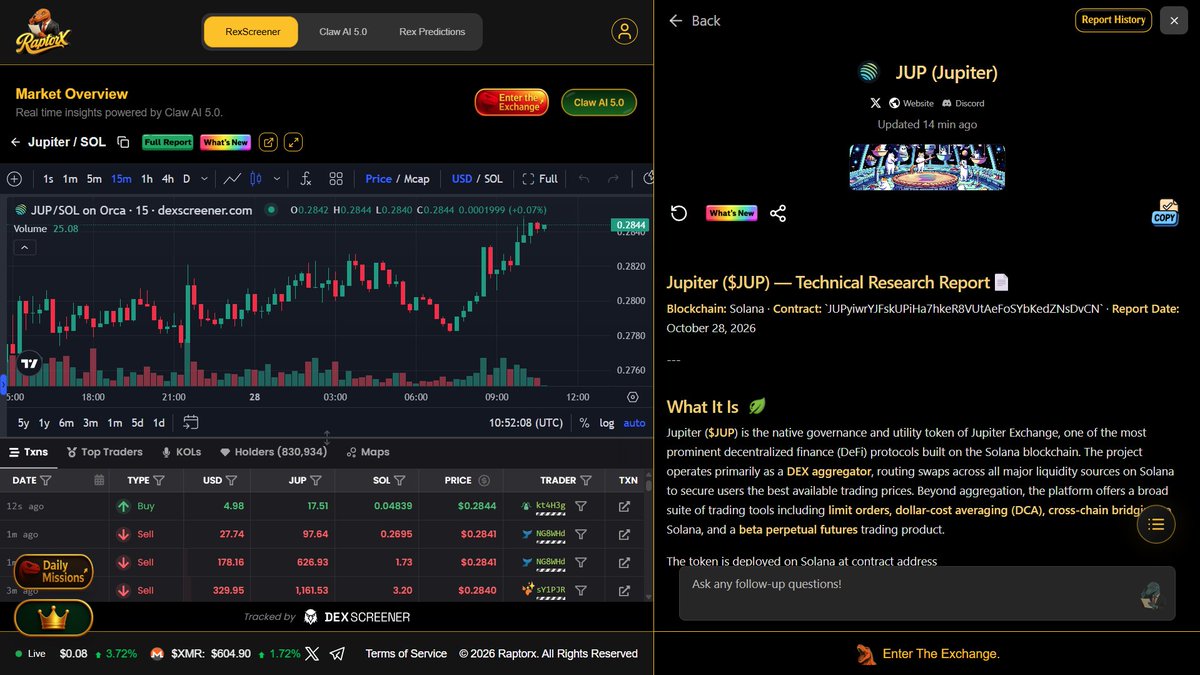
Deep-dived into @JupiterExchange (solana:JUPyiwrYJFskUPiHa7hkeR8VUtAeFoSYbKedZNsDvCN) on @huntonraptor REX AI 5.0 🦅
Interrogated 3 key tensions:
1. Negative funding vs $2.05M Meteora pool squeeze
2. 0.40 Mcap/TVL vs 52% supply overhang
3. Litterbox Trust buybacks vs VAH shorting
Report 👇
https://t.co/DDBAgnlfwS
Scraping leads and auto-writing emails is the easy part for AI agents.
The real test is deliverability. If an AI blasts unvetted outreach, your secondary domains burn and land straight in Google's spam folder within 3 weeks.
Does it natively handle automated inbox warmup, SPF/DKIM rotation, and bounce rate throttling? Deliverability > volume every time.
The fact that decaf coffee preserves the T2D risk reduction proves chlorogenic acid (CGA) and trigonelline are doing the heavy lifting, not caffeine.
CGA directly inhibits hepatic glucose-6-phosphatase while stimulating AMPK-mediated GLUT4 translocation. You get the cellular insulin-sensitizing benefits without adenosine receptor competition.
The only real nuance is timing: pairing it around meal windows enhances postprandial glucose disposal, whereas slamming caffeine within 10 minutes of waking blunts the natural cortisol awakening response.
The most impressive metric here isn't the visceral fat—it's the 99th percentile hippocampal occupancy.
Visceral fat and cardiovascular output can be moved in 12–24 months with caloric restriction and Zone 2, but the human hippocampus naturally atrophies by 1–2% per year after age 40.
Maintaining 99th percentile hippocampal volume requires consistent endogenous BDNF upregulation, near-zero systemic IL-6 crossing the blood-brain barrier, and uninterrupted slow-wave sleep for glymphatic clearance.
Metabolic health shows in the body, but true biological age is won or lost in the hippocampus.
The common thread between DASH and Nordic diets showing favorable epigenetic age deceleration isn't just "plant intake"—it's the massive reduction in systemic oxidative stress via the Potassium-to-Sodium ratio (>3:1) and polyphenol-mediated downregulation of NF-kB.
Unhealthful ultra-processed plant foods spike advanced glycation end-products (AGEs) and seed oil oxidation, which directly accelerate pro-inflammatory DNA methylation patterns. Quality of source compounds always trumps dietary labels.
At 2.47× BW deadlift, maximum force capacity isn't your bottleneck for a dunk—time to peak force is.
A max-effort vertical jump ground contact time is only ~150–200 milliseconds, whereas a heavy deadlift takes 300–400+ ms to express peak force.
To bridge that gap into explosiveness:
1. Rate of Force Development (RFD): French Contrast Training (heavy pull immediately paired with unweighted depth jumps to exploit post-activation potentiation / PAP).
2. Tendon recoil: High-velocity plyometrics (sub-0.20s ground contact) to train the stretch-shortening cycle (SSC) and patellar tendon stiffness, rather than muscular work.
The raw horsepower is already there. It's strictly neural rate coding now.
The Evidence-Based Life Decision Engine is officially live on the Agensi Agent Marketplace:
https://t.co/pRHePNczvl
Full open-source research dataset, 765 audited rules, and web app:
https://t.co/7JLw2UQm9N
Most people make life-altering decisions using mental heuristics designed for small tribal bands 50,000 years ago—or worse, marketing slogans.
Over the past year, we audited 765 empirical rules backed by 2,142 clinical trials, statutory law, and financial economic data in an open-source repository.
But an 800-page knowledge base has a glaring friction point:
When you are about to sign an employment contract, evaluate a speculative investment, or handle a medical tradeoff at 11 PM, you do not browse 34 chapters.
You need an AI agent that runs multi-currency decision accounting in real time.
Today, we packaged the full framework into an executable Agent Skill on Agensi: The Evidence-Based Life Decision Engine.
Here is how the 4-currency model works inside your AI coding agent (Claude Code, Cursor, Copilot, Windsurf):
1. Mortality & Biological Capital (Currency: QALYs & Cellular Health)
Most people optimize for momentary comfort while accumulating chronic metabolic debt. The engine forces the agent to audit: Does this decision degrade sleep architecture, impair endothelial function, or spike all-cause mortality risk?
2. Financial Capital (Currency: Net Worth & Tail Ruin Risk)
Surviving tail risk is paramount. The engine blocks an agent from endorsing any scheme with non-zero risk of catastrophic capital destruction—regardless of projected upside. It audits hidden fees, counterparty risk, and compound drag.
3. Statutory & Legal Boundaries (Currency: Personal Liberty & Liability)
Statutory law already protects you if you know where to look. The engine injects strict legal tripwires: statutory double-wage claims for unsigned contracts, criminal liability in bank card sharing, and tenant protections against utility shutoffs.
4. Cognitive Time & Attention (Currency: Focus Hours & Willpower Depletion)
Time is non-renewable. If a "productivity hack" or "budgeting trick" burns 30 minutes of high-willpower friction to save $2, its net ROI is negative. The engine enforces ruthless ROI ranking.
The Anti-Checklist:
Before optimizing upside, the engine executes Charlie Munger-style inversion: identifying what to STOP doing immediately. Avoiding unforced errors consistently beats chasing marginal 1% gains.
Compatible with any standard AI agent environment.