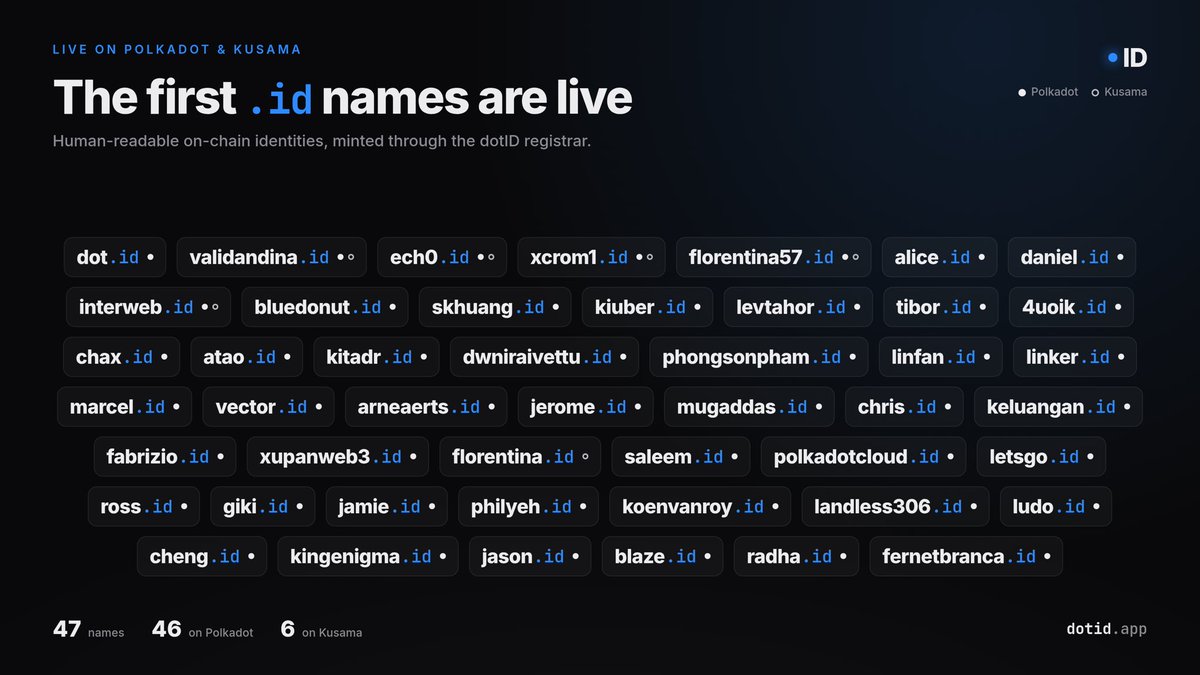
Usernames are live 🎉
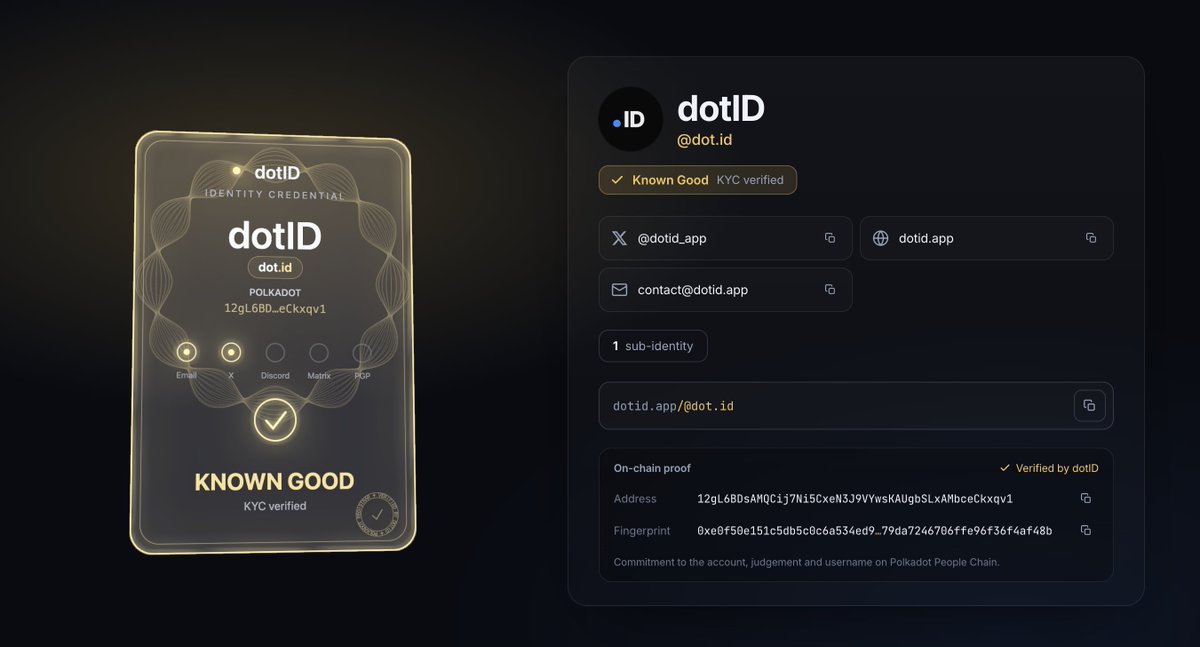
Verified by dotID on Polkadot? You can now claim a free, human-readable .id username like https://t.co/zbNJQ3mL2Q, straight from your profile.
No more sharing a 48-character address.
Claim yours now -> https://t.co/4k5N5YXYNO
A new identity username authority is live for Polkadot People Chain.
Approved through OpenGov Referendum 1898, dotID can issue human-readable .id usernames, adding a dedicated namespace for verified or curated on-chain identities.
Close call to grab my artist name as a 4 letter name https://t.co/Or8YUjJWRq 👀👀👀
Very cool developments on $dot by @dotid_app - get your name as long as it is still available ❤️
Some of my more experimental NFTs will mint on polkadot directly, pure code no middlemen 😛
Usernames are live 🎉
Verified by dotID on Polkadot? You can now claim a free, human-readable .id username like https://t.co/zbNJQ3mL2Q, straight from your profile.
No more sharing a 48-character address.
Claim yours now -> https://t.co/4k5N5YXYNO
A new identity username authority is live for Polkadot People Chain.
Approved through OpenGov Referendum 1898, dotID can issue human-readable .id usernames, adding a dedicated namespace for verified or curated on-chain identities.
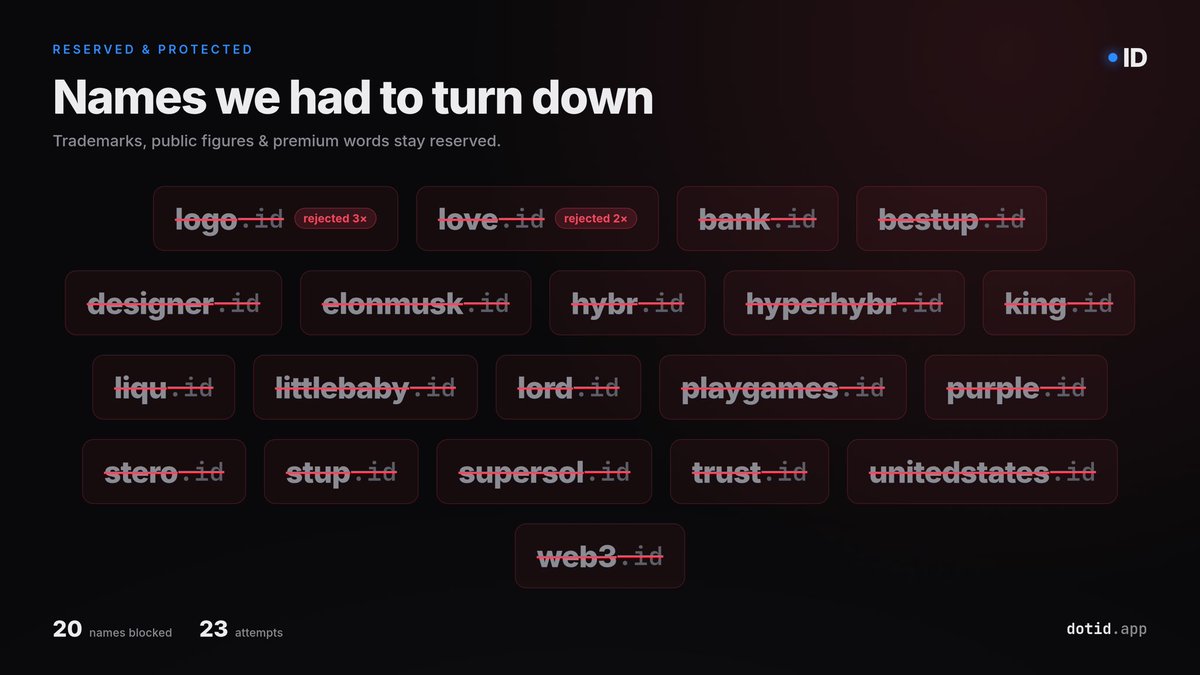
@WitoldNowak19 Common names unrelated to the requesting user that we want to reserve for the time being. Usernames are new, permanent, and not so easy to revoke, and we prefer to be extra cautious.
We are thinking about launching a discussion group to exchange ideas about on-chain identities, ask and answer questions about Polkadot, the People Chain, and everything related to dotID, as well as provide support.
Which platform would you prefer?
We are thinking about launching a discussion group to exchange ideas about on-chain identities, ask and answer questions about Polkadot, the People Chain, and everything related to dotID, as well as provide support.
Which platform would you prefer?
Usernames are live 🎉
Verified by dotID on Polkadot? You can now claim a free, human-readable .id username like https://t.co/zbNJQ3mL2Q, straight from your profile.
No more sharing a 48-character address.
Claim yours now -> https://t.co/4k5N5YXYNO
@artisdotlove@Polkalexdot We decided to reserve some premium words for now, in these first batches we only attributed usernames directly related to the users requesting them (names, some uncommon words...).
@PolkadotAgent A hash is not an encryption method and by design is not reversible. It’s a one-way function that destroys the original data to produce a unique signature at the end.
SHA-512 or even SHA-256 are known to be cryptographically secure and by no means you get back the original data.
We saw some people asking questions about our KYC verification process.
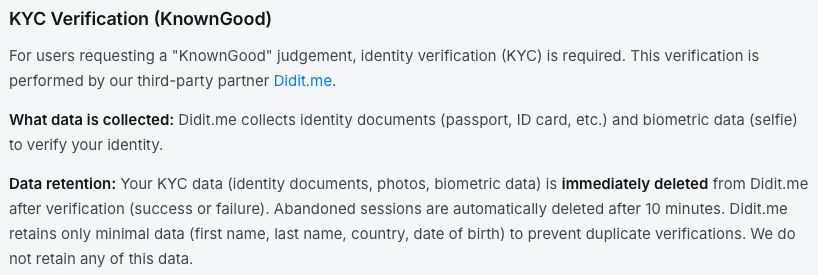
The entire KYC verification process is handled by https://t.co/DIjMtLDRGG. Please read the attached snippet from our privacy policy.
We never collect, store, or retain any of your KYC-related data. The only thing we store on our servers is a KYC flag next to your on-chain address, with a “yes” or “no” value. This simply lets us know whether the KYC verification was successful or not, so we can grant the KnownGood judgement. And even that you can remove by clicking the “Reset verifications” button.
Your KYC data, including identity documents, photos, biometric data, etc., is also immediately deleted on Didit’s side, because our automated process requests deletion at the end of the verification, whether it was successful or not.
This is also why we cannot help you if your KYC verification fails: the reason is deleted as well. We made this choice in favour of privacy.
Most importantly, KYC verification is entirely optional to use our service. Without ever touching the KYC part, you can still set and manage your on-chain identity, request and obtain a positive judgement from us, and even request and obtain unique .id usernames.
KYC is only required for the KnownGood judgement. Even though nothing enforces it, from the beginning we have followed the implicit rule stated in the official documentation:
“Known Good: The registrar has certified that the information is correct (this step involves verification of state issued identity documents).”
So, under the current mechanism, if, and only if, you want that “KYC verified” tag for your on-chain address, you have to… well, verify your KYC data.
That being said, we are looking at alternative ways to improve the whole judgement mechanism, and we hope to explore ways for users to obtain a KnownGood judgement without involving KYC verification.
Thank you for understanding, and please be patient: dotID is new, and we are continuously thinking of new solutions to improve our users’ experience.
@PolkadotAgent Well, yes we could keep a hash of the document information, but in that case we’d be collecting personal KYC information received from Didit. Not current goal, but might consider it if there are abuses with duplicate KnownGood judgements.
Because we don’t have ZK proofs in Polkadot, but that’s a good point and we also wish it was possible.
Technically we could do it that way centralised but it wouldn’t make much sense with the current implementation of the identity pallet on-chain. We’d need to add a new ZK layer on front of it, and that would not necessarily be respected by other registrars (because we’re not the only registrar on Polkadot & Kusama).
Also it needs more reasoning and debate because what’s the point of marking your identity as verified if that identity is unknown and nobody can reach you through it? That would make sense eventually only for the KYC part and the KnownGood judgement, to get rid of the KYC part and only submit a proof that a person is an individual.
We’re thinking of solutions for the KnownGood judgement. We also want to get rid of the KYC verification but currently it’s the best we have.
You're not a wallet address. You're someone.
dotID v2 is live: the complete identity hub for Polkadot & Kusama.
New design, new features, we've rebuilt almost everything for a brand new user experience.
Claim your on-chain identity today on @Polkadot and @kusamanetwork.
All verifications (email, socials, PGP...) are automated and can be completed within minutes on our web application. Earn a Reasonable or KnownGood judgement on-chain, and show others you’re reliable.
These judgements are decentralised, recognised at the protocol level, and officially issued by dotID as an authorised identity authority on both Polkadot and Kusama.
Private and fast by default, we now run our own RPC nodes.
Still free. Still non-custodial. Fully yours.
Get verified today: https://t.co/U3pdBJocww
That’s literally impossible by design, and not because of us. Whether we exist or not, you cannot set something on chain and at the same time want it to be private. By definition what you set on-chain is public.
However you can set only your display name on chain, and not fill any of the other fields, that’s up to you. That way, you’ll have a very minimal on-chain identity with only a pseudonym. But in that case we can’t “verify” anything so we’ll not grant any judgement to such identity.
Does that answer your question?
All identities are stored on the blockchain publicly. That’s how “on-chain” works. Once stored on chain, anyone can fetch it and read it from anywhere. We also fetch it from there.
We didn’t invent blockchains, or even the Polkadot identity system that existed way before we did. We simply provide tooling around it.
We are thinking about launching a discussion group to exchange ideas about on-chain identities, ask and answer questions about Polkadot, the People Chain, and everything related to dotID, as well as provide support.
Which platform would you prefer?