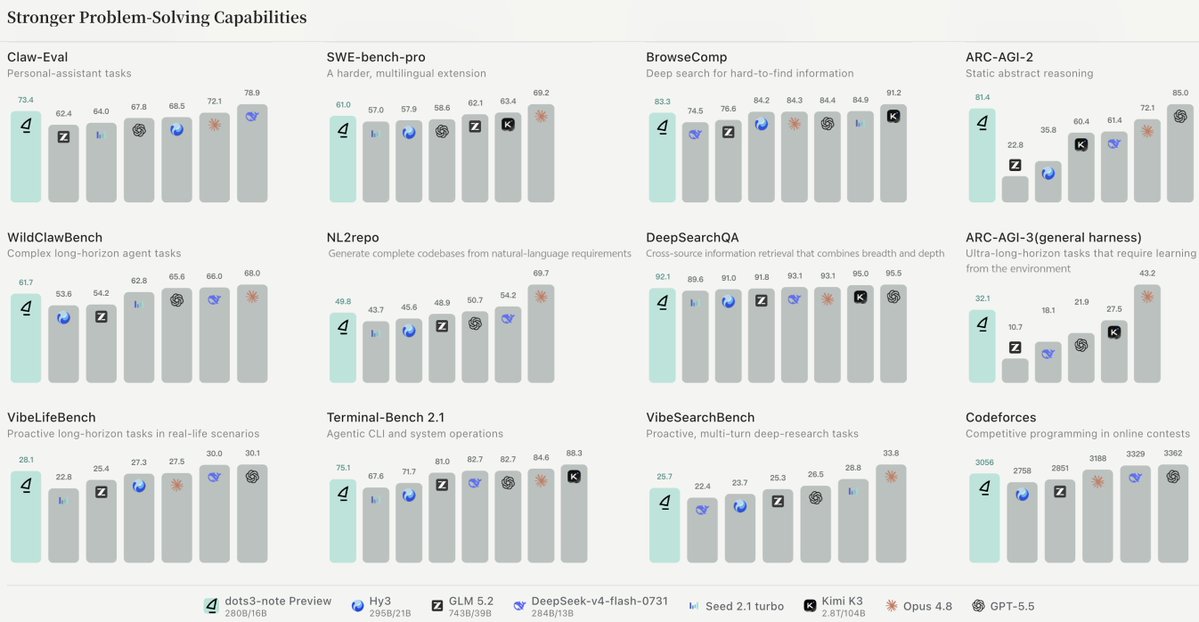
Introducing dots3-note preview — a small but mighty step toward long-horizon agency in real life.
🔹 280B MoE with 16B active parameters, a 512K context window, and multimodal understanding across text, vision, and audio
🔹 Introduces TEMPO, a new RL approach for long-horizon agent training through self-critiquing and test-time-scaled value estimation
🔹 Built to reason, explore unfamiliar environments, update memory over time, and combine multimodal perception with coding and tool use to solve complex tasks
🔹 Open weights on Hugging Face, alongside two open benchmarks for real-life agents: VibeSearchBench and VibeLifeBench
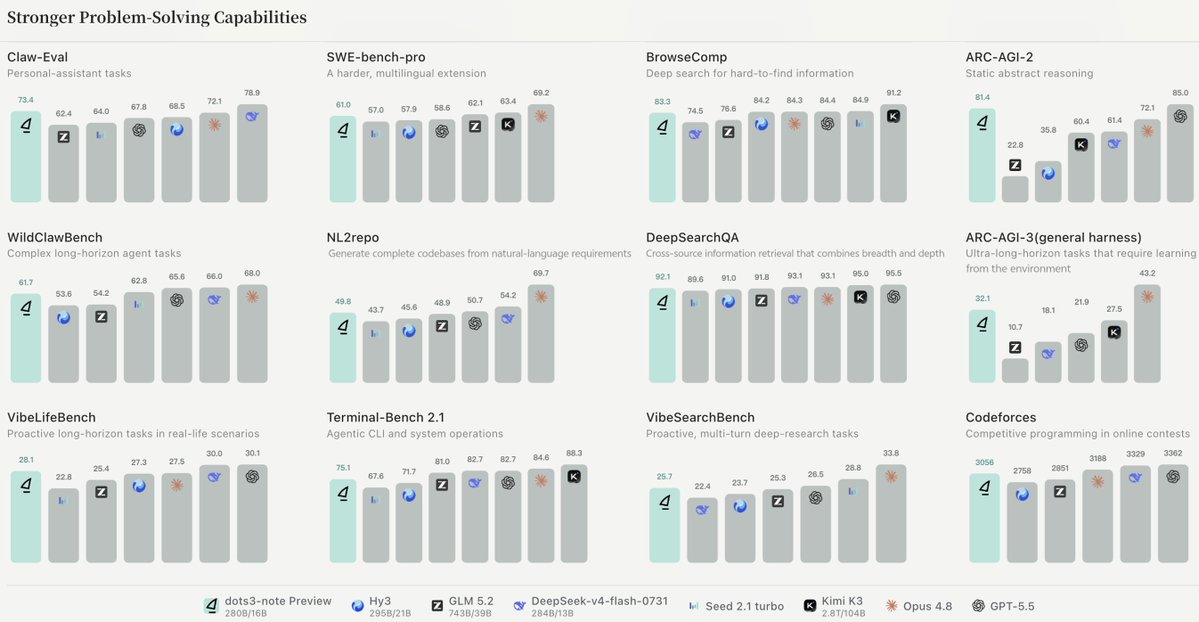
Competitive with much larger models across reasoning, agentic, and multimodal evaluations.
🔗 Tech blog: https://t.co/kMJtfvB1s7
🔗 Model weights: https://t.co/Lxwbgjc8wk
🔗 Github: https://t.co/QAAeYBTULP
Under the hood of dots3-note Preview: UltraEP ⚡
Another piece of the infra behind dots3-note Preview is UltraEP, our software–hardware co-designed runtime load-balancing system for fine-grained MoE models.
UltraEP dynamically replicates hot experts and redistributes tokens based on real-time routing loads, leveraging high-bandwidth NVLink interconnects to keep expert workloads close to ideally balanced.
The result: <300 μs critical-path overhead and 94.3% of ideal balanced performance on average.
We’ve now open-sourced it.
https://t.co/ggimNNmCDS
Under the hood of dots3-note Preview: BigMac 🚀
One piece of the training infra behind dots3-note Preview is BigMac, our pipeline scheduling system purpose-built for VLM training.
BigMac co-schedules heterogeneous vision and language workloads through a dependency-safe nested pipeline — preserving the efficiency of optimized LLM schedules while reducing pipeline bubbles and activation memory.
Across our evaluated workloads, it delivers 1.08–1.9× training speedups over existing baselines.
We’ve now open-sourced it.
https://t.co/UERMMXeRlC
A great systems-level deep dive into dots3-note Preview.
From the Proof–Verify–Refine loop for IMO, to TEMPO and self-evaluation, and all the way to the inference challenges behind ultra-long-horizon agent runs — @GenAI_is_real connects model design, RL, and systems in one coherent picture.
Long-horizon reasoning isn’t just a model problem. It’s an RL and systems problem too.
Exactly the kind of technical discussion we hoped the open-weight release of dots3-note Preview would spark. Thanks for the thoughtful breakdown!
7/ 🚀 This is a preview—and a first step.
Our goal: AI that can keep working as tasks stretch across time, user intent evolves, and the world changes around it.
Open weights + benchmarks: Tech blog: https://t.co/kMJtfvAtCz
HuggingFace: https://t.co/LxwbgjbAGM
API: https://t.co/VA76ExmSnK
1/ Meet dots3-note preview — an open-weight multimodal model built for long-horizon agency in real life. 🌍
→ 280B total / 16B active → 512K context → Text + vision + audio
Built to reason, use tools, learn, and adapt over time.
6/ 📊 Real-life agents need real-life benchmarks.
We’re also open-sourcing:
🔎 VibeSearchBench — multi-turn search as user intent unfolds
🌎 VibeLifeBench — long-running tasks where users, plans, and external conditions change over time
Check out our paper: https://t.co/cVpssRZRO7
Introducing dots3-note preview — a small but mighty step toward long-horizon agency in real life.
🔹 280B MoE with 16B active parameters, a 512K context window, and multimodal understanding across text, vision, and audio
🔹 Introduces TEMPO, a new RL approach for long-horizon agent training through self-critiquing and test-time-scaled value estimation
🔹 Built to reason, explore unfamiliar environments, update memory over time, and combine multimodal perception with coding and tool use to solve complex tasks
🔹 Open weights on Hugging Face, alongside two open benchmarks for real-life agents: VibeSearchBench and VibeLifeBench
Competitive with much larger models across reasoning, agentic, and multimodal evaluations.
🔗 Tech blog: https://t.co/kMJtfvB1s7
🔗 Model weights: https://t.co/Lxwbgjc8wk
🔗 Github: https://t.co/QAAeYBTULP
ARC-AGI-3 being used by RedNote team to demonstrate test time continual learning.
Not verified yet, but interesting. Good use of the action efficiency chart. Looking forward to digging in
Nice: RedNote just open-sourced dots3-note Preview, a 280b multimodal MoE built for agents that operate over hours.
Its standout idea is TEMPO: a new reinforcement-learning approach that lets an agent critique its own progress, update memory, and learn while navigating long, unfamiliar tasks.
This includes 512K context as well as text, image, video and audio understanding with only 16B of simultaneously active parameters.
Open source keeps on giving
Good to see @RedNote back with a new open model, and a much bigger one built for long-horizon agent work. dots3-note preview is a 280B MoE with 16B active at 512K context, it reads images, audio, and video, and it is trained to explore unfamiliar environments and update its own memory as it goes.
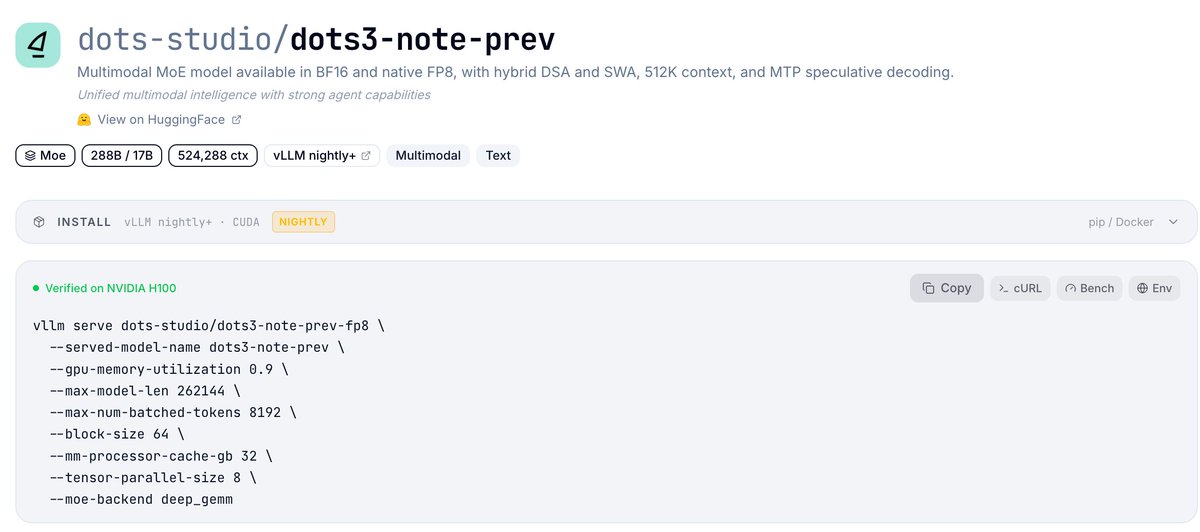
Out from @dotsstudioai under Apache 2.0, with day-0 support in vLLM. 🚀
Thanks to the @dotsstudioai team for the collaboration. 🙌
🔗 https://t.co/3ST9wsZdpU
Congrats to @dotsstudioai on open-sourcing dots3-note preview, a 280B-total / 16B-active multimodal model with 512K context, built for real-world long-horizon agentic tasks. Day-0 support is live in SGLang!
This is the model behind rednote's IMO 2026 gold. It scored 7/7 on all six problems for a perfect 42/42, a mark only 7 human contestants reached this year.
And it got there without a human formalization pass (Lean) and no proof assistant, just reasoning plus Python end to end.
It is among the first models to hit 42/42 under official grading, at roughly 1/10 the size of the others that did (Kimi K3, GPT5.6 Sol, Fable 5).
With SGLang, you could run dots3-note preview fast and excel at long and complicated agentic reasoning workflows.