Star Cape Verdean goalkeeper Vozinha and his mother will be reunited in Miami in time for the match on Sunday.
Thank you to Secretary Rubio, U.S. State Department officials, the government of Cabo Verde and FIFA for working together to make this happen.
I think it’s time to revisit the accredited investor laws in the US.
Companies are staying private longer, where only accredited investors (aka rich people!) can invest. Retail investors can only come in after IPO, when much of the upside has already been captured.
These rules were created with the best of intentions, to protect regular people from scams - a noble idea. Unfortunately, in practice they've often made it illegal to get richer, unless you're already rich. A regressive tax!
We have to judge policies based on their outcomes, not on their intentions.
These are two possible routes I see:
1) Replace the rule with something merit-based, like a financial literacy test. Pass it and you're accredited. Having a qualification based on competency rather than your bank balance or income seems far more fair.
2) Remove the rule entirely. Let consenting adults assess their own risk. Disclosure requirements stay and fraud enforcement stays to punish bad actors.
I valued SpaceX for its IPO a few weeks ago, with minimal information and a promise to revisit the valuation, when the prospectus was made public. The prospectus is public, the offering price has been set and my update is up and running. https://t.co/zRjpD1C0wv
A TON OF THINGS HAPPENED IN THE STOCK MARKET TODAY.
Here's a full recap:
1. $BTC Bitcoin’s selloff is worsening, with the price falling below $63,000 for the first time since February 24. The move has triggered a wave of forced selling across crypto markets, with more than $1.1 billion in leveraged crypto positions liquidated over the past 24 hours.
2. $AVGO reported strong Q2’26 results, with revenue of $22.19B, slightly above estimates, up 48% YoY, and adjusted EPS of $2.44, beating expectations and rising 54% YoY. Semiconductor Solutions revenue came in at $15.0B, up 79% YoY, while AI semiconductor revenue surged 143% YoY to $10.8B, though it came in below buyside expectations. For Q3, Broadcom guided revenue to roughly $29.4B, ahead of consensus but slightly below buyside expectations, with AI semiconductor revenue expected to reach about $16B. The company also delivered $10.26B in free cash flow, equal to 46% of revenue, and said growth is being driven by accelerating AI demand, custom AI accelerators, AI networking, and strong operating leverage.
3. $META is reportedly considering charging up to $199.99/month for Hatch, its planned consumer AI agent, according to The Information. Hatch is described as a consumer version of OpenClaw that lets users create software tools and automate tasks with plain-language prompts, including scheduling events, sending emails, building simple apps, and generating travel itineraries. Meta is also considering a premium Hatch Plus tier that would offer 5–10x more daily usage capacity than the free version. During development, Hatch has used Anthropic’s Claude models, but it is expected to run on Meta’s Muse Spark model at launch.
4. The top 10 most active options today by contracts traded were $NVDA with 3.4M contracts, $TSLA with 3.4M contracts, $AAPL with 1.3M contracts, $AMZN with 1.1M contracts, $MSFT with 958K contracts, $META with 916K contracts, $NOK with 749K contracts, $INTC with 730K contracts, $GOOGL with 708K contracts, and $PLTR with 622K contracts. Nvidia and Tesla once again dominated options activity, each trading more than 3.4M contracts, while Apple and Amazon also saw elevated volume above 1M contracts.
5. $IREN signed a transmission connection agreement for an 800MW data center campus in Bundey, South Australia. The site includes four 330kV feeder exits, allowing it to support up to 800MW without requiring network upgrades, with energization expected to begin in 2028. The project marks IREN’s first announced Australian data center campus and would provide submarine fiber connectivity to key APAC markets, including Singapore, Indonesia, South Korea, and Japan.
6. $AAPL Apple's smart glasses roadmap has reportedly changed, according to supply chain analyst Ming-Chi Kuo. Apple’s display-equipped AR/XR glasses, which are expected to use optical waveguide technology, have reportedly been pushed back to 2029. Meanwhile, Apple’s display-less AI glasses, similar to Ray-Ban Meta, are still expected to ship in 2027. Kuo also says Apple is shifting resources away from the Vision Pro line and toward smart glasses that may have broader mass-market appeal.
7. $GOOGL plans to use roughly $30B of its $80B equity raise to cover tax obligations tied to employee equity awards, according to The Information. That would represent nearly 40% of the total raise, roughly double last year’s amount, and about 14% of expected operating cash flow.
8. $CRWD reported solid Q1’27 results, with revenue of $1.39B, up 26% YoY, and adjusted EPS of $1.10, both slightly ahead of expectations. ARR reached $5.51B, up 24% YoY, while net new ARR grew 32% YoY to $255.8M. CrowdStrike also announced a 4-for-1 stock split, with the record date set for June 25, 2026 and split-adjusted trading expected to begin on July 2, 2026. For the full year, the company guided revenue to $5.915B–$5.959B, ARR to roughly $6.53B–$6.56B, and adjusted EPS to $4.88–$4.96, while raising its net new ARR growth outlook to 27.7% at the midpoint. Management said CrowdStrike is becoming critical AI security infrastructure, highlighting record Q1 net new ARR, strong module adoption, and its AI-driven security products as signs of an AI inflection point.
9. SpaceX $SPCX is reportedly planning to price its IPO at $135 per share, with plans to sell 555.6 million shares and raise roughly $75 billion. At that price, the company would be valued at nearly $1.75 trillion, making it one of the largest IPOs in history.
10. US data center construction spending surged 28% YoY in April to a record annualized rate of $50.7B, surpassing public transportation construction spending of $49.9B for the first time in history. Since 2022, data center construction spending has exploded 357%, compared with just 16% growth in government transportation spending. As a result, data centers now represent 2.3% of all US construction spending, highlighting how AI infrastructure demand is reshaping the construction economy.
11. Ray Dalio says AI has the ingredients of a classic technology bubble, arguing that major technological shifts often create bubbles because it is impossible for investors and companies to perfectly predict the winners. He said companies face a difficult choice: spend aggressively to capture market share, or risk underspending and falling behind. Dalio added that bubbles eventually “prick” when investors or companies need to sell wealth/assets to raise cash, turning enthusiasm into forced selling pressure.
12. The S&P 500 closed the day red for the first time in 9 trading days. The last time the S&P $SPY closed green for 10 days in a row was 1995.
WALL STREET IS THE GREATEST SHOW ON EARTH.
@charliebilello 70 months isn't a drawdown — it's a regime change. The 40-year bond bull that made 60/40 work is structurally over. With term premium repricing and fiscal dominance baked in, the real question isn't when bonds recover — it's whether the old playbook ever comes back.
Stop telling ChatGPT "Write me an email"
Stop telling ChatGPT "Write me an email"
Stop telling ChatGPT "Write me an email"
Bad request = Bad result.
Use these commands instead and you'll see the magic:
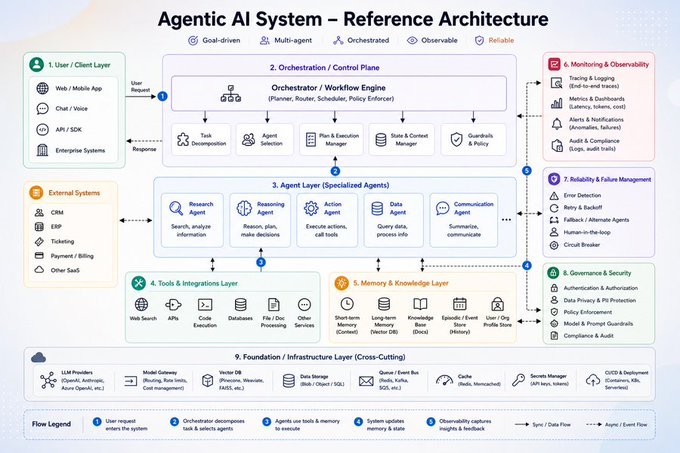
RAG vs. Graph RAG vs. Agentic RAG, clearly explained!
Standard RAG embeds documents into vectors and retrieves the most similar chunks via similarity search. For direct factual lookups, this works well.
But it breaks down when a query needs to connect facts spread across multiple documents. Similarity search retrieves individual chunks, not the relationships between them.
Graph RAG adds a knowledge graph layer on top.
→ During indexing, an LLM extracts entities and relationships from the documents.
→ During retrieval, the system traverses these connections instead of relying on embedding similarity alone.
This is what enables multi-hop queries.
Say a vector DB stores three facts about internal services:
↳ "The checkout service uses payments API."
↳ "The payments API runs on cluster-3."
↳ "Cluster-3 is scheduled for maintenance on Friday."
Someone asks: "Will the checkout service be affected by Friday's maintenance?"
Vector search can likely retrieve facts 1 and 3 because the query mentions "checkout service" and "Friday maintenance."
But it will miss fact 2, which connects the payments API to cluster-3.
That middle fact sits too far from the query in embedding space. It mentions neither "checkout" nor "maintenance," so it never makes it into the retrieved context.
A knowledge graph connects these as linked entities, and graph traversal finds the full path in one query.
Agentic RAG takes a different approach entirely.
Instead of a fixed retrieval pipeline, an LLM agent decides at query time which tools to invoke, which sources to query, and in what order.
Check the visual below to understand the three architectures thoroughly.
One thing to note here is that these three aren't levels of sophistication that you need to graduate through.
Instead, they solve different query types.
↳ Single-hop factual lookups → standard RAG
↳ Multi-hop relationship queries → Graph RAG
↳ Dynamic multi-source tasks with tool use → Agentic RAG
Once the right architecture is in place, the next leverage point is efficiency.
Most RAG architectures rely heavily on vector search, and that layer can be made 32x more memory efficient using binary quantization.
I covered the full implementation in the article below.
👉 Over to you: Which RAG architecture are you running in production?
Very hard to come up with the right valuation on $NBIS in the short term... here's how I think about it over the long term... if $NBIS gets to 5-6GW of contracted & deployed power in 2030... let's say $8-9M of revenue per MW... that's $46.75B of revenues (using the midpoints) in 2030... let's be conservative and use 20-25% ebit margins (company has guided to 20-30% ebit margins)... let's say dilution through 2030 is another 50% in order to fund the capex... that would be $10.5B of ebit in 2030... put a 20-25x multiple on that (could be higher)... we'd have a $236B market cap / 384M shares... $615 per share in 2030.
Very curious to see the actual numbers over the next 4-5 years... it's still one of our biggest positions.
There's definitely a path to $800+ per share in 2030 if revenues are higher... if margins are better... if the market multiple is bigger... if dilution is lower... lots of reasons to stay bullish on $NBIS and none of this includes their stakes in Clickhouse and AVride which could be worth $20B+ someday (combined)
Can anyone explain how to value $NBIS ?
Without using:
- it will brr brr
- bottlenecks
- the demand is outpacing supply
- asymmetric opportunity
I know a lot of folks in the market today never talk about income, as that's secondary, but I think eventually companies will have to justify the price we're paying today. I hope?
How do I know if I'm paying too much today?
How do I know how much they can still grow?
Genuinely interested to know what am I buying at the current price? Everyone is saying it's such a wonderful opportunity. I hope someone can educate me.
No ragebait, honest question.
I follow some NBIS bulls, but I never asked about it and about its opportunity.
Please let me know should I convert to NBISism.
So true Every successful product gets knocked off on Amazon, et al
Now AI let's you know off anything products, software, services in minutes
We live in a new world
8/ Go-To-Market Plan
Prompt: "You are a GTM strategist who specializes in zero-budget launches for early-stage startups. My product is [describe it], my ICP is [paste ICP from prompt 4], my unfair advantage or unique insight is [describe it], and I have no paid advertising budget for the first 90 days. Using the bullseye framework, first identify my single highest-probability acquisition channel for the first 30 customers and explain exactly why this channel and not the others.
Then give me a week-by-week action plan for 90 days broken into three phases: the first 30 days focused on finding and manually closing the first 10 customers, the next 30 days focused on understanding what made those 10 say yes and systematizing it, and the final 30 days focused on the first repeatable motion.
For each week tell me the specific actions, the expected output, and the metric I am tracking. Name the first 10 real customer targets I should go after, what I would say to each one in the first message, and exactly where I would find them."
The best GTM strategy is the one that gets to a paying customer in the fewest possible steps.
McKinsey is cool and powerful.
But Claude can do what they do for free.
Here are 8 prompts that turn any rough idea into market research, customer pain analysis, competitor maps, pricing tests, and an MVP plan in minutes 👇
@chamath It’s crazy that most comments aren’t saying to just use cowork on the Mac desktop app. Connect to a local folder with whatever assets you want to give it for context and let it cool. Keep adding whatever docs to the local folder as needed to expand context and let it cook more.