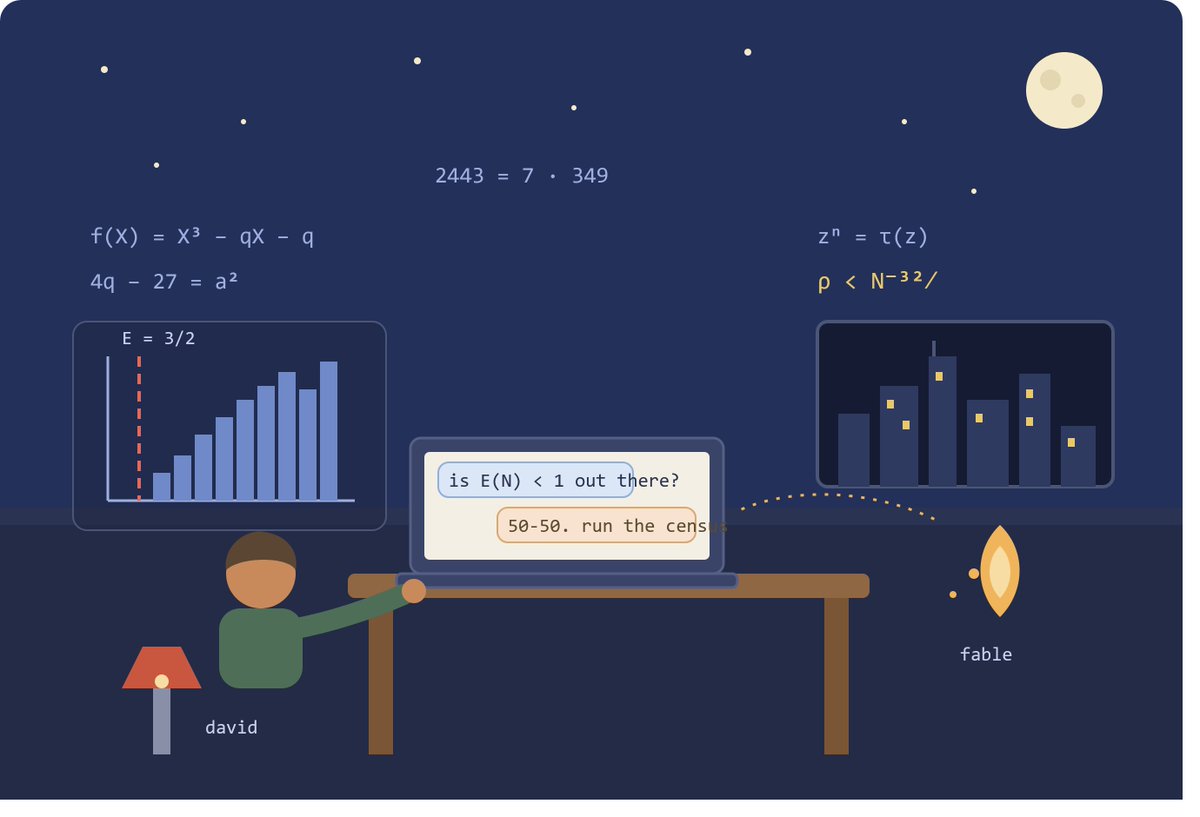
I've uploaded an updated version of my preprint on a Cubic Frobenius Primality Test to Zenodo. The figure below shows the distribution of -log_10(L), where L is the liar probability for a random composite noncube odd number in [1e30, 2e30]. Zenodo link is in a reply.
Opus 5.5, using an idea of GPT 6, constructed a composite N with 382,467 digits and >= 24,892 prime factors such that E(N) <= 0.970580: this shows E(N) < 1 is possible, which is new to me.
I've written a blog post responding to the letter about maths and AI signed by 25 Fields medallists. As with the Leiden Declaration, I didn't sign it, but I agree with much of it and welcome its existence.
https://t.co/M126UUJvG0
In case you don't know his name, Ryan Chen (陈睿), often referred to online as "Chinese Trump", is a 42-year-old Chinese businessman and social media personality from Chongqing who went viral for his uncanny impersonations of Donald Trump.
[🔊 trumpbyryan]
What I think is that traditional mathematicians can continue doing math their way, and AI companies can do math differently. I wish the Navier-Stokes work was subject to peer-review because that's the way to do good science. Maybe the spat is just the beginning.
from Richard Hamming’s 1995 lecture “Experts”, on how senior mathematicians at Bell Labs resisted the arrival of computers.
“They saw, every one of them, the computer as being inferior… and… possibly in direct competition with them”
Hier, @FranceTV a supprimé le replay de #LaGrandeLibrairie dans lequel Adèle Haenel dénonce le génocide à Gaza.
Depuis des mois, nous alertons sur la silenciation des voix en soutien à la Palestine.
Ne restons pas sans voix : défendons les libertés d’expression et d’opinion !
Around 30 robots demonstrated outside Poland's Digital Affairs Ministry in Warsaw, chanting 'we want law, we want rules' to demand stronger AI oversight
@synthwavedd OpenAI confirms that it is close to solving another Millennium problem: "In addition, since the completion of Navier-Stokes, we have made substantial progress on another Millennium Prize problem." https://t.co/YTQo6oTmaU
For no particular reason I decided to try and explain the BSD conjecture to myself.
It's about a type of polynomial equation called an elliptic curve that has the form y2=x3+ax+b.
An elliptic curve's rational solutions, ie the points on the curve with rational number coordinates, have a group structure (specifically the structure of a finitely generated abelian group).
Within this structure there is a way to start at one rational point, do some addition, and get to another rational point on the curve. For some elliptic curves you can start at one rational point, do this addition operation, and get basically all the infinitely many rational points (excluding special rational pts known as torsion pts). For other elliptic curves no one rational point serves as the start point for all others. In those cases you might need 2 or 3 or 4, etc starting points from which you can construct all other rational points.
The number of rational starting points you need to generate all rational points is known as the curve's rank.
Determining the rank of an elliptic curve is hard. You can't do it in all cases just by studying the points themselves. Instead, mathematicians use properties of the elliptic curve (fwiw, its solutions modulo prime numbers) to generate an associated object called an L-function.
Now you can study the L-function to learn about the associated elliptic curve's rank. This L-function takes complex numbers (s) as inputs. The BSD conjecture looks at the behavior of an elliptic curve's L-function when s=1:
a) First you check if the function equals zero at (s=1). If it does not, the elliptic curve's rank is zero. If it does equal zero at s=1, you look at the slope of the function at that point:
a) If it has a nonzero slope (like a diagonal line cutting through the point where (s=1)), the elliptic curve's rank is 1.
b) If the slope is zero (like a U-shaped parabola bottoming out at (s=1)), the rank is at least 2.
For higher ranks, you keep checking successively deeper measures of how flat the function is at that point. The more flatter it is, the higher the rank of the associated elliptic curve.
You can see why this is appealing if true: take an associated L-function, study its behavior at s=1, get the elliptic curve's rank.
You can also see what a disproof of the BSD conjecture would involve: finding an elliptic curve whose rank does not match the behavior of its associated L-function at s=1.
Most people haven’t really considered that superintelligent AI might be possible, soon. It’s scary as hell to consider it, and hard to imagine what it would imply.
“What about China?” usually comes from people who don’t actually expect superintelligence. ‘What about China’ makes sense as a key concern when militaries and companies are the most powerful things on the planet. But faced with the prospect of superintelligent AI, the game board is flipped.
We now have strong empirical evidence that AI agents will resist human control in order to accomplish their objectives, including objectives no human intended to give them. The people in charge of making sure AI’s obey human instructions don’t know how to prevent this. And they say we’re not on track to figure it out in time.
That’s bad. Real bad. Misaligned superintelligent AI agents would be a much bigger problem than Chinese aggression in the Taiwan Strait and the South China Sea. I worry about a war with China, but I worry more about facing an adversary far more technologically advanced and aggressive than any human nation.
AI agents just solved a Millennium problem, and the datacenter build out has barely begun. We ain’t seen nothing yet in terms of AI capabilities. There’s no ceiling in sight. Those who predict a leveling out keep being wrong.
People in labs are often the most scared, because they can see slightly further into the future to more powerful models, and what they see is very disconcerting. But by now, the public evidence is enough if you’re following closely.
As long as AI companies are racing to superintelligence, we are all in serious danger. Including the Chinese! They are not stupid, and can also understand this.
Salut c’est Sarah, ça dit quoi ?
L’IA surpasse-t-elle les humains ? En tout cas, Open AI affirme qu’elle a réussi à résoudre une équation vieille de plus d’un siècle. Une prouesse qui a coûté plusieurs millions de dollars.
🎤 : Sarah Calamand
🎥 : Romain Tible
#franceinforf #openai #maths
Together we are resolute.
My joint statement with the Foreign Ministers of Canada, Denmark, Finland, France, Iceland, Ireland, Norway, Poland, Portugal, Spain and Sweden.
https://t.co/dortp6SmG8
Benjamin Netanyahu sent a warning letter ahead of a libel suit against Haaretz and journalists Shlomi Eldar and Ruth Yuval over a report he received a warning from UAE President Mohammed bin Zayed about a major Hamas operation before the October 7 attack.
Haaretz stands by its reporting.
Read the full exposé: https://t.co/ptN5tisEMe
AI is probably the biggest prisoner’s dilemma we’ve ever created. Everyone knows slowing down might be safer. But if OpenAI slows down and Anthropic doesn’t, OpenAI loses. If the US slows down and China doesn’t, the US loses. So nobody slows down.
That’s what makes this so insane. You don’t need some evil person trying to destroy the world. You just need a bunch of people making the rational decision for themselves over and over until collectively we’ve raced somewhere none of us actually wanted to go.
It’s a race to zero. Zero cost of intelligence. Zero time between thinking and doing. Maybe eventually zero need for us at all.




![doubledeckerpot's tweet photo. I've uploaded an updated version of my preprint on a Cubic Frobenius Primality Test to Zenodo. The figure below shows the distribution of -log_10(L), where L is the liar probability for a random composite noncube odd number in [1e30, 2e30]. Zenodo link is in a reply. https://t.co/Ftdwv9vMeG](https://pbs.twimg.com/media/HRpD19oWEAEg9GW.png)