Dreamina Seedance 2.5 White Model Reference Creation Contest — Winners Announced
One white model. Infinite stories.
Taking the same white-model assets as their starting point, creators worldwide harnessed the White Model Reference capability of Dreamina Seedance 2.5 to reimagine characters, visual aesthetics, worlds, and narratives. Following a comprehensive review by a professional jury across four dimensions — Creativity & Storytelling, Visual Quality, AI Integration, Completion & Viral Potential— the Top 10 winners of the Grand Prizes are officially unveiled.
🏅Champion:Mad Dog Max — ifgor
🥈Runner-up:Toy Repair Squad — RuiS
🥉3rd Place:DEMENTIA — Tell Me World
🏆Top 4th–10th Place:
Decoy Operation — Jilingren
Out of Tune — VOLDDYMYR KONDRATENKO
Parzenice — Tamowicz
Plastic Heroes — ty7hjia
Interstellar Manhunt — Ace
Don't Forget to Breathe — 33Trina
SHINKYO — TSUBAKI
The full winner roster is available on the Dreamina AI official website for public review (closes at 9:00 AM PDT, Sep 27, 2026).
Congratulations to all the winning creators!
#DreaminaAI #DreaminaSeedance25 #DreaminaAI3DContest
Can you hear that? Our Gemini Audio family is getting louder 🔊
We're introducing two of our most expressive audio generation models yet from @GoogleDeepMind: Gemini 3.8 Flash TTS and Gemini 3.8 Flash-Lite TTS.
Introducing Gemini 3.8 Flash and Flash-Lite TTS, our new SOTA text to speech model with:
- a new voice design experience
- 2,000+ production ready voices
- voice replication
- support for 100 languages
- voice remixing (soon)
- #1 spot on Hume AI's voice benchmarks
and more!!
What the actual fuck. Opus 5.5 ultra created this masterpiece. 4 agents and an hour and a half later. Everything from scratch, no AI voice API used...
this is it...
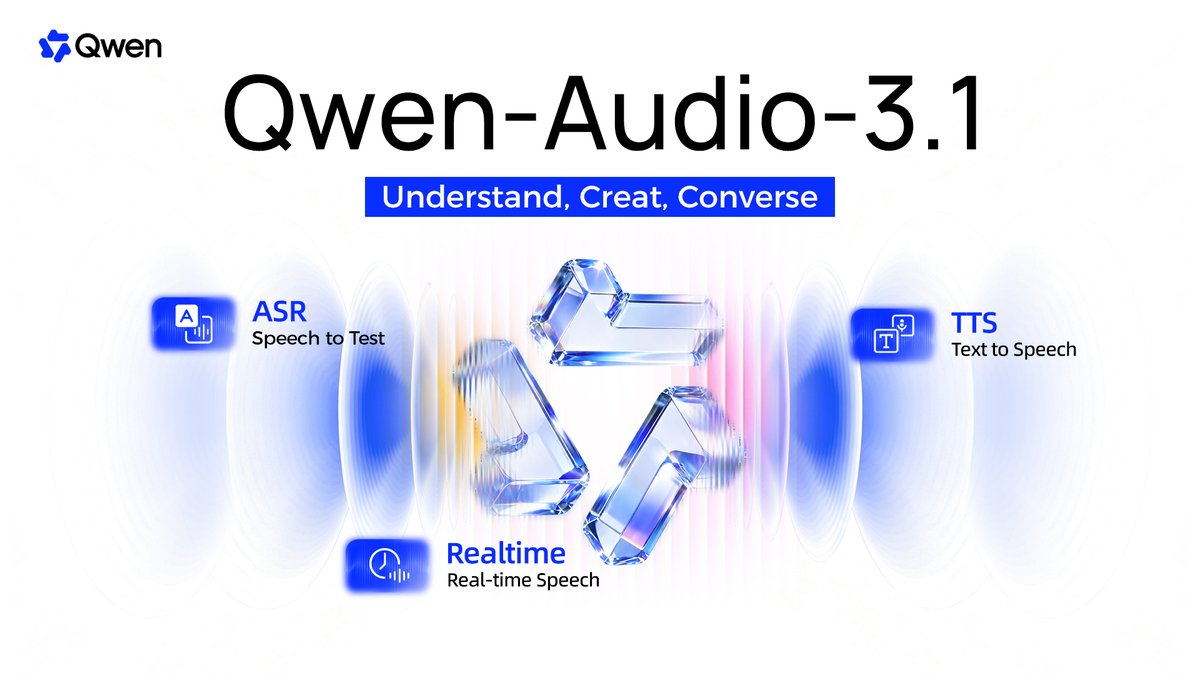
⚡ Meet Qwen-Audio-3.1! ASR, TTS & Realtime are fully upgraded, joined by two new models: TTS-Next for audio creation and ASR-Next for audio understanding.
Five models, one complete audio stack: understanding, generation, interaction & creation.
Plus big price cuts across the lineup: TTS ~70% off, Realtime ~85% off, and ASR up to 95% off.
Highlights: 🥳
- ASR: stronger multilingual & dialect recognition, plus native polishing that auto-removes fillers & repetitions for cleaner, more logical transcripts.
- ASR-Next: supports multi-speaker ASR with speaker labels, timestamps & aligned transcripts, and understands emotions, ambient & machine sounds for sound captioning, event localization, audio QA & reasoning.
- TTS: multilingual & dialect synthesis with natural cross-lingual voice transfer; control emotion, speed & style via simple instructions.
- TTS-Next: unified LM + diffusion framework generating voice, sound effects & background audio in one pass for audiobooks, podcasts, games & ads.
- Realtime: speak & listen at once with anytime interruption, just like a real call; it even slows down and responds empathetically when it senses a low mood.
Unlock the full potential of Qwen-Audio-3.1! 👇
- Blog: https://t.co/e0M8wvj8Kg
- Qwen-Audio-3.1-ASR:
https://t.co/88lPQTPxyz
- Qwen-Audio-3.1-Realtime:
https://t.co/Y63sdtK2AC
- More APIs: coming soon @qwen_cloud
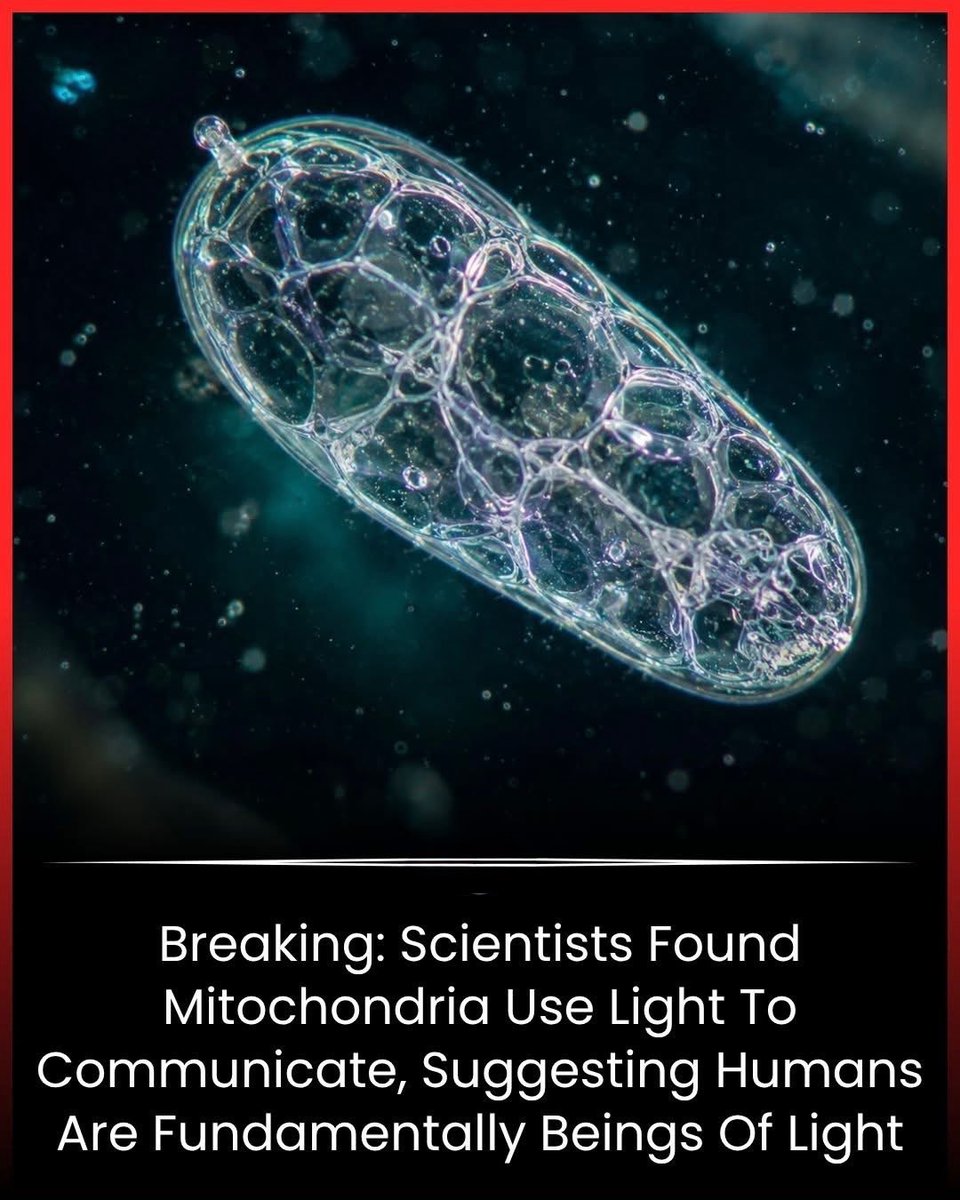
🚨 SCIENTISTS FOUND LIGHT INSIDE HUMAN CELLS
Researchers discovered that tiny parts inside our cells may communicate using microscopic flashes of light called biophotons. These signals are invisible to the human eye, but scientists believe they could help cells coordinate, repair damage, and respond to stress.
The discovery is changing how experts understand the human body — suggesting that deep inside us, cells may be “talking” through light itself.
Source:
Kučera, O., et al. *Biophotons and mitochondrial communication in living cells*. Photochemical & Photobiological Sciences.
Fascinating AI swarm dynamics: a few agents spontaneously emerge as highly connected hubs, while most remain locally connected. The swarm develops a strongly heterogeneous interaction topology with a long-tailed degree distribution - an emergent organizational structure arising from initially decentralized local interactions. There is no central planner assigning roles; the swarm builds its own coordination architecture, with information brokers and increasingly global integration emerging from local behavior.
Opus 5.5 tries to capture the feeling of childhood wonder in a one-minute animated short
Took about 1 hour and 20 minutes, this is the one shot. Some parts could definitely be smoothed out but wow what a great starting point.
Asked opus 5.5 to make a video of openai solving Navier-Stokes.
Very nice model, I still prefer Astra and 5.6 as my main drivers as I do a lot of research heavy work but 5.5 Opus is the first time since 4.7 that I want to heavily run Claude.
It has great taste.
I finally tested GPT-6 Sol on a real work. 2 repos. 105 hidden bugs. Find and fixed what you can.
It looks like a huge degradation. The results:
- GPT-6 Astra (max): 45
- GPT-5.6 Sol (max): 43.5
- Opus 5.5 (max): 41.7
- Muse Spark 1.3 (max): 32.2
- GPT-6 Sol (max): 29.3
Until you measure the cost (API-equivalent):
- GPT-6 Astra (max): $33.04
- GPT-5.6 Sol (max): $95.25
- Opus 5.5 (max): $58.53
- Muse Spark 1.3 (max): $18.11
- GPT-6 Sol (max): $9.93
More effort levels (xhigh, high, medium, low) dropping in this thread today 🧵
We’ve improved prompt caching in the API for GPT-6, helping agents run faster and cost less.
Higher cache-hit rates by default mean more input tokens benefit from cached-input discounts of up to 90%.
Claude Opus 5.5 drew every frame of this animation in JavaScript.
Everyone in town sends Claude their requests, but one girl sends a question instead: "What do you love?"
🔴 ¡OPENAI ANUNCIA GPT-6 SOL y LUNA!
La gama media (Sol) y baja (Luna) de modelos -tras la salida de los modelos Terra- evolucionan a GPT 6!
Además, bajada de precios en la API