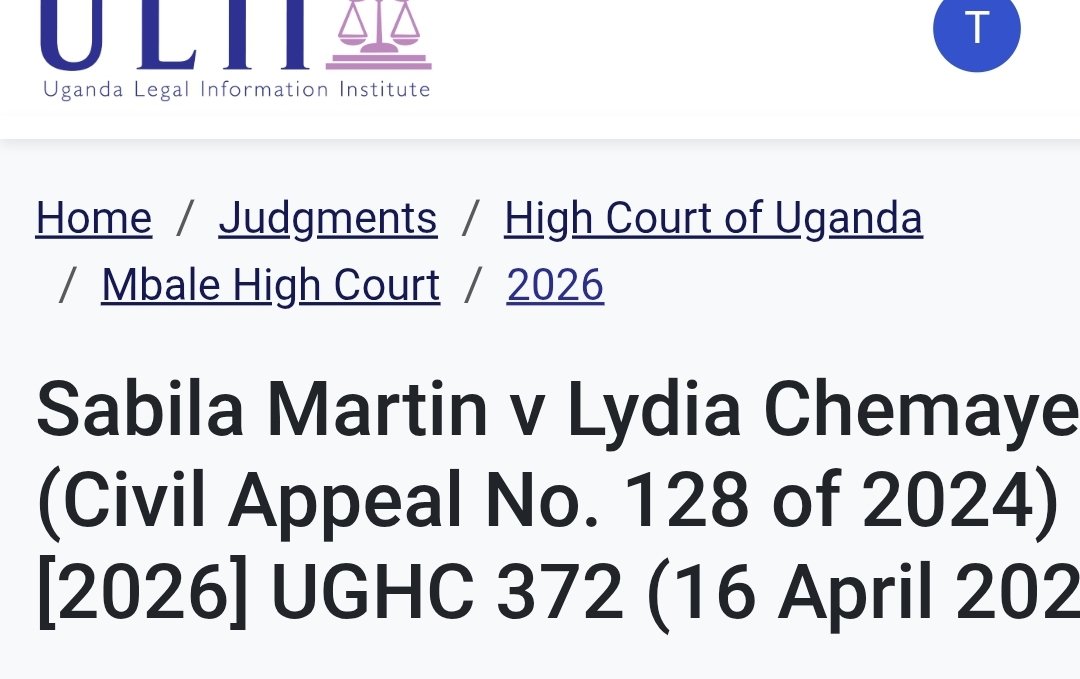
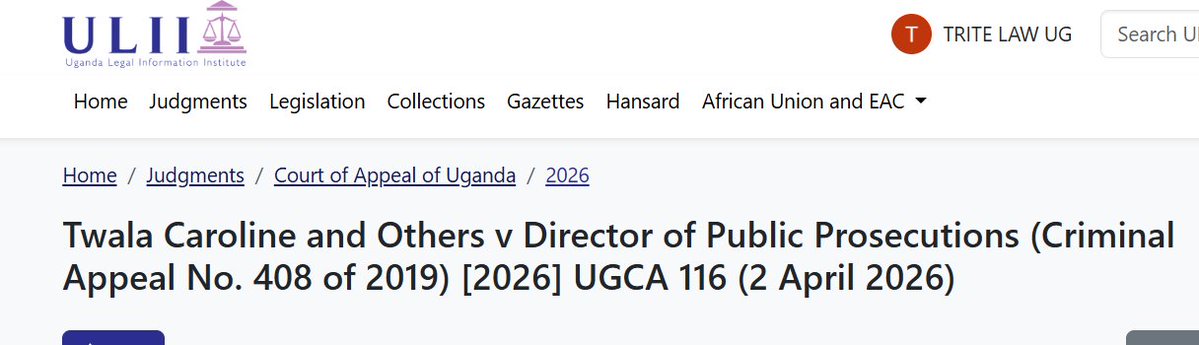
Supreme Court Holds That Where a Public Authority Defers, Rather Than Refuses, Performance of Its Duty, the Rule 5(1) Judicial Review Limitation Period Runs From the Final Administrative Decision, Not the Initial Default.
Writing for a unanimous coram, Bamugemereire, JSC held that where a public authority repeatedly defers the deployment of a validly appointed officer while making ongoing assurances that deployment will follow, the limitation period under Rule 5(1) of the Judicature (Judicial Review) Rules, 2009 does not begin to run until the authority communicates a definitive, final refusal.
The Court further held that an appointee who never commenced duty cannot recover salary arrears or NSSF contributions, but may nonetheless be entitled to general damages for the administrative wrong suffered. The decision carries significant implications for public bodies that manage appointment backlogs through informal deferrals rather than formal decisions.
Read more
https://t.co/Wd1xlgLMbm
What's the purpose of an LDC @LDC_Uganda Graduation Ceremony/Certificate when an LDC Graduate cannot practice law before a court of Law?
LDC Graduation ceremony should be replaced by the Advocates Enrolment Ceremony after all LDC is regulated by the Law Council!
While serving on ULS Council these are some of the issues we had raised with the Minister of Justice, Chief Registrar and Law Council.
Subjecting LDC Graduates @LawStudentsUg to the unnecessary process of enrolment while they can't practice law tantamounts to violation of their right to practice their Proffession and earn a living.
The Advocates Act should have been Amended as early as yesterday and I hope the @ug_lawsociety is pursuing the Amendments besides abolishing LDC!
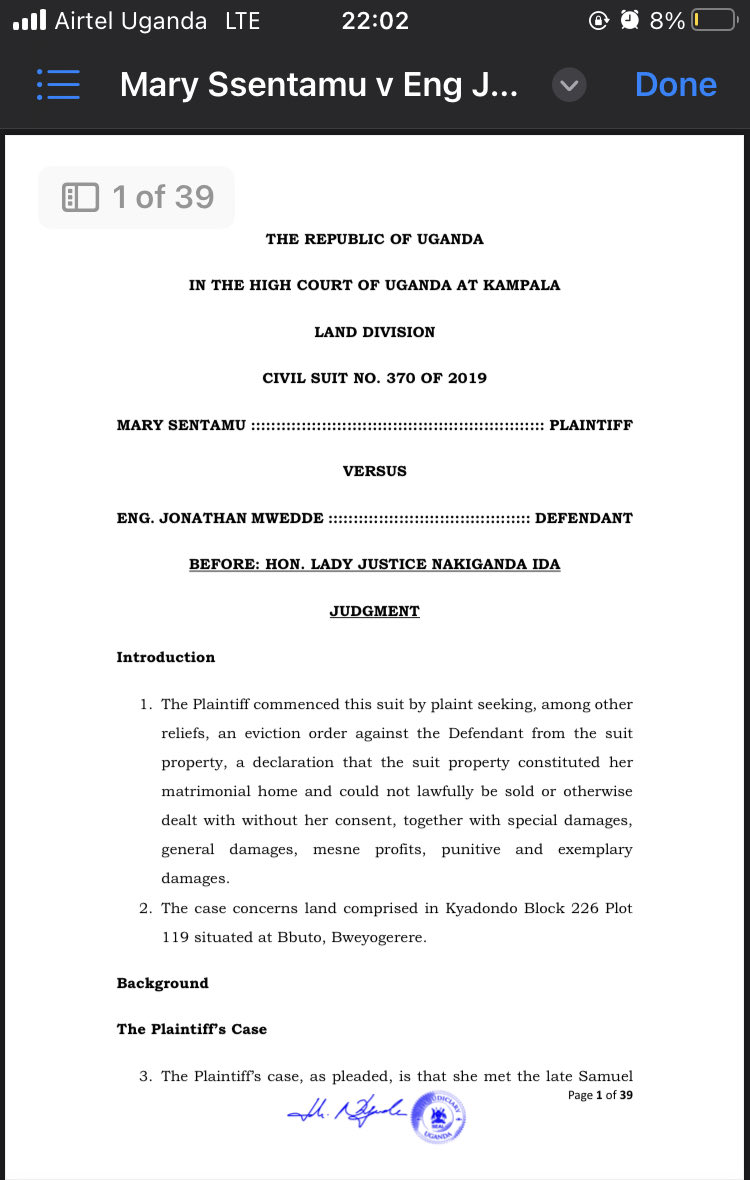
A TITLE DEED IS NOT AN EVICTION NOTICE!
Can a purchaser inspect land, find a wife and children living in the family home, assume that the wife consented to the sale, obtain a certificate of title and later remove the family using private security?
The High Court’s answer in Mary Ssentamu v Eng. Jonathan Mwedde (2026) was clear: No.
The Court found that the land was family land, even though it was not matrimonial property. The distinction matters. Matrimonial property and family land are not interchangeable legal concepts. Land may fall outside the strict definition of matrimonial property but still attract the statutory protection accorded to family land under the Land Act.
The Court’s most outstanding statement was:
“Occupation is itself notice of possible equitable rights. Good faith demands more than assumptions.”
That statement may significantly reshape how purchasers conduct land due diligence.
The Defendant had physically visited the property and found the Plaintiff, her husband and their children living there. The Plaintiff even showed him around the home. Yet, the Defendant did not obtain her written consent and merely assumed that she had agreed to the transaction.
The Court held that this was insufficient.
THE CRITICAL LESSON
A land search is important but it is not the entire due-diligence process.
A purchaser who finds a family in occupation cannot simply inspect the title, pay the purchase price and close the file. Physical occupation may reveal interests that are not immediately visible on the certificate of title.
The buyer must ask:
• Who lives on the land?
• What is the nature of their occupation?
• Is the land a family home?
• Is spousal consent legally required?
• Has the spouse given the consent in the form prescribed by law?
The Court found that the Defendant’s title had been acquired without the required spousal consent and ordered its cancellation. The land reverted to the estate from which the Defendant had purportedly acquired it.
But the judgment went further.
The Defendant argued that, as the registered proprietor, he was entitled to remove the occupants. The Court rejected the manner in which this was done and emphasised:
“Registration of title is not a license to evict occupants without judicial sanction or to dispossess persons by private force.”
The use of private security did not replace the need for a lawful court process. Ownership may confer rights, but those rights must be enforced through lawful procedures not self-help.
THE IMPLICATIONS
For purchasers: Do not buy with your eyes fixed only on the title. Look at the people occupying the land too.
For advocates: A title search alone may not be sufficient. Due diligence must include inquiries into possession, family occupation and spousal interests.
For spouses: Long-term occupation of a family home may create legally protectable interests, even where the spouse is not the registered proprietor.
For landowners: A title deed is not a private eviction order. The courts not force must determine and enforce rights of possession.
The deeper message is simple:
Land law protects more than paper ownership. It also protects lawful interests, family homes and the rule of law.
#LandLaw #FamilyLand
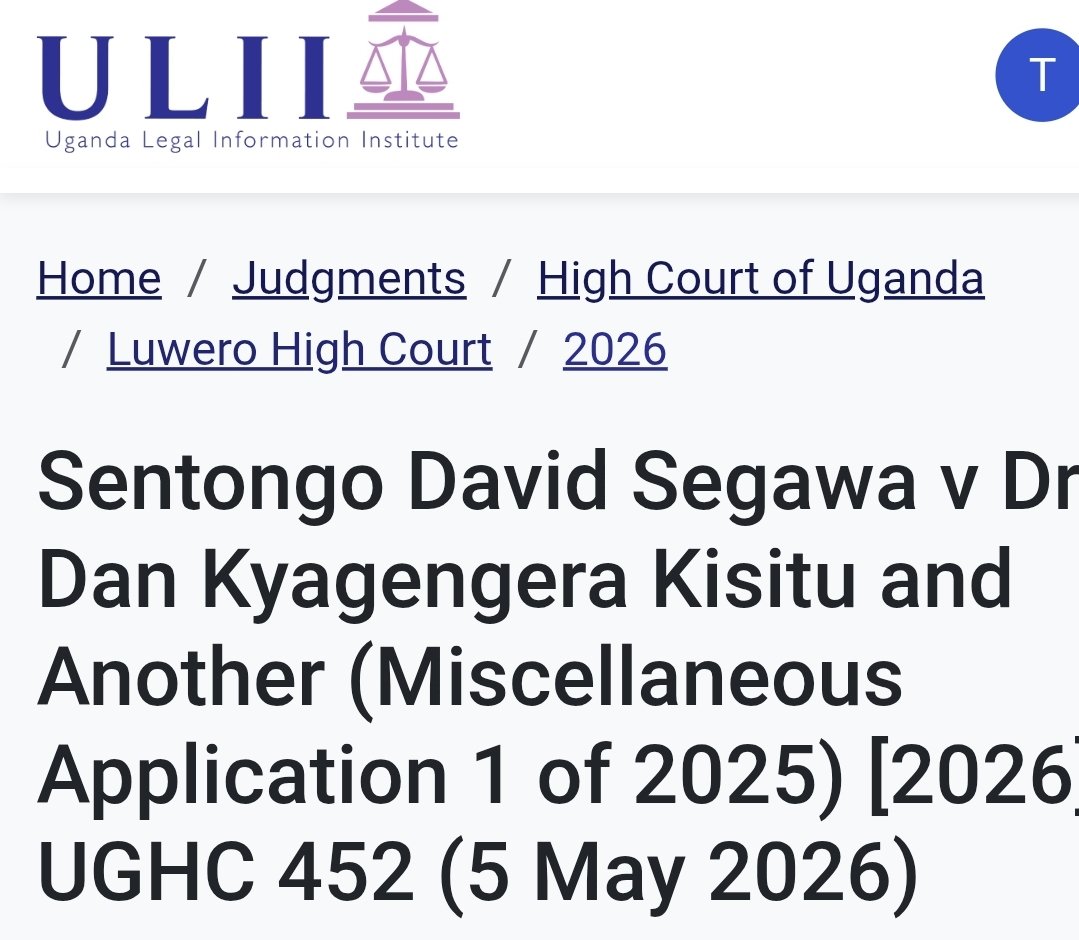
Mubiru J order Power FOAM (U) to pay USD 20075 debt,✍️An oral supply of goods evidenced by invoices and partial payment is enforceable✍️ principle of equity is that if a contract that should be in writing is not in writing, that does not eliminate the possibility of its enforceability✍️A debtor’s denial of receiving invoiced goods is inconsequential if they have subsequently made a partial payment on that same invoice
✍️A debtor’s denial of receiving invoiced goods is inconsequential if they have subsequently made a partial payment on that same invoice. The defendant did not claim that the payment was made under a mistake or solely for a completely separate transaction.
✍️making a voluntary partial payment, the defendant validated the underlying transaction and acknowledged that the debt is owed. This act was deemed to be acceptance of the delivery and waives the right to dispute the receipt of goods after the fact, by reason of estoppel as provided for under section 114 of The Evidence Act, a party is prevented from taking inconsistent positions.
✍️By paying a portion of the sum, the debtor is legally estopped from denying the existence of the contract or the receipt of the underlying goods.
✍️Courts consider partial payment as unequivocal conduct acknowledging the validity of the debt. This principle applies unless the debtor can provide clear evidence that the payment was made under protest , explicitly under duress or with an explicit denial of liability.
✍️If a debtor acts as though an obligation exists by making a part payment, they cannot later claim the goods were never delivered to escape paying the remaining balance
Appearances;
For the plaintiff : M/s Bashasha & Co. Advocates,
For the defendant : M/s Odokel Opolot & Co. Advocates
Delivered on 26-June-2026
Case link: https://t.co/haWYucolKx
Insolvency Is Not a Shield Against Judgment Debts
"Liquidation is a mode of debt recovery of last resort, but a mode nonetheless." — Lady Justice Patience T.E. Rubagumya.
The Commercial Court has reaffirmed a critical principle in Uganda's insolvency jurisprudence.
In China Nanjing International Ltd v Eco Petrol (U) Ltd, the Court rejected the argument that winding-up proceedings cannot be used to recover debts. Where a debt is undisputed, execution has been returned unsatisfied, and a company has failed to comply with a statutory demand, liquidation becomes a legitimate legal remedy not an abuse of process.
Court held that non-compliance with a statutory demand and an unsatisfied judgment debt were sufficient to presume inability to pay, ultimately ordering the company's liquidation and appointing the Official Receiver as provisional liquidator.
This decision sends a clear message to judgment debtors: continuing to trade is not, by itself, a defence against insolvency proceedings where an admitted debt remains unpaid.
Case: China Nanjing International Ltd v Eco Petrol (U) Ltd, Insolvency Petition No. 01 of 2026 (Commercial Division, 21 July 2026).
#Insolvency
Justice Lubega✍️Squatters are entitled to compensation for developments made on land under the law of equity where the developments were made with the knowledge of the controlling authority, ✍️even if the defendants are neither bona fide nor lawful occupants of the disputed land.
Legal Representation:
Plaintiff: Mr. Nangulu Eddie of M/s Nangulu & Mugoda Advocates
Defendants: Mr. Watulo Cornelius of M/s Sanywa, Wabwire & Co. Advocates
Case link: https://t.co/w9Kk3H5Gfw
Court of Appeal is not vested with jurisdiction to entertain an Appeal arising from a decision of the High Court made in the exercise of its revisionary powers ✍️The absence of an express right of appeal is fatal
Legal Representation
Appellant: Mr. Albert Mooli Sebutta, Mr. Mutessaira Jesphat, Ms. Namaganda Christine and Ms. Namiwulya Rachael
Respondent: Mr. Semalemba Peter, holding brief for Ms. Innocent Aleto,
Case link:
https://t.co/9Ib4dr0Ddx
Industrial Court Clarifies That Removal of an Employee's Work Tools Without Due Process Constitutes Unlawful Dismissal
The Court restated that a lawful dismissal requires both Procedural fairness, written notice, adequate time to prepare a defence, particulars of the allegations, and an explanation of hearing rights (citing Ebiju v Umeme Ltd); and Substantive fairness, a credible, verifiable reason amounting to a fundamental breach of contract, tested through a hearing (citing Uganda Breweries Ltd v Kigula).
Read more
https://t.co/DsZRWo5QSB
Kyofuna Jaridah v Kibuli Muslim Hospital and Another (Civil Suit No. 319 of 2019) [2026] UGHCCD 224 (15 July 2026)
Hospital held liable in tort for negligent neonatal care; the court found cumulative failures materially contributed to the infant's death and awarded damages totaling UGX 147,368,600/=
����:https://t.co/HNXoRVr7xT
I argued this case against Bunyangabu District Local Government, the CAO, the PS @Educ_SportsUg & the AG. Client is happy.
It's a nice decision on exceptions to the time limitation for instituting Judicial review matters.
Court while relying the concept of 'a continuing administrative
wrong' ruled that;
"...where a public authority fails to act on its own internal disciplinary processes and creates an administrative deadlock, the court's supervisory jurisdiction must be unlocked."
Kudos to @EsomuPeter for legal research support. @TenderiRaphael made sure everything that needed to be served was served on time.
If you want to read the entire ruling click on the link below.👇
Baluku Godwin Kikumu v Bunyangabu District Local Government and Others (HCT-01-CV-MC-0002-2026) [2026] UGHC 707 (30 June 2026) – ULII https://t.co/nTuKDRkD16
In George William Kalule vs. Norah Nassozi & Another; Civil Appeal No.29 of 2014 (September 15, 2017) Court of Appeal (per Buteera, Kakuru & Cheborion, JJA) invoked long term occupation in the absence of executed transfer forms to uphold a verbal gift of registered land👇🏿.
ICYMI
HIGH COURT REAFFIRMS REQUIREMENTS FOR GIFTS INTER VIVOS AND SUGGESTS ADDING A FOURTH CONDITION TO THE EXISTING LEGAL FRAMEWORK
The court suggested adding a fourth condition to the existing legal framework, on the legal principles governing gifts inter vivos making the full criteria:
📌The donor must have an intention to give the gift.
📌The donor must transfer the gift by executing a legally appropriate instrument based on the nature of land ownership.
📌The donor must deliver the property to the donee.
📌The donee must accept the gift.
Read more
https://t.co/8V9d2OzpLf
Court of Appeal in ⬇️noted✍
its settled law that attaching of the copies of National Identity Card by deponents purporting to be registered voters,is not proof that they are registered voters✍Proof must be by a proper & validly procured extract of the National Voters’ Register
Bukirwa J overrules OP 4 failure 2 attach a WSD 2 an Application 4 leave 2 appear & defend ✍️O36 CPR does not expressly require an Applicant to annex a draft WSD✍️While it may be considered good practice 2 annex a draft WSD its absence is not, in itself, fatal to the Application
Kuteesa Sam Kahamba v Alice Nambooze Osaga (Miscellaneous Application 85 of 2025) [2026] UGHC 456 (30 April 2026)
Security for costs refused where plaint was not frivolous and residence abroad or lack of local assets alone was insufficient.
👉:https://t.co/netaJbtXWw
Nalujja Federesi v Nabbosa Scovia (Miscellaneous Cause No. 32 of 2025) [2026] UGHC 450 (5 May 2026)
Decree-holder may execute a consent decree despite a caveat, but removing a deceased caveator’s caveat requires notice or joining the estate.
👉:https://t.co/ghhSISlfBg
In the matter of the Estate of Late Muhakanizi Keith (Miscellaneous Application No. 443 of 2026) [2026] UGHCFD 33 (31 March 2026)
Court granted conditional renewal of letters of administration for pension and non-pension assets, subject to filing an account within one month.
👉:https://t.co/GeGNzyWVya
Lubega J Reaffirms that customary distribution of an intestate estate maybe regarded as valid where it is properly undertaken and no beneficiary raises any dispute or contention✍️ However, where disputes arise, as in thepresent case, the question of legality becomes paramount.


![apollo_morgan's tweet photo. I argued this case against Bunyangabu District Local Government, the CAO, the PS @Educ_SportsUg & the AG. Client is happy.
It's a nice decision on exceptions to the time limitation for instituting Judicial review matters.
Court while relying the concept of 'a continuing administrative
wrong' ruled that;
"...where a public authority fails to act on its own internal disciplinary processes and creates an administrative deadlock, the court's supervisory jurisdiction must be unlocked."
Kudos to @EsomuPeter for legal research support. @TenderiRaphael made sure everything that needed to be served was served on time.
If you want to read the entire ruling click on the link below.👇
Baluku Godwin Kikumu v Bunyangabu District Local Government and Others (HCT-01-CV-MC-0002-2026) [2026] UGHC 707 (30 June 2026) – ULII https://t.co/nTuKDRkD16](https://pbs.twimg.com/media/HM9mWhPXIAANWm4.jpg)





![Uganda_LII's tweet photo. Kyofuna Jaridah v Kibuli Muslim Hospital and Another (Civil Suit No. 319 of 2019) [2026] UGHCCD 224 (15 July 2026)
Hospital held liable in tort for negligent neonatal care; the court found cumulative failures materially contributed to the infant's death and awarded damages totaling UGX 147,368,600/=
����:https://t.co/HNXoRVr7xT](https://pbs.twimg.com/media/HNXEQsFXIAA6kfE.jpg)
![apollo_morgan's tweet photo. I argued this case against Bunyangabu District Local Government, the CAO, the PS @Educ_SportsUg & the AG. Client is happy.
It's a nice decision on exceptions to the time limitation for instituting Judicial review matters.
Court while relying the concept of 'a continuing administrative
wrong' ruled that;
"...where a public authority fails to act on its own internal disciplinary processes and creates an administrative deadlock, the court's supervisory jurisdiction must be unlocked."
Kudos to @EsomuPeter for legal research support. @TenderiRaphael made sure everything that needed to be served was served on time.
If you want to read the entire ruling click on the link below.👇
Baluku Godwin Kikumu v Bunyangabu District Local Government and Others (HCT-01-CV-MC-0002-2026) [2026] UGHC 707 (30 June 2026) – ULII https://t.co/nTuKDRkD16](https://pbs.twimg.com/media/HM9mXCtXcAAmJnV.jpg)


![Uganda_LII's tweet photo. Kuteesa Sam Kahamba v Alice Nambooze Osaga (Miscellaneous Application 85 of 2025) [2026] UGHC 456 (30 April 2026)
Security for costs refused where plaint was not frivolous and residence abroad or lack of local assets alone was insufficient.
👉:https://t.co/netaJbtXWw](https://pbs.twimg.com/media/HHtBUz4WAAMQin8.jpg)
![Uganda_LII's tweet photo. Nalujja Federesi v Nabbosa Scovia (Miscellaneous Cause No. 32 of 2025) [2026] UGHC 450 (5 May 2026)
Decree-holder may execute a consent decree despite a caveat, but removing a deceased caveator’s caveat requires notice or joining the estate.
👉:https://t.co/ghhSISlfBg](https://pbs.twimg.com/media/HHlZB6iXAAYSNg7.jpg)
![Uganda_LII's tweet photo. In the matter of the Estate of Late Muhakanizi Keith (Miscellaneous Application No. 443 of 2026) [2026] UGHCFD 33 (31 March 2026)
Court granted conditional renewal of letters of administration for pension and non-pension assets, subject to filing an account within one month.
👉:https://t.co/GeGNzyWVya](https://pbs.twimg.com/media/HHc4Kt4XIAAS9i5.jpg)