La última carta de Indio
"Hay un ruido de platos vacíos en la Argentina.
Un sonido áspero.
Como ascensores cayendo dentro de hospitales apagados.
Como tizas partidas sobre pizarrones gastados en escuelas que ya no llegan a fin de mes.
Y mientras desde arriba venden épica financiera con sonrisa televisiva, abajo la realidad mastica gente.
Los jubilados cuentan monedas como si fueran balas sobrevivientes de una guerra perdida.
Les licuaron la vida despacito.
Primero los remedios.
Después la comida.
Después la dignidad de tener que elegir entre calefacción o un paquete de arroz.
Y todavía aparecen predicadores del ajuste diciendo que el sufrimiento “era necesario”.
Como si el hambre fuese una materia universitaria.
Como si ver ancianos revolviendo descuentos fuera parte del equilibrio fiscal.
Los laburantes tampoco llegan.
El sueldo dura menos que un semáforo en verde.
El consumo se desplomó porque ya no se compra: se sobrevive.
La heladera parece un teatro abandonado después del saqueo.
Y en las calles hay persianas bajas como párpados cansados.
Construcciones detenidas.
Fábricas respirando por tubos.
Comercios vacíos donde antes había ruido de monedas y olor a pan caliente.
La recesión avanza como hollín pegado detrás de las paredes.
Silenciosa.
Espesa.
Entrando en las casas mientras algunos influencers del mercado festejan numeritos como si la economía fuera un videojuego sin cadáveres.
También le metieron motosierra a la educación y a la salud.
Universidades asfixiadas.
Hospitales universitarios peleando por insumos básicos.
Docentes agotados enseñando entre ruinas presupuestarias y techos que lloran goteras.
Pero en la televisión hablan de libertad.
Siempre libertad.
Aunque millones estén cada vez más presos del miedo, de las deudas, de la angustia de perder el trabajo.
Y entonces aparece el gran truco del circo:
hacerte creer que la crueldad es valentía.
Que insultar es gobernar.
Que destruir es sincerarse.
Que el ajuste sobre los cuerpos cansados del pueblo es una especie de purificación divina.
Hay fanáticos aplaudiendo el incendio mientras el humo les entra por debajo de la puerta.
Gente defendiendo verdugos porque aprendieron a odiar más de lo que aprendieron a pensar.
Y lo más oscuro no es el personaje delirante que grita desde el escenario.
Lo verdaderamente oscuro es una sociedad agotada, partida, furiosa…
que empezó a normalizar que le rompan el alma a los más débiles mientras le llaman “cambio” al derrumbe.
La Argentina no se está quedando sin plata solamente.
Se está quedando sin alma.
Sin paciencia.
Sin futuro.
Y cuidado…
porque cuando un pueblo ya no siente el dolor del otro,
el monstruo deja de gobernar desde arriba.
Empieza a vivir adentro de todos".
INDIO
*
Su última carta.
"Les pido a ustedes (al Gobierno) que si tienen un poquito de sentido común por la Argentina, dejen que este hombre se despida como la gente. Por TODOS NOSOTROS"
Este tipazo CARGADO DE VERDADES se descargó adelante del micrófono 👏👏
📣 Tenemos el agrado de comunicar el ganador del concurso de logo de las Jornadas 2026 de la SBBM.
Felicitamos a ✨ Marcel Bentancor ✨
Agradecemos a todas las personas que enviaron sus propuestas.
¡Gracias por ser parte! 🙌
¡Nos vemos en las próximas Jornadas! 🧪🔬🧬
Los dibujos de Leonardo da Vinci constituyen el núcleo científico y creativo más importante de su legado.
Debido a que solo sobreviven alrededor de 20 de sus pinturas tradicionales, sus apuntes gráficos son la principal ventana hacia su pensamiento lógico y artístico.
•Anatomía:
Fuera de los temas bélicos, sus cuadernos y hojas sueltas abarcan disciplinas universales:
Estudios óseos y musculares sumamente precisos mediante la disección de cadáveres humanos y animales.
•Ingeniería y maquinaria: Planos revolucionarios de máquinas voladoras, puentes portátiles y carros de combate armados.
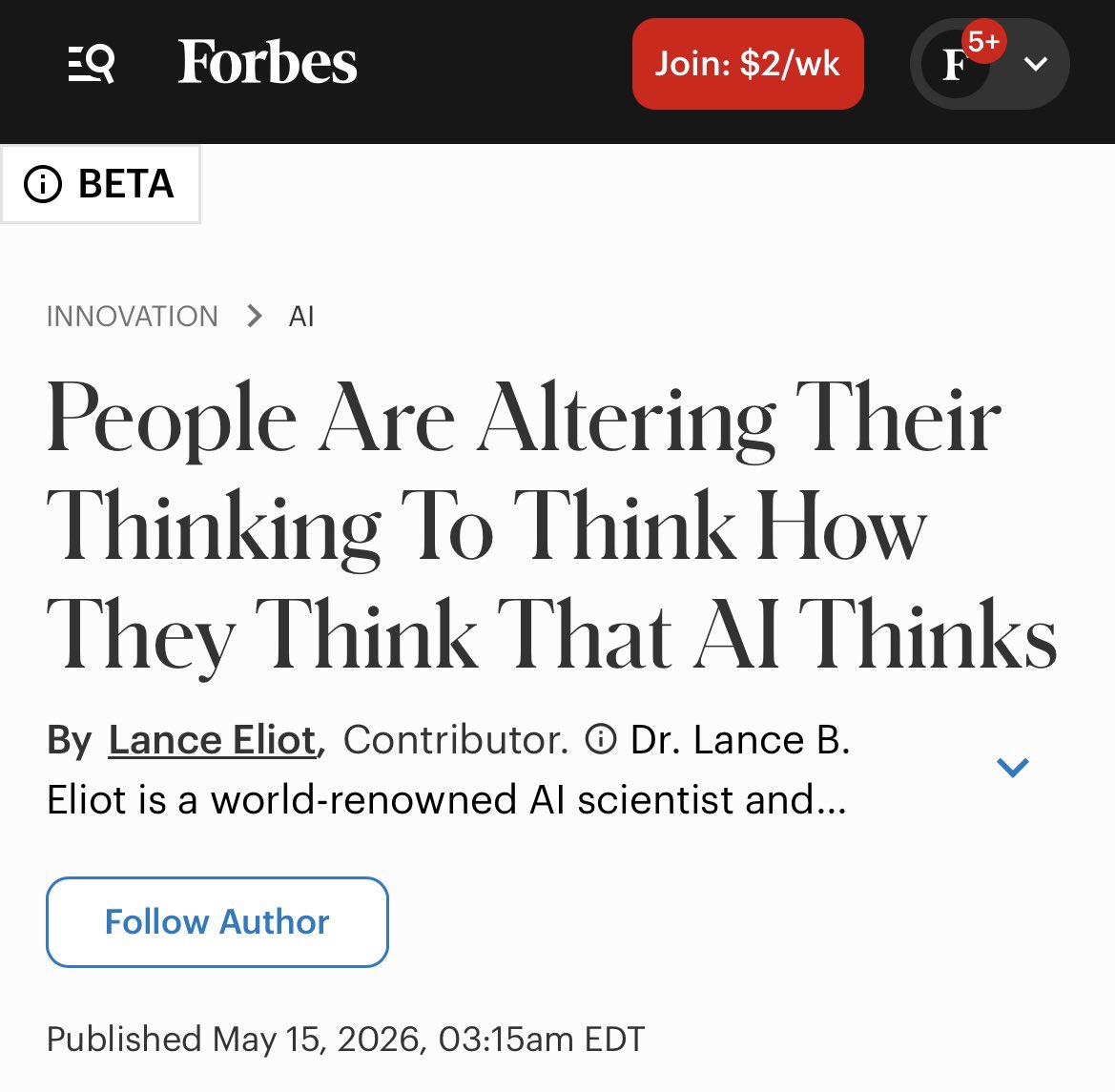
Something unexpected, and slightly worrying, is happening.
Ten days ago, I posted a preprint introducing the concept of LLMorphism: the biased belief that human cognition works like a large language model.
The preprint received an unusual amount of attention.
Hundreds of comments on social media and forums.
Reels on Instagram and TikTok.
YouTube videos.
Infographics for students.
And now it has even made it to Forbes.
It seems that I got some sort of zeitgeist.
Many people were already thinking about this.
Many people had already experienced it.
But they were missing a name and a theoretical framework.
So, here it goes:
LLMorphism is what happens when people start to see themselves as language models.
The psychological mechanism is analogical trasfer combined with metaphorical availability: LLMs become an available metaphor for cognition, and people project that metaphor back onto themselves.
The machine becomes the model of the human.
And this worries me because the risk is not only that we overestimate machines.
It is also that we underestimate ourselves: our embodied experience, our goals, our emotions, our responsibility, and our capacity for understanding.
*
Full paper in the first reply.
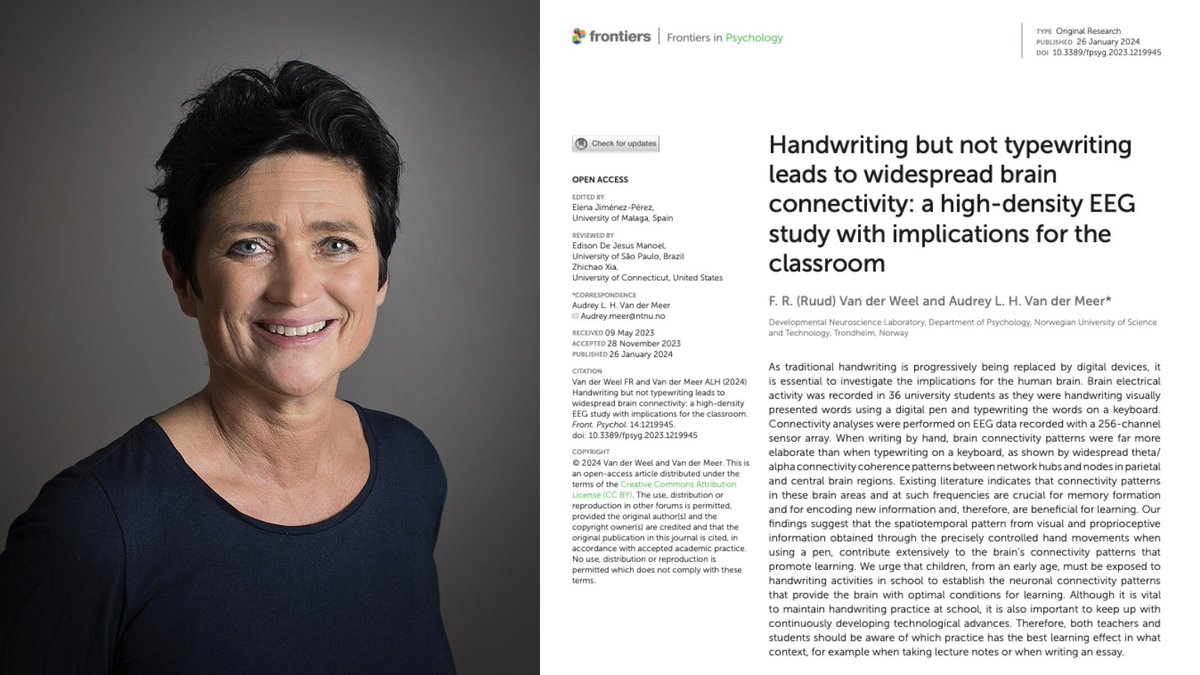
A Norwegian neuroscientist spent 20 years proving that the act of writing by hand changes the human brain in ways typing physically cannot, and almost nobody outside her field has read the paper.
Her name is Audrey van der Meer.
She runs a brain research lab in Trondheim, and the paper that closed the argument was published in 2024 in a journal called Frontiers in Psychology. The finding is brutal enough that it should have changed every classroom on Earth.
The experiment was simple. She recruited 36 university students and put each one in a cap with 256 sensors pressed against their scalp to record brain activity. Words flashed on a screen one at a time.
Sometimes the students wrote the word by hand on a touchscreen using a digital pen, and sometimes they typed the same word on a keyboard. Every neural response was recorded for the full five seconds the word stayed on screen.
Then her team looked at the part of the data most researchers had ignored for years, which is how different parts of the brain were communicating with each other during the task.
When the students wrote by hand, the brain lit up everywhere at once.
The regions responsible for memory, sensory integration, and the encoding of new information were all firing together in a coordinated pattern that spread across the entire cortex. The whole network was awake and connected.
When the same students typed the same word, that pattern collapsed almost completely.
Most of the brain went quiet, and the connections between regions that had been alive seconds earlier were nowhere to be found on the EEG.
Same word, same brain, same person, and two completely different neurological events.
The reason turned out to be something nobody had really paid attention to before her work. Writing by hand is not one motion but a sequence of thousands of tiny micro-movements coordinated with your eyes in real time, where each letter is a different shape that requires the brain to solve a slightly different spatial problem.
Your fingers, wrist, vision, and the parts of your brain that track position in space are all working together to produce one letter, then the next, then the next.
Typing throws all of that away. Every key on a keyboard requires the exact same finger motion regardless of which letter you are pressing, which means the brain has almost nothing to integrate and almost no problem to solve.
Van der Meer said it plainly in her interviews.
Pressing the same key with the same finger over and over does not stimulate the brain in any meaningful way, and she pointed out something that should scare every parent who handed their kid an iPad.
Children who learn to read and write on tablets often cannot tell letters like b and d apart, because they have never physically felt with their bodies what it takes to actually produce those letters on a page.
A decade before her, two researchers at Princeton ran the same fight using a completely different method and ended up at the same answer. Pam Mueller and Daniel Oppenheimer tested 327 students across three experiments, where half took notes on laptops with the internet disabled and half took notes by hand, before testing everyone on what they actually understood from the lectures they had watched.
The handwriting group won by a wide margin on every question that required real understanding rather than surface recall.
The reason was hiding in the transcripts of what the two groups had actually written down.
The laptop students typed almost word for word, capturing more total content but processing almost none of it as they went, while the handwriting students physically could not write fast enough to transcribe a lecture in real time, which forced them to listen carefully, decide what actually mattered, and put it in their own words on the page.
That single act of choosing what to keep was the learning itself, and the keyboard had quietly skipped the choosing and skipped the learning along with it.
Two studies. Two countries. Same answer.
Handwriting makes the brain work. Typing lets it coast.
Every note you have ever typed instead of written went into your brain through a thinner pipe. Every meeting, every book highlight, every idea you captured on your phone instead of on paper was processed at half depth.
You did not forget those things because your memory is bad. You forgot them because typing never woke the part of the brain that would have made them stick.
The fix is the thing your grandmother already knew.
Pick up a pen. Write the thing down. The slower road is the faster one.
Quiero mostrarles algo que es, o debería ser, parte de la historia de la ciencia.
A principios de los 90, cuando internet aun no estaba muy difundida, el ISI (Inst. de Información científica) tenía servicio de suscripción al "Current contents", que era una especie de...
There are simple equations that reveal a lot about biology.
For example, given the concentration of a molecule, one can quickly calculate the average spacing between those molecules in a cell.
The equation involves an assumption; namely, that a cell can be sliced into a cube, with one molecule sitting in the center of each box. Each box has a side length of d, and a volume of d × d × d, or d³.
Imagine zooming out of this hypothetical cell. The whole cell has a volume, V, and contains N molecules, which means it has N little boxes. So the total volume of the cell is given by the volume of one box times the number of boxes:
V = N × d³
Rearranging this equation, we get:
d³ = V / N
Now, the term N/V is just the same thing as density, or the number of molecules per unit volume. We can therefore flip it around and call it c, or "concentration." Rearranging once more, then, we get:
d³ = 1 / c, or equivalently, d = c^(-1/3)
This is a beautiful little equation!
Remember that c is the concentration of a molecule and d is the average spacing between those molecules. Now we can use this to figure out how tightly packed a particular molecule is within the cell.
Consider glutamate, which has a concentration of about 100 millimolar, or 0.1 moles per liter. Multiply by Avogadro's number and convert (1 cubic meter = 1,000 liters), and we get c = 6.022 × 10²⁵ m⁻³.
Finally, if we take the inverse cube root, we get d = 2.55 nanometers. So each molecule of glutamate sits, on average, about 2.55 nanometers from its neighbors, which is a distance smaller than the width of a typical protein.
It's fun to repeat this with other things, too. Try it for water, ATP, ribosomes, and so on. If you wanted to recreate a David Goodsell painting (see below), you could also use this equation to calculate how far apart each object in the painting ought to be!
No sabemos qué es más apasionanante. Si este paper que propone que los LLMs crean formas tridimensionales rotatorias, abstraccion3s para entender el mundo físico, gramática o matemáticas...o que hayamos creado una tecnología como esta y que estemos solo empezando a entenderla.
I took 1.7 million photos over 6 days to catch this photo of a commercial jet in front of the sun.
The moment it happened, TWO floating prominences were visible, making this not just my best aircraft transit photo, but one of the luckiest of my career! Videos of the transit 👇