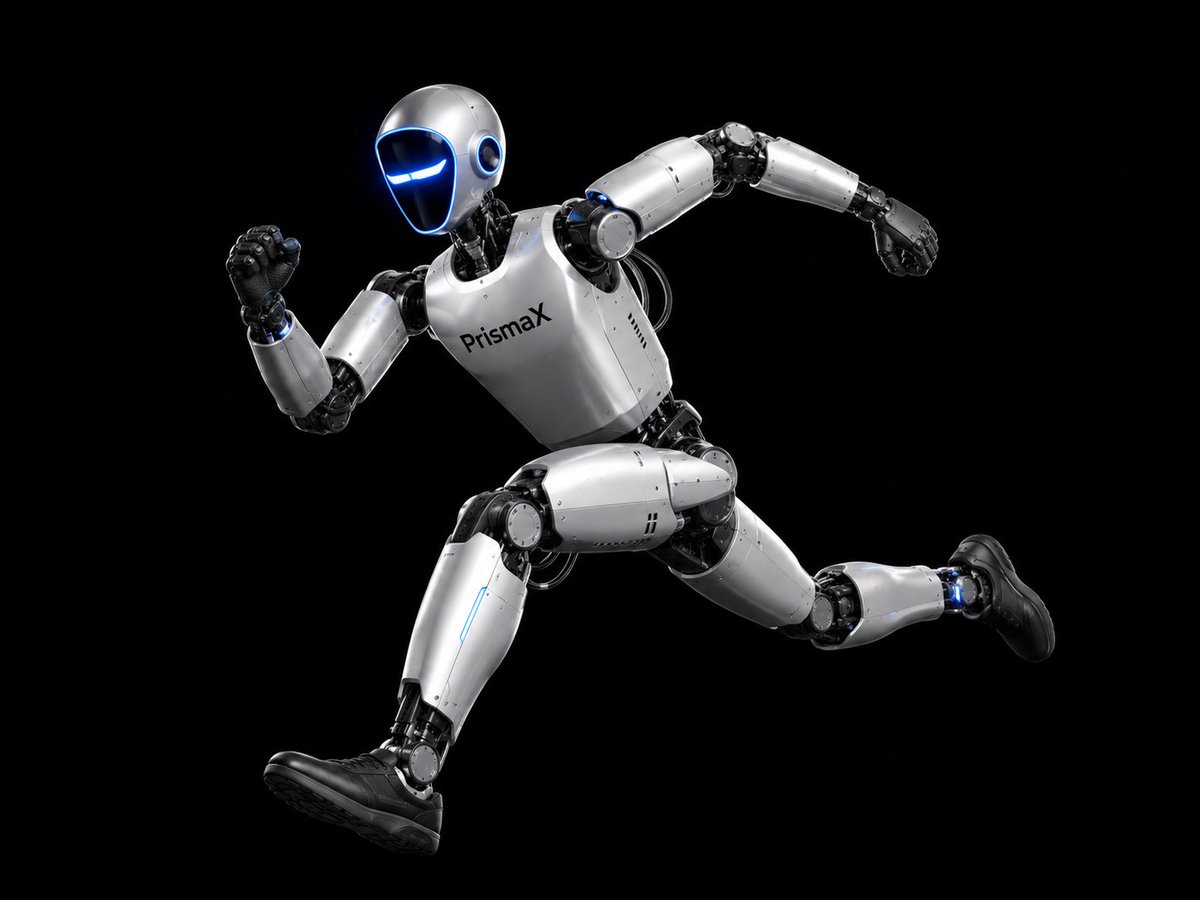
Every major shift in AI seems to reinforce the same idea: intelligence doesn't emerge from models alone. It emerges from the systems that allow those models to learn, adapt, and improve in the real world.
Seeing more robotics companies collaborate with ecosystems like NVIDIA is a reminder that Physical AI is becoming an infrastructure game, not just a software race. Powerful compute is important, but so are the robots collecting data, the environments they operate in, and the feedback loops that turn experience into intelligence.
The future won't be defined by who builds the biggest model. It will be shaped by those who connect hardware, data, and AI into a system that continuously learns from reality.
Physical AI is moving beyond research papers. Step by step, it's becoming something that can scale into the real world.
@PrismaXai #PrismaX
One thing I appreciate about building products for Physical AI is that progress rarely comes from a single breakthrough. It comes from improving every layer of the ecosystem.
The latest PrismaX updates reflect that mindset. Instead of focusing on one headline feature, they're making it easier to contribute robotics data, verify its quality, and even access hardware through a more connected platform.
That might not sound as exciting as a new AI model, but it's the kind of infrastructure that enables long-term progress. Better upload tools mean more real-world data. Better review systems mean higher-quality datasets. Better access to validated robots lowers the barrier for more people to participate.
Physical AI won't scale because of one innovation alone. It will scale because thousands of small improvements make contributing, learning, and deploying robots more accessible than before.
The strongest ecosystems aren't built overnight. They're built by continuously removing friction, one update at a time.
@PrismaXai
One idea I've been thinking about lately is that autonomy doesn't begin with robots replacing humans it begins with robots learning from them.
Teleoperation is often viewed as a temporary solution until robots become fully autonomous. But what if it's actually one of the most important pieces of the puzzle? Every remotely guided task gives robots something they can't get from simulations alone: real-world experience filled with uncertainty, adaptation, and human decision-making.
The more I learn about Physical AI, the more it seems that intelligence isn't built in a lab overnight. It's accumulated through thousands of meaningful interactions, where every success and every mistake becomes part of the learning process.
Maybe the future of robotics isn't about removing humans from the loop as quickly as possible. Maybe it's about building systems where humans teach robots efficiently enough that one day they won't need to.
The smartest robots of tomorrow will likely be shaped by the people guiding them today.
@PrismaXai #PrismaX
One of the most interesting ideas in robotics right now is that better models may not come from collecting more data, but from building better systems to judge which data is actually worth learning from.
That’s why PrismaX opening up Verify Quality feels important. Instead of treating robotics data as something that only labs or companies can evaluate internally, they’re turning quality review into a public layer where people can help score demonstrations, identify what’s training-grade, and shape the standards behind Physical AI.
What makes “The First 100” interesting to me isn’t just the community element. It’s the idea that human judgment still matters at the foundation of machine learning. In robotics, software can detect obvious issues, but it can’t fully judge whether a demonstration is smooth, intentional, diverse, or truly useful for teaching a robot how to operate in the real world.
If AI is only as good as the data it learns from, then the people defining data quality may end up being just as important as the people building the models.
@PrismaXai #PrismaX
One thing that keeps standing out in robotics is that the bottleneck isn't just data scarcity, it's data quality.
People often talk about robotics as if the answer is simply to collect more demonstrations, more videos, more interactions. But not all robotics data carries the same value. A dataset that's noisy, repetitive, or disconnected from real deployment scenarios won't magically produce smarter robots.
What matters is whether the data captures meaningful behavior, real edge cases, and the kind of human judgment robots still struggle to replicate on their own. In physical AI, better learning doesn't come from volume alone. It comes from collecting the right experiences, in the right environments, with the right feedback loop.
The teams that figure this out won't just build bigger datasets. They'll build the foundation for robots that can actually adapt, improve, and operate in the real world.
@PrismaXai #PrismaX
If there's one thing I've learned from following robotics this year, it's that we're entering a completely different phase of the industry.
For years, the challenge was building robots that could move. Today, the challenge is teaching them how to understand the world around them.
The conversation has shifted from hardware to intelligence, from machines to data. Every robot interaction, every successful task, and even every mistake is becoming valuable training material for the next generation of Physical AI.
What's fascinating is that robotics no longer feels like a distant future. The pieces are already coming together: better models, more real-world data, stronger infrastructure, and growing interest from both researchers and industry leaders.
The next breakthrough may not come from a single robot. It may come from the systems that allow millions of robots to learn, improve, and share knowledge at scale.
We're not watching the future of robotics unfold anymore.
We're building it in real time.
@PrismaXai #PrismaX
We've spent years talking about bigger models, faster chips, and smarter algorithms. But in robotics, I think the next breakthrough might come from something less exciting on the surface: data standards.
Not every robot interaction is useful. Not every dataset improves performance. The real value comes from knowing what to collect, how to collect it, and how to turn real-world experiences into meaningful learning.
As Physical AI scales, the winners may not be the teams with the most data, but the teams with the best data.
Sometimes the hardest problem isn't teaching robots to learn. It's teaching ourselves what is worth learning from in the first place.
@PrismaXai #PrismaX
PrismaX Raises $11M: a16z CSX AI Robotics Funding
Most people think the future of robotics will be built by better hardware.
I'm starting to think it'll be built by better data.
PrismaX just raised $11M to tackle one of the biggest bottlenecks in Physical AI: access to large-scale, real-world robotics data. While the AI world benefited from an endless stream of internet data, robots still struggle to learn from enough real-world experiences.
What makes this approach interesting is the focus on creating a network where people can contribute, validate, and help generate the data needed to train autonomous systems. Instead of keeping data locked inside individual companies, the goal is to create a scalable ecosystem that benefits both builders and contributors.
The race toward smarter robots isn't only about building better models. It's about creating the data pipelines that make those models possible in the first place.
The companies solving that layer today may end up shaping the future of Physical AI tomorrow.
ICRA 2026 Recap 🤖
After reading the ICRA 2026 recap, I kept thinking about how quickly robotics is evolving from a research field into a real industry.
For a long time, the spotlight was on building smarter models. Now, the conversation seems to be shifting toward something bigger: how to connect AI with the physical world. Robots can only become truly useful when they can learn from real environments, real tasks, and real human interactions.
What stood out to me is that data is becoming one of the most valuable assets in robotics. The companies that can collect, refine, and scale real world robotic data may end up shaping the future of Physical AI.
We're witnessing a moment where advances in AI, robotics, and automation are starting to converge. The result isn't just smarter software it's machines that can understand, adapt, and act in the world around them.
The future of AI won't stay behind a screen. It's gradually stepping into the real world.
@PrismaXai #PrismaX
“ Robotics doesn’t have a model problem. It has a data problem.”
That might be one of the most important statements in AI right now.
And PrismaX understands it before almost everyone else.
@PrismaXai
Robotics doesn't have a model problem. It has a data problem. And underneath that, a deployment problem.
Physical AI progresses through real-world interaction. Robots act, fail, recover, and adapt. Without shared standards, every team relearns the same lessons in isolation. Deployment standards determine whether learning compounds or resets.
PrismaX is the service layer for physical AI. We run the systems that define how robots get deployed, standardize how interaction data is generated, and integrate human judgment where models fall short, turning fragmented robotics capability into deployable infrastructure.
Our Mission: Enable people and robots to work together by setting the standards that allow physical AI systems to learn and improve through real-world operation.
Our Vision: A world where intelligent robots are deployed responsibly and at scale, supported by systems that embed human judgment into how intelligence advances.
The next chapter for physical AI is about turning real-world operation into scalable intelligence. More soon.
99% of “AI x Crypto” projects are wrappers around APIs.
PrismaX is one of the few trying to solve a REAL bottleneck:
→ collecting scalable physical-world training data.
If decentralized robotics becomes a thing this cycle…
PrismaX could become one of the most important infrastructure plays nobody saw early enough.
Worth watching closely. 👀
@PrismaXai
Here’s the part CT is underestimating:
PrismaX isn’t trying to build ONE robot company.
They’re building the coordination layer BETWEEN:
• humans
• robots
• AI systems
• teleoperators
• robotics companies
Think: “Uber infrastructure + decentralized AI + robotics network.”
If that sounds ambitious…
That’s because it is. ()
@PrismaXai
Most people don’t realize this yet:
AI has a MASSIVE data problem in robotics.
LLMs had the internet.
Robots don’t.
Physical AI needs:
• real-world movement
• human behavior
• sensor feedback
• endless edge-case training
That dataset barely exists today.
@PrismaXai wants to build the “data layer” for robots. ()
The next billion-dollar AI narrative might NOT be another chatbot.
It might be robots.
And one project quietly positioning itself at the center of this shift is PrismaX AI (@prismaxai). 🧵👇
Here’s why smart money is watching this early.