People don't fail because they lack vision. They fail because they can't see clearly through the data in front of them.
I built the OLPADR™ Method to fix that—a 6-step, evaluator-grade system turning vague ambitions into concrete, measurable proof.
For business leaders. Nonprofit founders. Mission-Driven Orgs.
#OLPADR #PolicyAnalysis #ImpactEvaluation #ClarityToImpact
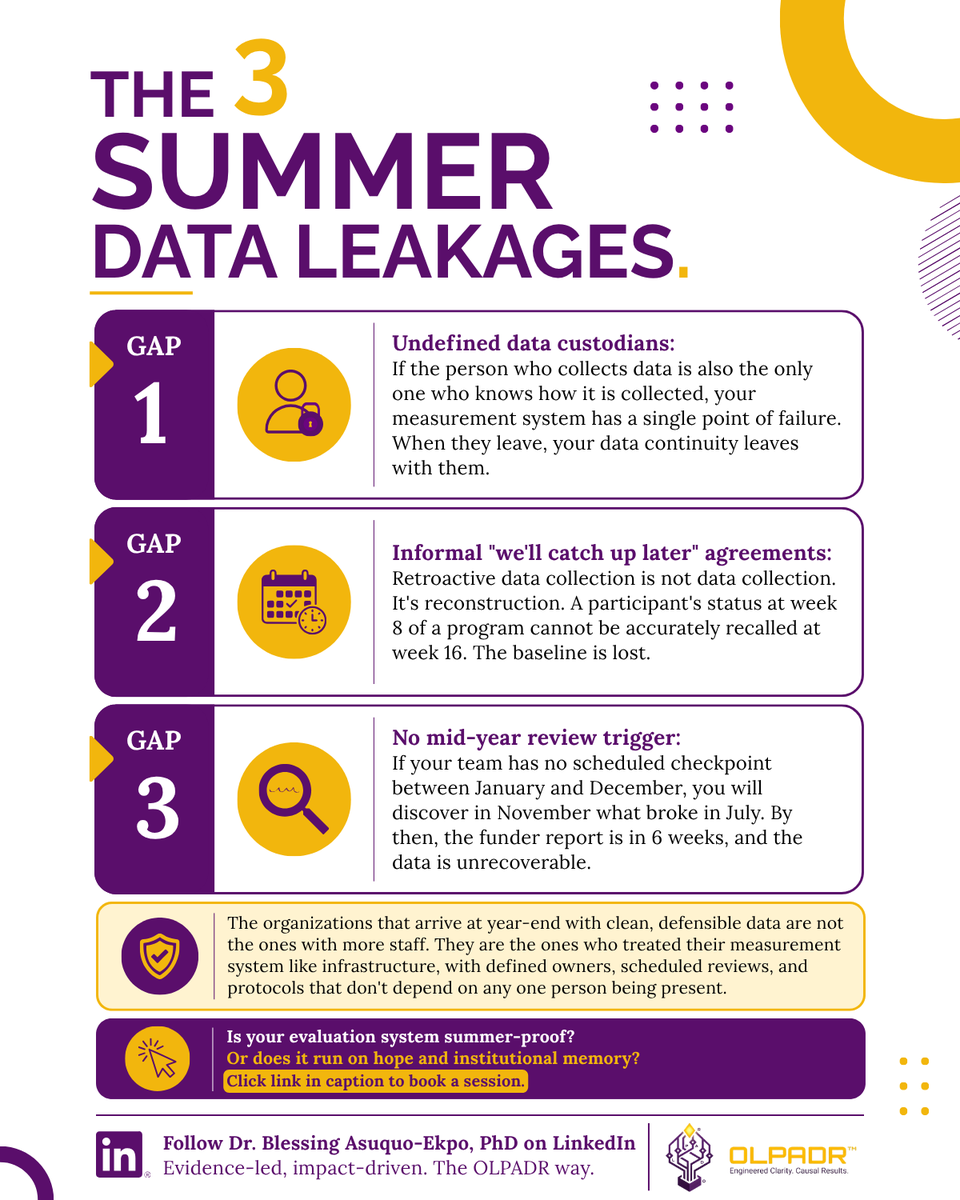
Your data coordinator just put in their July leave request. What happens to your evaluation system while they are gone?
I'm Dr. Blessing. Let's audit the logic.
2021 Urban Institute: data quality degradation spikes in Q3 tied directly to reduced staffing and informal data management.
Three gaps drive it every year:
1. No named data custodian. One person knows the
system. They leave. It stops.
2. "We'll catch up later." A participant's week 8 status
cannot be reconstructed at week 16. That data point
is gone permanently.
3. No mid-year review. No August checkpoint means
November is when you find what broke in July, 6
weeks before the funder report is due.
Organizations with clean year-end data-built protocols independent of any one person's presence.
Is your evaluation system summer-proof?
I have 2 spots open in June for Passion to Proof™.
Book your scoping call here: https://t.co/x2SOWXvJ3d
Evidence-led, impact-driven. The OLPADR way.
#OLPADR #ClarityToImpact #ProgramEvaluation #NonprofitLeadership #ImpactMeasurement
A client told me my work was "technically correct," and it was the most useful insult I've gotten all quarter.
I'm taking 3 new clients in June. Comment or DM to start.
#OLPADR#ClarityToImpact#ProgramEvaluation
A theory of change with no "because" isn't a theory. It's three boxes, hoping for the best.
Get the Logic Model Template Library, evidence anchor column included. Link in bio.
#OLPADR#ClarityToImpact#LogicModel
A nonprofit reports: "1,000 people served." A funder asks: "What changed?" The room goes quiet.
I'm Dr. Blessing. Let's audit the logic.
"1,000 people served" is an output proof that the program ran and people showed up. It is not evidence that anything changed in those 1,000 lives.
Income. Employment. Health. Behavior.
The output count tells a funder nothing about any of those things.
Here is what needs to be in the measurement architecture instead:
A baseline. No comparison point means no proof of change, only proof of status. The baseline has to exist before programmed delivery begins.
A defined outcome indicator. Not "we track participant progress." A specific measurable result percentage of completers achieving a defined threshold with a numerator, denominator, data source, and timeframe named explicitly.
A follow-up mechanism. Exit-day outcomes capture change under controlled conditions. A 2021 American Journal of Evaluation study found 61% of programs with positive exit outcomes showed regression within 6 months.
Following up at 90 days and 6 months is the difference between a reaction and a proven outcome.
A traceable data quality protocol. Every data point should connect to a timestamped record and a named instrument. "How do you know?" should be answered by a document, not a memory.
The organizations winning competitive grants are not necessarily the ones with the highest participant counts. They are the ones who can answer "what changed?" with evidence.
If a funder called today and asked that question how confident would you be?
Take the free Impact Readiness Diagnostic; link in bio.
Evidence-led, impact-driven. The OLPADR way.
#OLPADR #ClarityToImpact #NonprofitLeadership #GrantWriting #ProgramEvaluation #ImpactMeasurement
A green dashboard across every KPI for 8 months straight.
Then Q4 revenue dropped 23%.
The problem wasn't the data; it was what they chose to measure.
Vanity metrics count what's easy. Leading indicators predict what's coming. This dashboard had zero of the latter.
Is your KPI architecture built to warn you or impress you?
Schedule your Evidence Ledger Audit: https://t.co/dylrolt6R5
#OLPADR #ClarityToImpact #ImpactMeasurement
I'm Dr. Blessing. Let's audit the logic.
I'm defending D. And I want to argue against C first.
Outcome achievement measures whether something changed at exit. Long-term follow-up measures whether it held.
A change that reverses in 90 days is not an outcome; it's a reaction. American Journal of Evaluation, 2021: 61% of programs reporting positive outcomes at exit showed significant regression within 6 months when follow-up data was collected.
Outcome decay is real, it's documented, and most programs aren't measuring for it. Satisfaction is the participant liking the experience.
Completion rate is expensive attendance. Outcome achievement is changed at the moment you control the conditions.
Long-term follow-up is proof the program actually works. If you're defending one number, make it the one that proves the change lasted.
Which of these does your system actually track? Drop your answer.
Taking on new clients in July. DM "TRIAGE" if your program needs metrics that hold past the program year.
Evidence-led, impact-driven. The OLPADR way.
#OLPADR #ClarityToImpact #ProgramEvaluation
$4,800 in. $287,000 out. Here is the exact build.
I'm Dr. Blessing. Let's audit the logic.
$1.2M nonprofit. 3 programmes. 0 defensible outcome metrics.
Last grant rejection: "Insufficient evidence of participant-level outcomes."
Phase 1: Logic model and 12 defined indicators from existing admin data: $800.
Phase 2: Typeform intake + Airtable database + automated 90-day follow-up: $1,200. Progress report time: 3 days → 10 minutes.
Phase 3: Staff training. Data entry accuracy: 62% → 91% in 60 days: $1,200.
Phase 4: 8-page baseline-to-endline evaluation report. Used in 3 grant applications. 2 funded. $287,000 returned: $1,600.
The breakthrough was not technology. It was clarity about what to measure, how, and who owns it.
What is currently stopping your organisation from having this?
Take the Impact Readiness Diagnostic: https://t.co/f7kYtFdQws
Evidence-led, impact-driven. The OLPADR way.
#OLPADR #ClarityToImpact #NonprofitFunding #ProgramEvaluation
These 3 evaluation tools can defend any grant application.
But two popular ones will quietly discredit you. Here's the full list.
I'm Dr. Blessing. Let's audit the logic.
I've reviewed enough evaluation systems to know that the problem isn't usually a lack of tools. It's the wrong tools, and there are too many of them.
Here are the three you need. And the two you need to stop using as proof.
THE THREE YOU NEED:
1. A logic model that was built correctly: Not the one-page template you downloaded from a foundation website in 2019.
A logic model that maps your actual inputs to your actual activities through a defensible theory of change to population-specific outcomes with a defined timeframe.
The operative word is defensible. Every arrow in that model should be able to cite a mechanism. Not an assumption.
2. An indicator dictionary [One document]: Every indicator your program tracks.
For each one: the definition, the numerator, the denominator, the data source, the collection method, the collection cadence, and the staff member responsible.
If two people on your team define "program completer" differently, you have a measurement infrastructure problem, not a data problem.
The indicator dictionary eliminates that gap.
3. An evidence ledger: This is a structured record that links each claim in your grant application to the specific data that supports it, with the source, the date, and the collection method documented.
When a program officer asks, "Where did this number come from?" the answer is a row in a ledger, not a conversation.
THE TWO YOU DON'T NEED (AS IMPACT EVIDENCE):
4. Satisfaction surveys: Satisfaction data tells you how people felt about your program.
It does not tell you what changed because of it. Use it for program improvement. Never as a primary outcome indicator.
5. Attendance tracking: Attendance proves access. Not impact. A participant who attended 90% of sessions and showed no measurable change is an attendance success and an outcome failure.
The organizations I work with that are consistently funded all have tools 1, 2, and 3 in place before they write a single grant sentence.
Which of the three do you currently have, and which one is missing?
I have 2 spots open in June for Passion to Proof™ intensives. If you're a nonprofit facing pressure from funders, click the link to book a session with me.
Book session: https://t.co/x2SOWXvJ3d
Evidence-led. Impact-driven. The OLPADR™ way.
#OLPADR #ProgramEvaluation #ImpactMeasurement #NonprofitLeadership
These 3 evaluation tools can defend any grant application.
But two popular ones will quietly discredit you. Here's the full list.
I'm Dr. Blessing. Let's audit the logic.
I've reviewed enough evaluation systems to know that the problem isn't usually a lack of tools. It's the wrong tools, and there are too many of them.
Here are the three you need. And the two you need to stop using as proof.
THE THREE YOU NEED:
1. A logic model that was built correctly: Not the one-page template you downloaded from a foundation website in 2019.
A logic model that maps your actual inputs to your actual activities through a defensible theory of change to population-specific outcomes with a defined timeframe.
The operative word is defensible. Every arrow in that model should be able to cite a mechanism. Not an assumption.
2. An indicator dictionary [One document]: Every indicator your program tracks.
For each one: the definition, the numerator, the denominator, the data source, the collection method, the collection cadence, and the staff member responsible.
If two people on your team define "program completer" differently, you have a measurement infrastructure problem, not a data problem.
The indicator dictionary eliminates that gap.
3. An evidence ledger: This is a structured record that links each claim in your grant application to the specific data that supports it, with the source, the date, and the collection method documented.
When a program officer asks, "Where did this number come from?" the answer is a row in a ledger, not a conversation.
THE TWO YOU DON'T NEED (AS IMPACT EVIDENCE):
4. Satisfaction surveys: Satisfaction data tells you how people felt about your program.
It does not tell you what changed because of it. Use it for program improvement. Never as a primary outcome indicator.
5. Attendance tracking: Attendance proves access. Not impact. A participant who attended 90% of sessions and showed no measurable change is an attendance success and an outcome failure.
The organizations I work with that are consistently funded all have tools 1, 2, and 3 in place before they write a single grant sentence.
Which of the three do you currently have, and which one is missing?
I have 2 spots open in June for Passion to Proof™ intensives. If you're a nonprofit facing pressure from funders, click the link to book a session with me.
Book session: https://t.co/x2SOWXvJ3d
Evidence-led. Impact-driven. The OLPADR™ way.
#OLPADR #ProgramEvaluation #ImpactMeasurement #NonprofitLeadership
Imposter syndrome is not your enemy. It's a calibration signal.
It fires at the edge of what you actually know. The evaluators who treat it as information, not paralysis, are the ones who go back with a three-page memo and get cited in federal grant applications.
If you never feel it, you're not pushing far enough.
I'm taking on 3 new clients in June. DM me.
#OLPADR #ClarityToImpact #ProgramEvaluation
The evaluation problem your team is avoiding is probably solvable. It just hasn't been framed as a systems problem yet.
I'm Dr. Blessing. Let's audit the logic.
Running open office hours today in the comments, 2 to 3 hours. Evaluation problems only.
Last time, someone said mental health outcomes aren't measurable. PHQ-9 and GAD-7 say otherwise.
The real problem was that no validated instrument was selected before the first session. Baseline gone. Evidence gone. Grant gone.
Someone else said funders want stories, not data. A 2022 Candid report found 78% of program officers use quantitative outcome data in final decisions even at narrative-first foundations.
The story gets you read. The data gets you funded.
Someone said their data goes into reports nobody reads. That's not a data problem. That's a decision architecture problem.
Every indicator needs a decision rule. If it doesn't connect to an action, it's compliance paperwork dressed up as measurement.
What's the evaluation problem your team has been sitting on?
Drop it in the replies. I'll respond to every one.
Or take the 5-minute Impact Readiness Diagnostic. 500+ orgs have used it: https://t.co/f7kYtFeom0
Evidence-led, impact-driven. The OLPADR way.
#OLPADR #ClarityToImpact #ProgramEvaluation
I'm Dr. Blessing. Let me tell you why I support D.
No utilization plan means no one answered: who uses this, for what decision, and by when?
Without that answer before the evaluator starts, the scope is vague, the audience is undefined, and the report becomes a document nobody commissioned for a decision that doesn't exist yet. '
American Evaluation Association 2022 guidelines: evaluations commissioned with a formal utilization plan were 4.2× more likely to influence organizational decisions than those without one.
$35,000. 18 months. Not the evaluator's fault. A planning failure, not a findings failure.
Before your next evaluation, what decision does it need to inform? Drop it below.
Taking on new clients in July. DM "AUDIT" if you need an eval system built for use, not filing.
Evidence-led, impact-driven. The OLPADR way.
#OLPADR #ClarityToImpact #ProgramEvaluation
Nonprofits are reporting “impact” they can’t actually prove. Funders are still funding it. And the gap is becoming normal.
I’m Dr. Blessing. Let’s audit the logic.
Here’s what “impact” often looks like in most reports:
A program ran. Attendance was recorded. A survey was completed. The average score was positive. The report says “lives changed.”
That’s not impact. That’s activity with better branding.
Three patterns show up again and again:
- Self-reported outcomes with no verification:
People say they got jobs or increased income. No employer data. No independent check. It gets logged as fact.
- Retroactive baselines:
No pre-data collected, so “baseline = zero” gets assumed at reporting time. Improvement becomes guaranteed, not proven.
- Activity disguised as outcomes:
Completion rates, attendance, sessions delivered. These are delivery metrics, not change metrics.
The issue isn’t dishonesty. It’s weak measurement systems being treated as evidence.
Most organizations are not measuring impact. They are documenting activity and calling it impact.
So the real question is simple:
Are you measuring change or reporting effort?
I have 2 spots open in June for Passion to Proof™ intensives. For nonprofits ready to move from narratives to defensible evidence systems.
Evidence-led. Impact-driven. The OLPADR way.
#Nonprofits #ImpactMeasurement #GrantWriting #Evaluation #Philanthropy #OLPADR
"Technically correct but could have been written for any organization."
That was a client's feedback on my first draft of their logic model. And it was the most useful thing anyone said to me all quarter.
I'm Dr. Blessing. Let's audit the logic.
Here is the problem with technically correct: funders are not reading your logic model to confirm you understand evaluation theory. They are reading it to confirm that you understand your program. Your population. Your geography. Your theory of why change happens for these specific people.
Generic structure signals generic thinking. And generic thinking does not get funded.
I rewrote the model from the ground up. A second 90-minute call I offered at no charge. Intake data. Session observations. Outcomes written so specifically that they could only be true for that cohort, in that community, at that point in their program.
That version got funded.
The feedback that stung was the feedback that worked.
I now ask every client at the halfway mark: does this feel like it was built for you, or for a program like yours?
If the honest answer is "a program like mine," you do not have a logic model. You have a template with your name on it.
Does your current evaluation system actually reflect the specificity of your program?
I am opening 3 spots in May. DM me to start the conversation.
Evidence-led, impact-driven. The OLPADR way.
#OLPADR #ClarityToImpact #ProgramEvaluation
A program officer called me after awarding our client $600,000. She said the M&E section is why they got it.
I'm Dr. Blessing. Let's audit the logic.
47 applicants. Three finalists. One funded. The deciding factor wasn't mission alignment. It wasn't budget competitiveness. It was that the M&E section answered every question the review panel was going to ask before they asked it.
Here's what that actually looks like in practice.
The funded M&E section had a locked indicator with zero ambiguity. Not "We will track participant progress" but the exact metric, the exact verification method, the exact timeframe, and the exact source. The reviewer has nothing left to question because you already questioned it.
It had a documented baseline pulled from Bureau of Labor Statistics Q3 data showing 62% 90-day employment placement for comparable programs. The 75% target didn't feel optimistic. It felt earned.
It had a mid-cycle decision protocol. If 45-day tracking showed the program falling short of trajectory, a staffing adjustment would activate automatically. That one sentence tells a funder something almost no M&E section ever does: the data will change decisions, not just appear in a report.
And it had a data quality assurance plan. Two independent staff members are cross-verifying records. Discrepancies triggering an audit before any quarterly report is filed. Version-controlled retroactive corrections. The program officer told me that piece alone she had never seen before.
The other 46 applicants? "We will collect data and report to the funder quarterly." That is a calendar note dressed up as accountability.
What's the weakest component in your current M&E section right now?
Download the impact brief template here: https://t.co/farZorj88t
A funder asked, "How do you measure impact?" Your answer is about to determine whether you get the grant.
I'm Dr. Blessing. Let's audit the logic.
C is worse than D. Here's why.
"Let me get back to you" is a knowledge gap. Recoverable. You follow up. The relationship survives.
"We're working on it" tells a funder you know the gap exists and haven't fixed it.
That's not a data problem but a credibility problem.
Candid's 2023 sector report: 68% of foundation program officers cited inability to demonstrate measurable outcomes as the primary reason for declining renewal funding.
Not program reach. Not budget. Measurement infrastructure.
"Working on it" is not a system. It's a confession. Funders don't fund faith. They fund defensibility.
Which of these have you heard in a real funder meeting? Drop the letter.
Taking on new clients in July. DM me "PROOF" if your nonprofit needs to build the evidence before the next conversation.
Evidence-led, impact-driven. The OLPADR way.
#OLPADR #ClarityToImpact #NonprofitLeadership






![dr_blessingae's tweet photo. These 3 evaluation tools can defend any grant application.
But two popular ones will quietly discredit you. Here's the full list.
I'm Dr. Blessing. Let's audit the logic.
I've reviewed enough evaluation systems to know that the problem isn't usually a lack of tools. It's the wrong tools, and there are too many of them.
Here are the three you need. And the two you need to stop using as proof.
THE THREE YOU NEED:
1. A logic model that was built correctly: Not the one-page template you downloaded from a foundation website in 2019.
A logic model that maps your actual inputs to your actual activities through a defensible theory of change to population-specific outcomes with a defined timeframe.
The operative word is defensible. Every arrow in that model should be able to cite a mechanism. Not an assumption.
2. An indicator dictionary [One document]: Every indicator your program tracks.
For each one: the definition, the numerator, the denominator, the data source, the collection method, the collection cadence, and the staff member responsible.
If two people on your team define "program completer" differently, you have a measurement infrastructure problem, not a data problem.
The indicator dictionary eliminates that gap.
3. An evidence ledger: This is a structured record that links each claim in your grant application to the specific data that supports it, with the source, the date, and the collection method documented.
When a program officer asks, "Where did this number come from?" the answer is a row in a ledger, not a conversation.
THE TWO YOU DON'T NEED (AS IMPACT EVIDENCE):
4. Satisfaction surveys: Satisfaction data tells you how people felt about your program.
It does not tell you what changed because of it. Use it for program improvement. Never as a primary outcome indicator.
5. Attendance tracking: Attendance proves access. Not impact. A participant who attended 90% of sessions and showed no measurable change is an attendance success and an outcome failure.
The organizations I work with that are consistently funded all have tools 1, 2, and 3 in place before they write a single grant sentence.
Which of the three do you currently have, and which one is missing?
I have 2 spots open in June for Passion to Proof™ intensives. If you're a nonprofit facing pressure from funders, click the link to book a session with me.
Book session: https://t.co/x2SOWXvJ3d
Evidence-led. Impact-driven. The OLPADR™ way.
#OLPADR #ProgramEvaluation #ImpactMeasurement #NonprofitLeadership](https://pbs.twimg.com/media/HK2d9CdWoAApjt-.jpg)





