Dear friend @ARanganathan72 Ji, I hope u find this post in good taste as I'm writing this in capacity of a Finance Professor & not as Modi-Bhakt.
“Modi Govt borrowed ₹154 lakh crore!”
Correct. Now let's apply some basic Financial Management before screaming “DEBT = BAD”.
A Govt doesn't borrow just to put money in a bank account.
It borrows to create assets that generate economic activity for decades.
From 2014-15 to 2026-27:
🔹 Central Capex: ₹1.81 lakh cr → ₹12.22 lakh cr — nearly 7X
🔹 National Highways: 91,287 km → ~1.46 lakh km
🔹 Airports: ~74 → 160
🔹 Railway broad-gauge electrification: 99.6%
🔹 Rural roads: 7.8 lakh km built during 2014-25
🔹 Renewable capacity: 76 GW → ~289 GW
🔹 Solar: 2.8 GW → ~165 GW — nearly 60X
Now comes the REAL financial-management question:
What is the return on that borrowed money?
RBI research estimates that ₹1 of Central Government capital expenditure can generate up to ₹3.25 of additional GDP through the fiscal multiplier—and public investment can crowd in private investment.
That's the point.
If the government had refused to borrow, it had only two choices:
1️⃣ Don't build the infrastructure.
OR
2️⃣ Raise substantially more taxes to finance it.
And taxing citizens/businesses heavily to fund infrastructure would take purchasing power out of the private economy while reducing the capital available for private investment.
Instead, the government borrowed at sovereign rates (which are way lower than commercial lending rates) and deployed a much larger share of expenditure into productive capital formation.
And here's the kicker:
Taxes weren't simply increased to pay for this borrowing.
Bharat's direct-tax-to-GDP ratio reached 6.7% in FY2024-25—the highest in three decades—while tax administration and compliance improved.
At the same time, the government has actually delivered major tax relief—including raising the income-tax threshold to ₹12 lakh in Budget 2025-26.
Not to forget, Modi Sarkar has substantially reduced Indirect Taxes too with GST reforms. I need not tell readers how CONgress led UPA Govt was squeezing consumers with high indirect taxes & that too with cascading effect. "Tax on Tax" was what consumers paying under UPA Govt run by so-called economists.
So the Modi Sarkar model is:
Borrow → Build productive assets → Increase economic capacity → Crowd-in private investment → Grow the tax base → Consolidate fiscal deficit → Give tax relief.
That's fundamentally different from UPA Govt's useless model which was:
Borrow → Spend on consumption → Borrow again to pay for yesterday's spending.
Debt is not automatically good.
Unproductive debt is dangerous.
But borrowing to create infrastructure whose economic return exceeds the cost of borrowing?
That's not “destroying the economy”.
That's using the balance sheet to build the economy.
The question isn't:
“How much did Modi borrow?”
The question is:
“What did India get in return?”
And on that question, the numbers are VERY uncomfortable for the critics.
I hope Anand ji that I'm able to remove all your concerns & worries over Govt Debt.
I rest my case.
Sourav Das, Ashutosh Ranka, and Abhijeet Dipke are going to BJP-ruled states to show the condition of government schools while claiming that the BJP destroyed our education system.
Fine. They are covering only BJP-ruled states.
The states they are covering are Delhi, Rajasthan, Bihar, and West Bengal.
Let’s expose them with facts.
The BJP-led government came to power in Delhi in 2025. Before that, Delhi was governed by the AAP.
The BJP-led government came to power in West Bengal just three months ago. Before that, the state was governed by the TMC.
The BJP-led government came to power in Bihar just four months ago. Before that, the state was governed by the NDA/JD(U)-led government.
The BJP came to power in Rajasthan in 2023. Before that, the state was governed by Congress.
So, the condition of the government schools they are showing cannot simply be blamed on the BJP. In most of these states, the BJP has only recently come to power. Yet they are trying to portray these long-standing problems as if the BJP created them.
They weren’t covering these states a few months or years ago because the BJP wasn’t in power in most of them.
The poor condition of government schools has been a problem in our country for decades. Our current government is working to fix it, but progress takes time, especially after decades of misgovernance.
You cannot create a world-class education system overnight. It takes time, investment, and consistent effort.
Today, I will upload pictures of government schools that have already been built or are currently being developed by our government.
No one has shown you these pictures, but I will.
Our generation is filled with blackpillers. Be a whitepiller in this generation.
Our government is doing great work. Progress takes time, and I truly believe that our country will become a developed nation one day.
Don’t let yourself be manipulated by people like Abhijeet Dipke and Sourav Das
PM Modi’s Independence Day message had one clear theme: Viksit Bharat needs bigger ambition, faster reforms and greater self-reliance.
His ‘Sapta Dhara’ roadmap caught my attention:
🏭 Manufacturing- make India a global production powerhouse
🌾 Agri & food processing- move farmers higher up the value chain
🤖 Technology & innovation- AI, semiconductors and future technologies
🚆 Logistics- build faster, cheaper, world-class connectivity
🛡️ Defence- greater indigenous capability
🌱 Green & blue economy- energy security with sustainability
🌏 Soft power- take India’s culture, ideas and influence to the world
And importantly, AI training for 1 crore youth, free online competitive-exam coaching, a national sports talent hunt and an ambitious 100 GW nuclear-energy goal by 2047!
The President has assented to the #VandeMataram Amendment, passed without discussion in Parliament, which requires the singing of the National Song in full at the start and ending of any official function, in addition to the National Anthem.
As one who greatly respects both, and can sing the first two stanzas of the former (but not the other four, which were never required till now) as well as the entire anthem, i would like to point to just one practical consideration our zealots appear to have overlooked: human nature.
"Jana Gana Mana" requires audiences to stand respectfully and focus their attention for a reasonable 52 seconds. The National Song in full takes 3 minutes and 10 seconds. Tamil Nadu has just decided that both will be preceded by the State Song in Tamil for another 2 minutes. Do we really expect audiences to stand still and respectfully for six minutes before and after every function, a total of 12 extra minutes? Can respect and patience be legislated?
I fear that the intent of the Bill, to promote greater respect for the National Song , will not be achieved, but its opposite may well be....
There was a time when a holiday overseas began the moment you touched down at your destination airport.
The sheer expanse. The travelators. The duty-free stores bursting with an abundance of alcohol, perfumes, dark glasses, watches, scarves and handbags.
We, the perennially starved of plenty, were awestruck.
The holiday mood began right there.
But today, Heathrow, Frankfurt, Charles de Gaulle - they all look jaded compared with our airports. In need of a serious up-grade.
And though I am now satiated by the abundance that duty-free stores offer, the sheer pleasure of seeing it all at our airports remains undiminished.
Perhaps that joy can only be understood by those who once experienced so little.
From Indira Gandhi International to Dubai International, the journey was seamless. A smooth, effortless flow that would have seemed almost unimaginable to us once.
And now, yes, let’s clean up our cities.
It is so doable. It is such low-hanging fruit.
Cleaner streets, better-maintained public spaces, less litter, greater civic discipline. These are not grand, impossible ambitions. They are within our reach.
And the payoff will be far greater than just making us more attractive to visitors.
It will make us feel good about where we live.
And perhaps that is the most important payoff of all.
Why India Needs a Dedicated Digital Minister Before It's Too Late
- Mallika Bajaj
In an interview on the ANI Podcast with Smita Prakash, Mallika Bajaj (Digital Transformation Architect) argued that India urgently needs a dedicated, young Digital Minister to counter the escalating threats of cognitive warfare, data leaks, and algorithmic manipulation.
Bajaj highlighted several critical reasons why India cannot afford to wait:
🔴 Combating Cognitive Warfare: Hostile foreign architectures engineered on social media manipulate Indian youth through algorithms, making a digital-focused defense strategy necessary.
🔴 Preventing Massive Data Leaks: National data leaks compromise everything from individual citizens to high-profile entities like the Defense Ministry.
🔴 Countering AI-Driven Misinformation: Evolving AI technologies and deepfakes make it impossible for citizens to verify information at the ground level without structural government intervention.
🔴 Securing Mind Sovereignty: Technology platforms seek control by creating predictive outcomes. India must actively protect its citizens’ attention spans and mental independence ("securing minds before securing minerals").
🔴 Keeping Pace Globally: Other nations are moving rapidly to institutionalise technological oversight, such as the UK appointing dedicated AI envoys.
Ultimately, Bajaj argues that information has become the "first weapon of modern warfare". Instead of just consuming tech tools created by Big Tech, India requires specialized leadership to build independent, sovereign digital infrastructure and safeguard national security.
Credit : Podcast With Smita Prakash.
🔴 Must Watch 🔴
“Foreign Algorithms Are Quietly Conditioning the Minds of India's Youth” - Mallika Bajaj
Mallika Bajaj is a digital transformation expert who studies how technology affects the way people learn, behave and think.
Digital transformation architect Mallika Bajaj argues that foreign social media algorithms are engaging in “cognitive warfare” by conditioning Indian youth through an Algorithmic Cognitive Reinforcement Loop (ACRL). Bajaj suggests these platforms prioritize “Four Vs” (Viciousness, Virality, Vulgarity, Violence) over truth, prompting a need for Indian cognitive neural sovereignty and indigenous technology development.
Credit : ANI Podcast With Smita Prakash Clips.
Do you know who slows Bharat down?
Not Pakistan.
Not China.
Not even the 0.5 front.
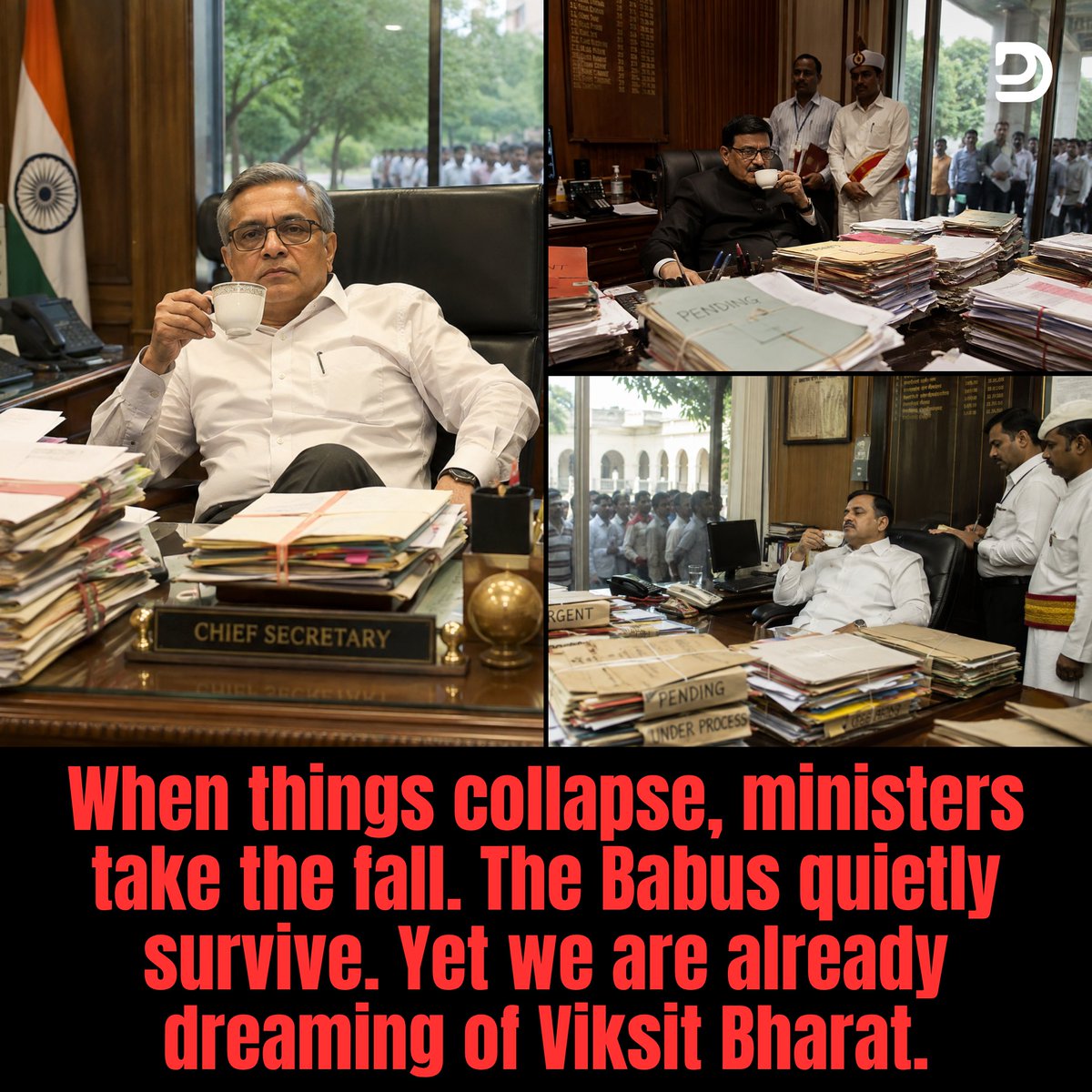
The biggest drag is the IAS System.
In 1947, the British left.
But we kept the Architecture.
The brown sahibs of India.
And the system was built not to serve citizens.
It was to extort from citizens.
The system does not reward outcomes.
It rewards survival.
It rewards tenure.
It rewards procedural safety.
And when survival becomes the incentive,
execution becomes the casualty.
A file enters an office as a newborn.
It leaves with voting rights.
Some files are not pending.
They are deliberately kept pending.
With the "Forwarded for Necessary Action" tag.
Officer A marks it to Officer B.
Officer B marks it to Officer C.
Officer C seeks clarification from Officer A.
This is our Administrative efficiency.
The safest bureaucrat rarely solves the biggest problem.
He simply avoids the riskiest decision.
No decision.
No signature.
No blame.
Career safe.
Promotion comes with years.
Accountability never arrives.
Today, Bharat has ~5,577 serving IAS officers.
~8000 are retired.
Cost to the taxpayer?
Serving IAS cadre.
Up to ~₹6,500 crore a year.
Retired IAS pensions.
Up to ~₹2,000 crore a year.
And that is not the whole machine.
Salary.
DA.
HRA.
Government accommodation.
Bungalows and their maintenance.
Official cars.
Drivers.
Fuel.
Air and rail travel.
Hotels.
Daily allowances.
LTC.
Medical benefits.
Transfers and relocation.
Training.
Phones.
Laptops.
Office infrastructure.
Electricity.
Support staff.
Secretariat machinery.
Collectorate machinery.
Security.
Pensions.
Family pensions.
Gratuity.
The government pays to recruit them.
Train them.
House them.
Move them.
Transport them.
Support them.
And finally, retire them.
But here is the strange part.
We can calculate almost every input.
Where is the public dashboard measuring the output?
Where is the public KPI?
Which Collector reduced file pendency the most?
Which Secretary delivered the highest policy outcomes?
Which officer consistently completed projects on time?
Which officer transformed public service delivery?
Which officer remained a bottleneck for years?
Where is the scorecard?
Every profession is measured.
Businesses measure profit.
Students are measured.
Teachers are measured.
Companies are measured.
Taxpayers are measured.
Citizens are measured.
Political parties are measured.
Why are Babus never measured?
And why is their promotion guaranteed?
Now, imagine an IAS officer.
He played ping-pong with files his whole career.
One table to another.
One department to another.
One decade to another.
Then he retires.
But the taxpayer doesn't.
Why should taxpayers keep paying?
For a career never measured by performance?
The British built this system to extract from us.
And we still live under its architecture.
While proudly calling ourselves independent.
The voice of the students has reached the Govt. The Govt has responded well with Anti Paper Leak Bill, Fast Track Courts etc & the dialogue should now move forward to strengthening the overall education system. While pointing out flaws is important it is equally important to appreciate the good work. The kind of language used by some youngsters is not good and doesn’t set the right example - excellent points by @bhumipednekar
I just have one thing to add here : The CJP protest used students. Their interest was never the student’s interest. They are a front to engineer “Regime Change” and the sooner we recognise this the better
This video is of Marathi actress Ketki Chitale being released from jail
-22 FIRs were registered against her
-Was arrested like a wanted criminal
-Spent over 40 days in jail
And why?
For sharing a poem on social media criticizing Sharad Pawar..
INDI alliance has the audacity to talk about democracy, FoE etc?
A friend of mine, who happens to be an MBA student with a decent job, asked me whether I support the ongoing protest
When I asked him why do you think I should support the protest?
He said:
> India has the highest debt of 500 lakh crore
> Highest unemployment rate in the world
> No new education institutions
> Primary schools getting closed
> Highest inflation in the world
> Per capita GDP very low in comparison to other countries in the world
> Students not being able to crack competitive exams
> Multiple paper leaks
> Vishwaguru is JUMLA
I was surprised to see how someone so educated could be so misinformed.
I answered to his questions:
> In 2014, India's external debt stood at around 23.9% of GDP (approximately ₹55 lakh crore)
Today, it is around 19.1% of GDP (about ₹181 lakh crore). This is nowhere close to the ₹500 lakh crore figure he mentioned
> Sudan has the highest unemployment rate in the world not India, India currently has an unemployment rate of 5.5%. In global comparisons among major economies, India performs better than countries like France (8.1%) and Spain (10.83%)
> In 2014, India had 16 IITs, 7 AIIMS, 13 IIMs, and 9 IIITs. Today, there are 23 IITs, 22 AIIMS, 20 IIMs, and 25 IIITs
> Venezuela has the highest inflation rate in the world not India, India is performing the best even in the ongoing wars with inflation below 4.5%
> India's per capita income has increased by more than 45% since 2014
> The inability to crack competitive exams is largely an individual outcome. However, the government's role is to ensure a fair, transparent, and merit-based examination system
> If we are comparing with the past, the situation was worse. Even high school examination papers used to be leaked. That said, paper leaks remain unacceptable, and there must be strict accountability
> Any country that confers its highest civilian honour does not do so without recognizing a person's influence, contribution, or global stature. Whether one agrees with the term "Vishwaguru" or not, India's growing international standing cannot be dismissed
I have no issue with anyone protesting or criticizing the government. In fact, that's a fundamental right in a democracy. But if your arguments don't stand up to basic fact-checking, then you're not challenging the government, you're simply spreading misinformation.
@aravind@Sanjay_Dixit@SanjeevSanskrit@JaipurDialogues@UdayMahurkar@prafullaketkar
Fact 1: Home Ministry cancelled #FCRA registration of @Wangchuk66’s NGO, #SEMCOL, in September 2025 following a CBI inquiry that found financial irregularities & foreign exchange violations in the NGO.
Fact 2: @abhijeet_dipke was an #AAP social media volunteer in 2020-23 & helped the AAP team create a digital campaign for the Delhi election.
Fact 3: Govt must fix accountability for the NEET paper leaks. But it must not give into street thuggery & political blackmail.
At the ongoing protest site at Jantar Mantar, a truck filled with stones was standing ready.
Now news is coming in that CJP protesters carried out stone-pelting and injured Delhi Police personnel.
Abhijit Dipke wants to incite riots in the name of CJP students’ rights.
The question is
If the truck was not placed by CJP supporters, how did a CJP person confidently locate a random truck standing in some corner?
How did they research the sizes of the stones in such a short time?
A CJP person finding the truck so easily… this reveals more about CJP’s intent than anyone else’s.
why did CJP protesters start pelting stones at the Delhi Police?
Shabana Azmi, chairperson of the British Christian NGO 'ActionAid' in India that receives more than ₹85~₹100 crore in foreign funding every year. Deep State has started fresher notoriety on July 20 - the beginning of monsoon season to actualize regime change plot and push India towards absolute anarchy. Deep State clowns will intensify notoriety as they are mad at Foreign Contributions Regulation Act (FCRA).
I am humbly calling upon Indian media, think-tanks and nationalist forces to raise voice against these foreign mercenaries.