Why does Canada exist as a separate country at all?
With Trump’s threats of annexation, images of North America draped in the red, white, and blue, and talk of Canada as the 51st state, a basic question underlies the current dispute.
Why didn’t Britain’s possessions north of the rebellious American colonies become part of the United States?
This is a strangely personal story for me, as my ancestors played an outsized role in engineering the Canadian nation into existence. 1/ a🧵
"Henry Ford drew inspiration from the disassembly lines of Chicago’s meatpacking plants, where carcasses hung from overhead trolleys passed stationary butchers.
He reversed the process, adding rather than subtracting parts as an increasingly complex machine moved down the line and finally roared to life."
Read the full essay on my subst@ck. Link in replies
Henry Ford's productivity revolution did not end at the factory gates. The farmer who abandoned his fields for the assembly line was now helping manufacture the tractors, trucks and agricultural machinery that would replace his own labour back on the farm.
His departure no longer meant a corresponding loss of agricultural output. Instead, the remaining farmers could cultivate vastly more land with far fewer hands.
Consider the sheer multiplication of mechanical power. A human being engaged in sustained physical labour generates roughly 100 watts; a horse, 500–1,000 watts.
The engine of a typical family car can deliver more than 100,000 watts at full output. Make that kind of power ubiquitous in the form of a tractor or combine harvester, and a single farmer can cultivate and harvest land that once demanded the backbreaking labour of hundreds.
Extend this revolution to freight transport, construction, earthmoving and the colossal machinery of modern mining, and one begins to appreciate how thoroughly mechanical power has multiplied human productive capacity.
And critically, machines multiply machines. Excavators mine the iron ore, locomotives transport it, steel mills refine it, and precision machine tools transform it into still more machinery.
Fordism thus revolutionized productivity twice: first in the factory that produced the machine, then in the fields, mines, and workshops where that machine was put to work in an ever-accelerating, self-reinforcing cycle.
read the full essay on my subst@ck. link below.
Donald Trump has revealed that he told Google to rename the Atlantic “Trump Ocean”.
The US president said when he called Sundar Pichai, the tech firm’s chief executive, with the proposal, Mr Pichai pleaded with him to drop the request.
🔗 https://t.co/KbJf33mVjV
The Greatest Productivity Revolution in Human History: How Henry Ford Changed the World.
By 1927, some 23 million motor vehicles traveled America’s roads, compared with barely 18,000 in the Soviet Union and fewer than half a million in Germany.
The productivity unleashed by Ford's assembly line created a staggering gap, and was increasingly recognized as a profound economic and strategic vulnerability.
The Soviets in particular had no intention of remaining trapped in a subordinate position in the international division of labour. They refused to accept a future in which they exported grain and raw materials to pay for the sophisticated machinery of more advanced industrial economies, forever confined to their comparative advantages in agriculture and raw materials.
Such dependence threatened to become self-perpetuating, and with the winds of another European war already stirring, industrial backwardness was beginning to resemble not just an economic liability but an existential threat.
Mastering American mass production became an urgent national priority. In the coming age of mechanized warfare, the gulf between industrial powers and industrial laggards threatened to become as decisive as the advantage Cortéz possessed over the Aztecs.
Read the full essay on my Subs@ck. link below.
@Dr_Keefer Solid thesis. Solar proves it: PV tech existed in the 1950s, but only mass manufacturing in the 2000s drove costs down 90%. Energy is life, but manufacturing makes it cheap.
I’ve long thought of myself as an energy determinist, perhaps even something of an energy reductionist, inclined to explain the extraordinary hockey stick of economic growth over the last several centuries primarily through the lens of the increasing availability of the “holy trinity” of coal, oil, and gas.
As my friend Doomberg regularly opines, “Energy is Life.”
More recently, however, I’ve become something of a prime mover determinist, for energy alone can accomplish remarkably little without the means to transform it into useful work.
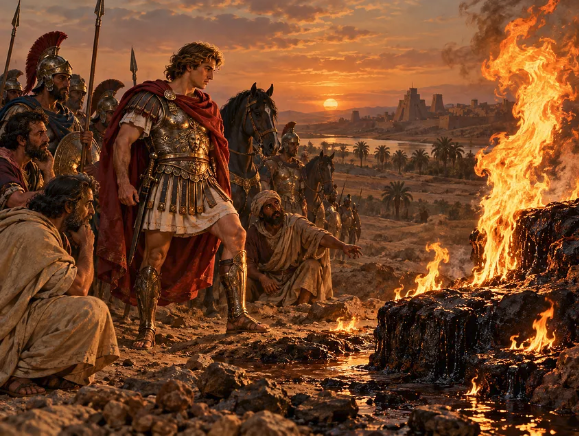
Plutarch recounts that during Alexander the Great’s conquests of the Middle East, he marveled at the flammability of the petroleum seepages he encountered in Mesopotamia.
However, beyond primitive incendiary applications, later developed into Greek Fire, petroleum remained little more than a curiosity for Alexander, who had no tanks or trucks with Otto or Diesel engines to harness this fossilized sunlight and turbocharge his force projection through mechanized mobility.
After reading @Stefan Link’s Forging Global Fordism at the suggestion of subscriber Engineer Guy, I am now firmly in the camp of the manufacturing determinists. The invention of prime movers accomplishes relatively little until they can be mass produced cheaply and in enormous quantities...
For the full essay check out my Subst@ck link below.
Decouple media now has the definitive histories of the Iranian and Israeli nuclear weapons journey from Irans engagement under the Shah with Eisenhower's Atoms for Peace program and later the AQ Khan network and Israel's success at acquiring a French plutonium production reactor and reprocessing facility. If you want the ultimate backgrounders check out the podcast and substack. https://t.co/FI7lK1CRfE
BREAKING: Netanyahu says Iran's Supreme Leader Mojtaba Khamenei has now decided to lift the restriction on nuclear weapons and is trying to develop them again. He says based on this, he has now instructed the IDF, Mossad and security agencies to topple the Iranian regime.
"Mojtaba Khamenei decided to follow in his father's footsteps. He has taken the safety off, and Iran is once again trying to develop its weapons of death," Netanyahu said minutes ago.
"There is only one way to remove this threat once and for all, to topple the regime in Iran," he adds.
"We are ready to strike you with full force," Defence Minister Katz says.
Iranian lawmakers said on Sunday that Mojtaba Khamenei's position on nuclear weapons will differ from his late father's and that Iran must now acquire nuclear weapons.
On Tuesday, October 13th, 2026, @CanadiansEnergy and the Canadian nuclear community suffered a tremendous loss with the passing of my dear friend of 25 years @jules_besseling.
Jules played a critical role in the development of our CNSC license extension submission for @opg Pickering, with his decades of expertise in pressure tube design and aging informing the main points of the article.
Jules was an active member on the @BWXT Community Liaison Committee here in Peterborough, his presence and vitality will be sorely missed. https://t.co/CWAzGKSsmH
The reason for the rate ask is threefold:
1. OPG breaks up billing for each segment; each generator has their own rate, so if investment is being made, it is not borne by other sources (hydro, gas).
2. OPG has one operating nuclear plant presently, Darlington A, at 3,512MW. That output has to cover the plant's OPEX (~$40/MWh) plus the SMR new build, plus the Pickering refurbishment.
3. OPG is trying to avoid debt (which is why they previously asked for more and were denied). While the $100-110/MWh they were paid for the combined output of Pickering and Darlington was able to cover the $12.8bn refurb cost for Darlington in a "pay as you go" fashion, this is not the case for the $27bn Pickering refurb, carried only by Darlington's output.
As a ratepayer, and a fan of public power, I think this is a bad move. We should be allowing some debt here to keep rates at a level that doesn't needlessly provide ammunition for groups like the OCAA.
Vote option 2 for the future of the three-fingered AI-generated children of Alberta. And spare a thought for the AI-generated dad's elbow while you're at it. That has to hurt.
The Threat of Hiroshima to Prevent Another Auschwitz
The Story of Israel's Nuclear Weapons Arsenal a 🧵
“We also know there are known unknowns; that is to say we know there are some things we do not know.” Donald Rumsfeld
1/ Israel is widely believed to possess roughly ninety nuclear weapons. There has been no official Israeli test nor public declaration of a nuclear arsenal. Instead, it maintains the carefully worded formulation that it will “not be the first to introduce nuclear weapons into the Middle East.”
This formulation has survived the exposure of its secret nuclear complex by a former technician and more than half a century of regional wars.
The origins of this arsenal are as improbable as the silence surrounding it. In the 1950s, Israel was an impoverished state struggling to absorb hundreds of thousands of immigrants. Within little more than a decade, it acquired the capacity to manufacture nuclear weapons, taking advantage of a brief opening in the international nuclear order.
Israel’s nuclear arsenal was conceived as an apocalyptic insurance policy against national annihilation. Yet their most consequential applications may have been far more limited: the threat of a nuclear demonstration, intended to shock the superpowers into intervening and securing the conventional military assistance needed to avert defeat.
Their continued existence without official acknowledgment has depended upon an enduring accommodation among Israel, Washington, its Arab neighbours and the international nonproliferation system.
The following essay is based on my conversation with Professor Avner Cohen, author of Israel and the Bomb and The Worst-Kept Secret, whose research has done more than any other to reconstruct Israel’s clandestine nuclear past.