The snow situation this year is deeply concerning.
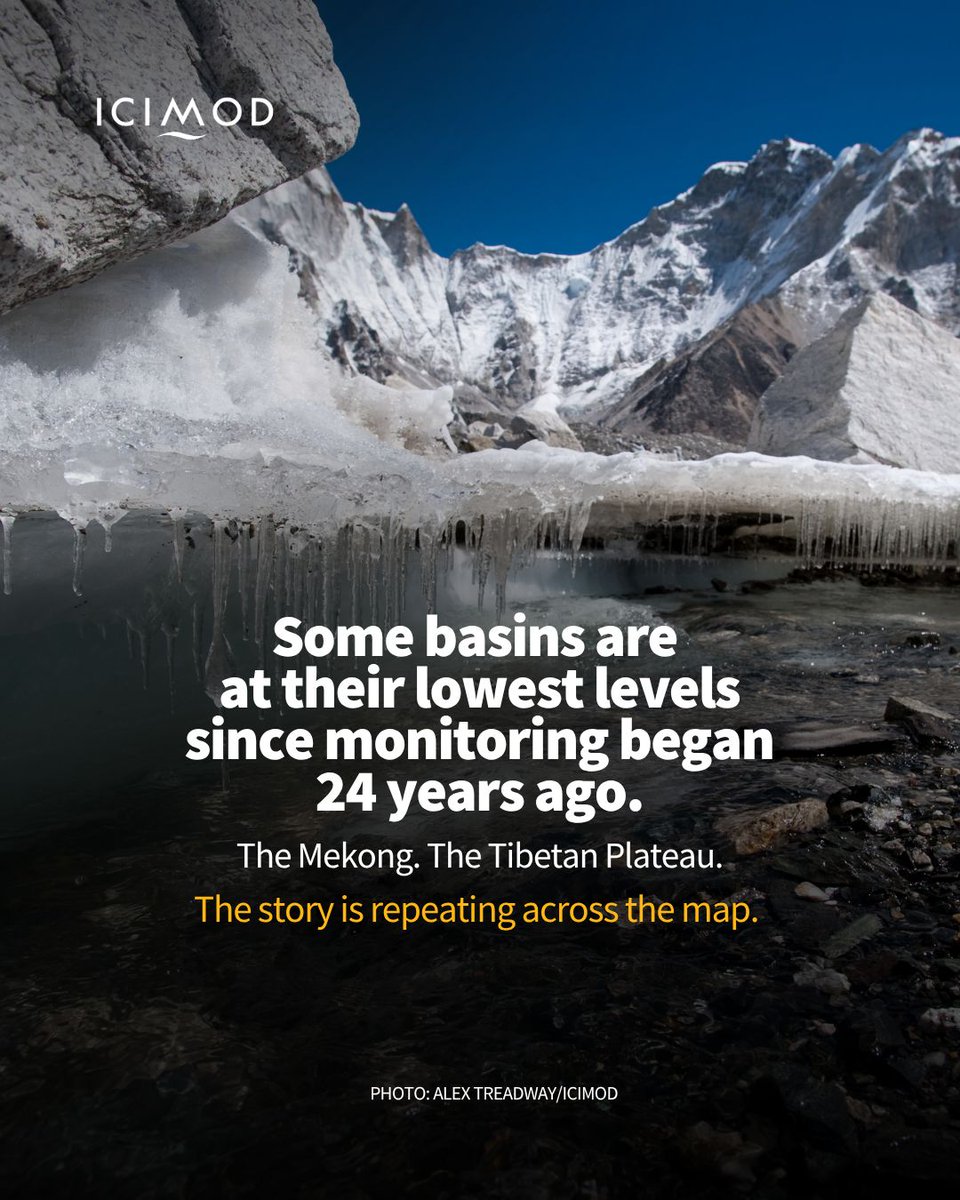
The HKH snow persistence is at its lowest in 23 years — below normal for the third consecutive year, threatening the water in 12 major rivers and billions who rely on them.
The water lifeline for a vast region is under pressure. The Hindu Kush Himalaya has recorded its lowest snow persistence in 23 years, marking the third year of this worrying pattern. This directly impacts the flow of twelve major rivers and the lives of the billions who depend on them.
Learn why this regional issue has global implications: https://t.co/J3V2S0H19n
Read the full report: https://t.co/dg0NCE84Ny
What happens in Pakistan’s high mountains does not stay there.
Accelerating glacier & snow change and expanding glacial lakes are increasing risks.
In this BBC Urdu report, I discuss why monitoring, early warning, and timely evacuation matter. https://t.co/2WVckQ9fzC
@icimod
We invite abstracts for our three-day Intl. conference on advancing science, policy, and regional cooperation in the Decade of Action for Cryospheric Sciences (2025-2034) in Kathmandu this November.
For queries, reach out to: [email protected]#Cryosphere#Mountains#HKH
Mountain communities are having to adapt in real time due to melting glacier and shifting water systems.
Come together to build stronger science and policy for the Hindu Kush Himalaya (HKH).
We are inviting abstracts that connect cryosphere science with policy, water governance, disaster risk, and mountain livelihoods for our three-day conference in Kathmandu this November as part of the UN Decade of Action for Cryospheric Sciences (2025-2034).
Join researchers, early-career scientists, mountain communities, and decision-makers for a transformative three-day gathering to share your work, exchange ideas, and engage with experts from across the region and beyond.
Learn more about the conference themes and submit your abstract by the deadline: https://t.co/7td23OIkZN
#Cryosphere #MountainScience #HKH #ClimateandEnvironment
Call for abstracts now open for ICIMOD’s conference on cryosphere science, policy & regional cooperation, Kathmandu, 25–27 Nov 2026.
Deadline: 30 Jul 2026
Apply: https://t.co/jG2FEX5jMg
Queries: [email protected]#Cryosphere#HKH#ICIMOD
The Hindu Kush Himalaya (HKH) has a vital place in the global water agenda.
The HKH is the source of ten major river systems and supports nearly two billion people downstream. These river systems sustain water, food, energy, ecosystems, livelihoods, and economies across Asia.
But this system is under growing pressure from glacier retreat, shifting snowmelt, erratic monsoons, floods, droughts, groundwater stress, and ecosystem degradation.
The HKH Rivers Outcome Document brings these challenges together as a shared regional agenda for water and climate resilience by linking science, river basin cooperation, early warning, resilient services, ecosystems, and financing.
ICIMOD’s accreditation to participate in the 2026 United Nations Water Conference provides a timely opportunity to carry this regional evidence into global SDG 6 and post-2030 water discussions.
Our message is clear: water resilience has to start at the source.
What happens in the mountains does not stay in the mountains. It flows downstream through rivers, food systems, energy systems, ecosystems, and economies.
Learn more: https://t.co/lgxVCBamj2
Access the HKH Rivers Outcome Document: https://t.co/iVsIj4pwCP
#HKH #WaterSecurity #SDG6 #ClimateResilience #RiverBasins #ICIMOD #UNWaterConference
For four consecutive years, the snow didn’t return.
New data from the Hindu Kush Himalaya shows record‑low snow levels across most major river basins reshaping how water will flow across Asia this year.
Learn more: https://t.co/5whqigkM2d
گزشتہ چار سالوں کے دوران ایچ کے ایچ ریجن میں برف باری میں ستائیس فیصد تک کمی دیکھنے کو ملی ہے۔ دو ارب لوگ شدید متاثر ہونگے ۔کیا پاکستان سمیت دنیا بھر کے ممالک اس اہ�� مسلے سوچ بھی رہے ہیں؟
#HKH
#Gliacer #Snow
@Dr_MSher
The Indus River Basin is under serious threat of water scarcity after snow cover in the Hindu Kush-Himalaya (HKH) region dropped 27.8% below the long-term average, according to the ICIMOD Snow Update Report 2026. This marks the fourth consecutive year of below-normal snow persistence, with the Indus Basin recording an 18.1% deficit. The sharp decline in seasonal snow, combined with low spring precipitation, is likely to cause reduced river runoff, early summer water shortages, and increased drought risk for nearly 300 million people dependent on the basin. The report warns of a systemic collapse of snow reserves and urges immediate adaptive water management and regional cooperation.
My latest HKH Snow Update 2026 shows that snow persistence has hit a new record low this winter, falling 27.8% below normal and marking the fourth consecutive below-normal winter across the Hindu Kush Himalaya. For further details please see
Full report: https://t.co/KvMQMSd41X
Surging glaciers: an often-overlooked risk across High Mountain Asia
A new study with a global synthesis of glacier surges in Nature Reviews Earth & Environment brings together the most comprehensive inventory to date of surge-type glaciers of ~3,100 globally, highlighting their importance in disaster risk reduction and climate adaptation.
Unlike “normal” glacier flow, surges are periods of rapid acceleration that move large volume of ice from high to low elevations, often resulting in abrupt glacier-front advance.
What the review means for High Mountain Asia
High Mountain Asia hosts ~51% of the global surge-type glacier population, while the Arctic/Subarctic hosts 48.3%.
In High Mountain Asia, the biggest clusters are the Pamirs and Karakoram, in Pamir 686 surge-type glaciers (22.0% of global total), and in the Karakoram 454 surge-type glaciers (14.5% of global total)
At least 81 surge-type glaciers globally have caused hazards, such as ice-dammed GLOFs that can damage infrastructure and cause loss of life.
The most common hazard signal in the Karakoram
The review shows that GLOFs from ice-dammed lakes are the most common surge-related hazard (74.3% of all surge-related hazards), and most surge-dammed lakes documented during surges are in the Karakoram (28 glaciers).
The paper reports “emerging evidence” that climate warming is changing surge behaviour, while also noting that research on climate-change impacts on surges is still in its early stage and varies by region.
With populated valleys, roads, hydropower and irrigation infrastructure below many surge-prone glaciers, the findings reinforce the need for surge-aware satellite monitoring, targeted field observations during surges, and improved forecasting and modelling, linked directly to transboundary preparedness and risk reduction.
@Dr_MSher@Team_Musadik
#Hkh #Gilgitbaltistan
Our global review identifies ~3,100 surge-type glaciers, with >50% in HMA, such as in the Pamir & Karakoram. Also, surges are causing hazards, surges have already caused hazards@ at least 81 glaciers mostly through ice-dammed lake outburst.
Read the paper: https://t.co/YRkHPUzg5u
Winter snow in the HKH is arriving later in the year & becoming more erratic. The impacts extend far beyond the mountains, affecting billions of people. I’m pleased to have contributed to this story, sharing insights into the changing cryosphere in the HKH.
@icimod#HKH#Snow
Raushan, Gupis (Gilgit-Baltistan) – 22 Aug 2025
A glacial lake outburst flood (GLOF) triggered a debris flow, damaged infrastructure, and blocked the river, creating a new lake.
The upstream small glacier vanished by Aug 7 amid extreme warming. A debris flow/landslide likely impacted the lake, eroded the moraine dam, and triggered the outburst.
⚠️ Risks ahead:
Upstream lakes, incl. one >3× larger than today’s burst, remain dangerous due to inflows.
Main Gupis River blockage: unstable debris dam could fail, unleashing a much larger flood.
#GLOF #Gupis #Ghizer #Pakistan #Hazards #Cryosphere #ClimateChange
@icimod@ndmapk
My heart breaks for every community affected by the devastating floods in Pakistan, from Gilgit Baltistan to Azad Jammu and Kashmir and especially Buner, Swat, Bajaur and Shangla in Khyber Pakhtunkhwa.
My deepest condolences to everyone who has lost loved ones, homes and livelihoods.
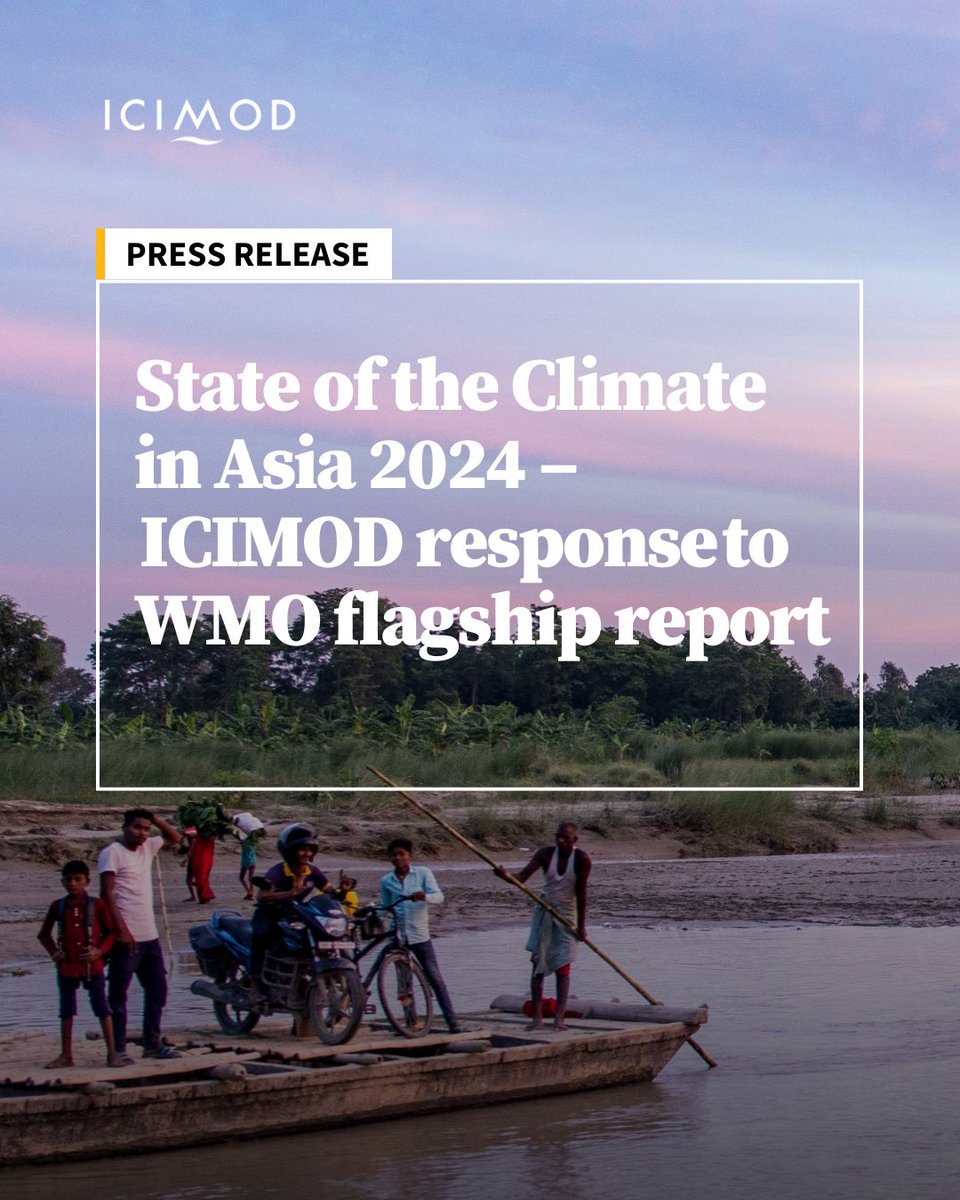
@icimod responds to @WMO's State of the Climate in Asia 2024:
🚨Asia warming at 2× global rate
🌊Worst floods since 1949
🔥Myanmar hits 48.2°C
🚱4.8M in China face drought
🌧️Nepal endures record rainfall
Accelerated melting is depleting water resources, worsening early-summer shortages & heat stress across the HKH region.
Read more: https://t.co/UC3hk8O4JX
#ClimateAction @icimod@WMO
ICIMOD responds to WMO’s 2024 State of Climate Asia report with a press release.
Key takeaways for our region:
Asia is warming at twice the global average, states the World Meteorological Organisation (WMO) in report issued today
Continent ‘hit hard by rising temperatures and extreme weather’, states United Nations’ authority on climate, weather, and water
Floods in Asia in 2024 were some of the most severe precipitation-related events since records began in 1949.
Weather extremes, from prolonged heatwaves, and drought, to rain – responsible for “havoc”, “heavy casualties”, “destruction” and “heavy economic and agricultural losses” across the continent, WMO states
4.8 million people affected by drought in China in 2024, Myanmar set a new temperature record of 48.2ºC, praise for Nepal’s coordinated response to record-breaking rainfall in September, Urumqi Glacier No.1 in China’s Eastern Tian Shan recorded most negative mass balance since records began in 1959
Reduced winter snowfall and extreme summer heat “punishing” for glaciers
Work of national meteorological and hydrological services and their partners “more important than ever”, states WMO Secretary General
Read the complete press release with expert inputs here: https://t.co/olC05eq3YU
The cryosphere is in deepest crisis—but is anyone really listening? ❄️
Glaciers are vanishing, permafrost is thawing, and snow is disappearing. The alarm bells are deafening. Yet global action remains painfully slow. #Cryosphere#ClimateCrisis
OPINION: Regional solidarity for disaster preparedness
The HKH nations are positioning themselves as active leaders for a resilient, just and sustainable future.
https://t.co/o9cQpRqSa8 —by Abrar H Hashmi