A medical student slept 10 hours every night.
Still exhausted.
Still sleepy.
Still falling asleep during lectures.
Blood tests were normal.
What neurological disorder was everyone missing?
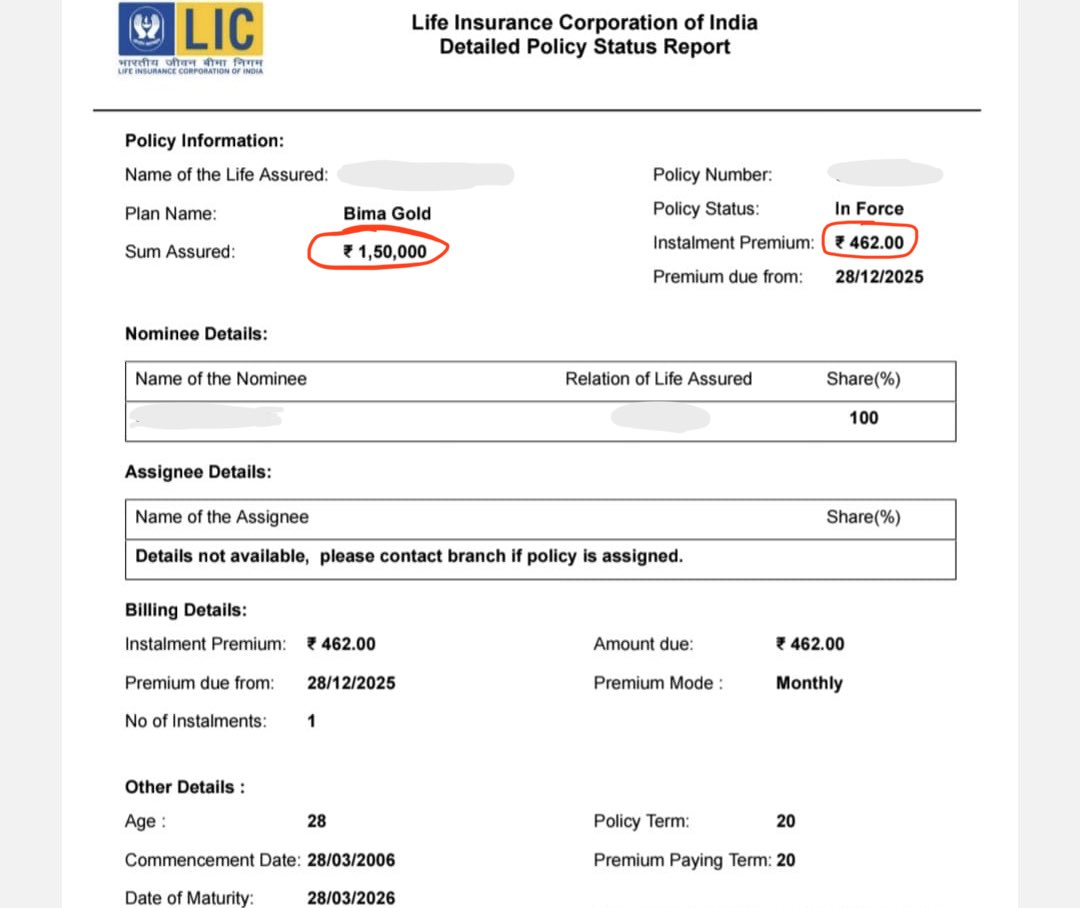
One of my relatives invested ₹462 every month in LIC from 2006, and he’s going to get ₹1.5 lakhs this year at maturity after investing for 20 years.
That’s a CAGR of around 2.98%, which is less than half of inflation. If he had invested in an FD, he would get ₹2.41L, and in a mutual fund (12% return), he would get ₹4.75L.
LIC policies only make their agents and employees richer, not the investors. Even its stock has given just 0.34% returns in the last 3.5 years.
Stay away from any friend or relative selling you LIC policies because they know the reality, and if they’re still selling them to you, they are greedy snakes and don’t have your best interests in mind.
The New Dilemma of Young Doctors:
As NEET PG counselling begins, I find myself reflecting on the messages I receive from young MBBS graduates.
Their questions have changed. They no longer ask which specialty will help them save the most lives or sharpen their medical skills the most.
Instead, they ask which branch gives less work, stable income, fewer stressors, and a peaceful work life balance.
When I look back at the previous generation of doctors, most of them came from modest backgrounds and entered medicine with hunger, grit, and the hope of building something meaningful through long hours and sacrifice.
But today’s students come from secure homes, armed with apps, notes, and online lectures. Knowledge has become bite sized, consumed for exams rather than absorbed for depth.
I see bright minds drowning in overload, losing curiosity, losing passion, exhausted before their journey truly begins.
And then there is the system they walk into. Gone are the days when a young specialist could open a small clinic, build trust, grow slowly, and take pride in independence.
The rise of corporate hospitals has changed everything. Young doctors now see seniors stretched thin, doing endless duties, facing medicolegal risk, and carrying emotional scars.
They see depression, burnout, even death by suicide at rates far higher than the general population. They watch years of training lead to the same pay scale as a PHC doctor and very little autonomy. It no longer feels like a noble climb. It feels like walking into a tunnel where passion gets traded for survival.
So when the new generation chooses work life balance over traditional glory, I do not see weakness. I see a response to a system that asks for sacrifice without giving dignity in return. And honestly, I do not blame them.
If we continue down this path, government hospitals will worsen, specialists will shrink, and the common man will suffer most. This is not a commentary on students changing. It is a call for the system to evolve. They are not choosing comfort. They are choosing sanity. And their hesitation, their questions, their fear, it is all a signal.
A signal we must listen to before silence turns into a crisis we cannot reverse.
In the end, I must acknowledge that these thoughts are not mine alone. This is a summary of an article written by Dr Sivabalan, Professor and Head, Department of Psychiatry at Sri Lalithambigai Medical College and Hospital, Chennai.
His words reflect what many of us are witnessing in the medical community today, a shift in priorities, a silent crisis in training and motivation, and a system that needs urgent reform. I am simply sharing his insight because it perfectly mirrors what I see around me as well.
There has to be a time in your life where you have.
- No girlfriend
- No side Chics
- Few friends
Just you and your grind.
That phase is called the Ghost Mode, and you can make the greatest comeback of your life.
Here is how to have a successful Ghost Mode......
It isn’t about passing a funded account or getting to payout. It is about repeatability.
Can you repeat your performance over and over and over and over again? If so then you have attained generational wealth, it is only a matter of time
Most traders learn.
Some apply.
Few reflect.
Almost none refine.
That’s why they stay stuck.
Here’s the 4-step loop that actually builds skill in trading:
👇
Most traders don’t fail because of strategy.
They fail because of:
– No journaling
– No trade reviews
– No data-driven decisions
– No accountability
– No real growth
Track like a pro—or keep guessing.
People put a ton of pressure on themselves by telling the entire world they are going to become a trader.
It’s best to work in silence.
People around you will know when you make it.
There will be signs. 🪧
When HTF order flow is bullish...
EVERY bearish PD Array on the LTF will fail. Your SIBIs will turn into inverted FVG or BPRs. Your order blocks will turn into mitigation blocks or breakers.
Stop thinking you are finding high probability setups from lower timeframe traps.
make a daily checklist of tasks you need to get done
start with something easy to cross off
that small win triggers dopamine and puts you in a momentum loop
which will make it easier to do the higher effort tasks
Exceptional traders are defined by their drawdown periods.
How well they handle it, how well they’re able to come out of it and how they manage risk and execution during that phase.
That’s one question I always ask traders to understand how good they really are.
—> tell me about a time you were in drawdown and how you managed to get out of it?
This is where most traders usually blow up or never gain back real confidence.
I’ve been watching the markets a lot the past two weeks, and so far I’ve placed 0 trades.
I’ve always have a difficult time kicking the year off and putting on my first one to two trades.
I’ve realized that if I go into drawdown early on, it kills my momentum for the year. Which also adds some hesitation to take on trades.
Mind you, I’ve been trading for 11+ years and still struggle with this issue.
97% of you will continue to fail and lose in trading, that’s the harsh truth.
You’re not prepared to manage money because you’re still stuck in a gambler’s mindset.
Your expectations are unrealistic, and you’re not grounded in the realities of what it takes to succeed.
You’re avoiding the work & the hours you need to put in to get to the position you want to be in.
Yet you think the market owes you anything? You still treat this like a game and not the professional business it is.
it’ll continue chew you up & spit you out until you have serious talk with yourself about changing.