We live in a country where many judges remain silent when it comes to the issues faced by doctors.
But the moment their own blood pressure crosses 160 mmHg,
they ask their assistant,
“Please arrange an appointment with the best doctor at the best private hospital.”
That is the reality.
Just watched a documentary on the James Webb Space Telescope, and the ending left me strangely overwhelmed.
After years of extraordinary work by scientists, the telescope finally showed us images of our universe—and suddenly, our everyday concerns felt incredibly small.
The universe is ancient, vast, perhaps infinite. We are here for barely 70–100 years, and yet we spend so much of that precious time arguing over who will win the next election, BJP or Congress, whether India will become “developed” by 2047, or getting trapped in countless day-to-day conflicts.
Meanwhile, time keeps moving.
What struck me most was the scientist who dedicated a significant part of his life to this project—not for fame or politics, but simply to help humanity understand where we came from and what exists beyond us.
Please watch this documentary. It genuinely makes you pause and rethink what we choose to do with our limited time.
And I sincerely hope ISRO and NASA collaborate even more closely in the future. Imagine what we could discover together about the universe, the possibility of life beyond Earth, and answers to questions humanity has been asking for centuries.
We are tiny.
Our time is short.
But our curiosity is limitless. 🌌🇮🇳
@dr_yograj@TinyDhillon@ajaykraina
Nepal has reportedly witnessed a tsunami-like water surge that was said to be more than 50 feet high.
It is an extremely tragic incident and my deepest condolences are with the families who have lost their loved ones.
But this is exactly why we need to talk about disasters before they happen, not only after tragedy strikes.
I also want to raise the same concern about Uttarakhand and Himachal Pradesh.
Please, let us have a nationwide discussion about the way tourism is being promoted in these Himalayan states.
The government’s objective of increasing tourism, generating more revenue, and using that revenue for public welfare is not wrong in itself.
The problem is the method of execution.
We cannot keep exploiting nature in the name of tourism.
Instead, tourism in the Himalayas needs to be strictly regulated, scientifically planned, and kept within the ecological carrying capacity of these regions.
If the revenue generated from tourism is important for the states, perhaps the Central Government should consider providing greater financial support to them, rather than encouraging unlimited tourism and construction.
If we preserve the natural beauty and ecological stability of the Himalayas and restrict tourism to sustainable levels, perhaps we can actually save the Himalayas for future generations.
Look at Nainital.
The Lower Mall Road had been sinking and facing structural problems for a long time, and it has remained closed.
Now, even the Upper Mall Road has started showing signs of damage.
Yet, we still haven't seen the kind of nationwide discussion and serious policy debate that this situation deserves.
Look at Himachal Pradesh as well.
Multi-storey apartments are being constructed in areas that were never designed to sustain such levels of urbanisation.
Businessmen from Delhi, Mumbai and other major cities are buying and settling in these Himalayan regions.
The Bir-Billing area has undergone massive commercialisation.
But hardly anyone wants to have a serious conversation about the environmental consequences of this uncontrolled development.
Instead, whenever these issues are discussed, the conversation quickly becomes:
What did Congress say about BJP?
What did BJP say about Congress?
We need to move beyond this political blame game.
The Himalayas are not a political battleground. They are an ecological lifeline.
If we don't have this conversation before the next disaster, we will once again be discussing the tragedy only after lives and livelihoods have already been lost.
#Himalayas #nepalflood2026 #uttrakhand #himachalpradesh
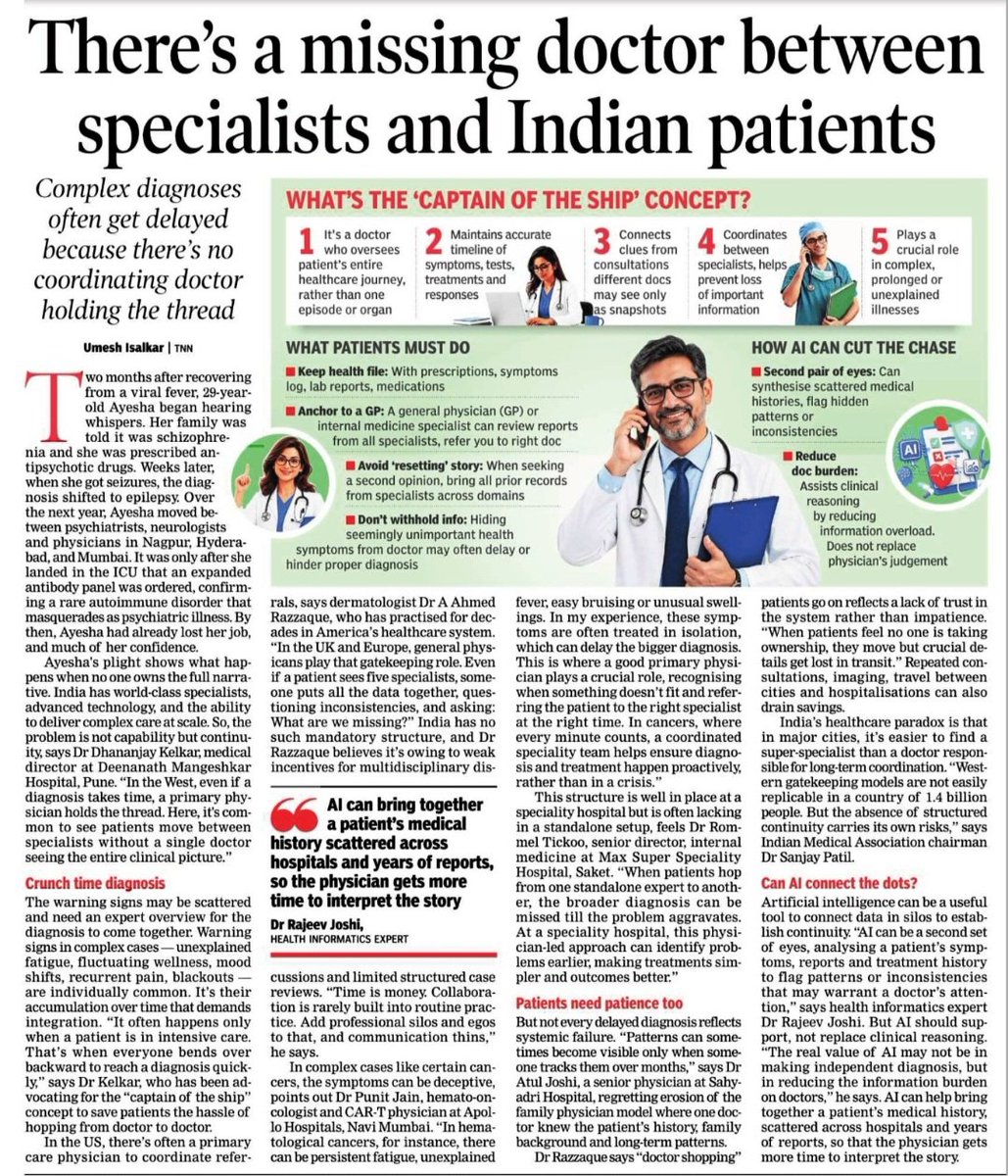
There is a missing link between specialists and patients in India due to the absence of a primary coordinating doctor or General Practitioner (GP) who handles long-term care management and brings all medical records together.
Key Elements of the "Captain of the Ship" ConceptCentral Oversight:
A single doctor oversees the patient's entire healthcare journey rather than focusing on an isolated medical episode.
Timeline Maintenance: They maintain an accurate, chronological timeline of symptoms, tests, treatments, and medication responses.
Connecting Clues: They evaluate consultation summaries from different specialists that might otherwise be viewed only as disjointed snapshots.
Coordination Between Specialists: They bridge the communication gap between multiple experts to prevent the loss of critical health information.
Complex Illness Management: They play a decisive role when dealing with complex, prolonged, or completely unexplained conditions.
What Patients Must Do...
Keep an organized health file including prescriptions, symptom logs, laboratory reports, and medication histories.
Anchor themselves to a trusted General Practitioner or Internal Medicine Specialist to review outside reports.Avoid resetting their medical story by carrying all previous records across domain lines when seeking a second opinion.
Disclose all symptoms without holding back information, as seemingly minor symptoms can influence a proper diagnosis.
How AI Can Assist....
Synthesize fragmented medical histories and surface hidden symptom patterns or logical inconsistencies across datasets.
Support clinical reasoning and cut administrative burdens to minimize electronic information overload.Act purely as a collaborative second pair of eyes without replacing actual physician judgement.
Sir, the biggest problem is that whenever we post something genuinely good or meaningful on social media, a certain percentage of people immediately start looking for one thing: “What is wrong with this?”
Their first instinct is to find a fault, criticize it, and start an argument. Very rarely do they acknowledge what is correct, what is useful, or what is actually worth appreciating.
Most of the people participating in such discussions are mediocre non-medicos who have little understanding of basic medical science, clinical practice, or treatment protocols.
Many of them see complications that are clearly mentioned in our textbooks and taught to us during medical training, and then interpret those very complications in real life as “doctor negligence.”
And then we have another uncomfortable issue within our own fraternity.
Some doctors - including senior doctors and medical influencers - make reels where they reveal patient identities, faces or identifiable clinical details.
At that point, shouldn't we ask them: Where did your medical ethics go? Where did patient confidentiality go?
Almost every doctor-influencer on Instagram appears in scrubs while making videos, constantly projecting: “Look, I am a doctor"
Everyone in healthcare knows the primary purpose of scrubs: maintaining hygiene and reducing contamination in clinical environments.
Yet today, many doctors wear scrubs simply to create the impression of being a doctor and to attract more attention on social media.
There is nothing wrong with educating the public or creating awareness.
But when the primary motivation becomes more views, more followers, monetisation, and ultimately more OPD, we need to question where the profession ends and self-promotion begins.
Our seniors in medical college taught us something very basic: the doctor–patient interaction is supposed to take place within a confidential clinical space.
Our textbooks taught us the same thing.
Patient confidentiality, dignity, and trust are not outdated concepts.
Medicine is a profession built on trust - not a content-creation business built on views.
Imagine if social media closed every day at 6pm like a shop.
We would all be forced to meet up and speak to each other in real life, to be present with our families, to go outside, to read, to make art, music………..
एक ₹3.37 लाख करोड़ का सवाल!
#ViksitBharatReality
केंद्रीय बजट 2026–27 के अनुसार:
• SC कल्याण आवंटन: ₹1.96 लाख करोड़
• ST कल्याण आवंटन: ₹1.41 लाख करोड़
• SC + ST: ₹3.37 लाख करोड़
• शिक्षा मंत्रालय: ₹1.39 लाख करोड़
• अंतरिक्ष विभाग: लगभग ₹13,706 करोड़
यानी SC+ST कल्याण के लिए आवंटित राशि पूरे शिक्षा मंत्रालय के बजट से 2.4 गुना से भी अधिक और ISRO के बजट से लगभग 25 गुना है।
सामाजिक न्याय महत्वपूर्ण है, लेकिन योग्यता, शिक्षा, वैज्ञानिक अनुसंधान और राष्ट्रीय तकनीकी क्षमता भी उतनी ही महत्वपूर्ण हैं।
सवाल किसी समुदाय के कल्याण का नहीं, बल्कि राष्ट्रीय प्राथमिकताओं और संसाधनों के संतुलन का है।
यही वास्तविकता है।
स्रोत: केंद्रीय बजट 2026–27, भारत सरकार — https://t.co/TFdIg3tpkX
We often hear a bureaucrat or a politician, after retirement, saying that “I was told to do this, so I had to do it.”
“I was instructed to do that, so I had no choice.”
Interestingly, their ambition to change the country suddenly awakens after retirement but while they are in office, before retirement, their priorities often seem limited to themselves and their families.
The country suddenly becomes important only after retirement.
Sir, I saw the comments under your post, and people have expressed mixed opinions about the tweet and the handwriting of the PG resident.
First of all, the PG resident has very good handwriting. If she is able to prepare multiple discharge summaries throughout the day with such handwriting, that is genuinely commendable. She certainly seems to be a hardworking resident.
Secondly, the liver specialist is also right in saying that government hospitals should move towards digital discharge summaries rather than relying on hard copies. The system definitely needs improvement.
In fact, I work in a Delhi government hospital myself. Even today, we are preparing hard-copy documents; almost nothing has become digital, except MLCs. MLCs have only recently started being made digitally - until about six months ago, those were also prepared manually.
Thirdly, since she is a resident—probably a PG-1 we should give her the benefit of the doubt regarding the protocol and management mentioned in the discharge summary. That is a separate matter for discussion between the senior resident and the PG resident and should not necessarily be judged by someone outside that clinical hierarchy.
So, in the end: yes, the handwriting is genuinely very good! 😄
Wishing the resident all the very best for her training and career.
Good evening, Sir
नितिन गडकरी ने अपनी ही पार्टी में जो सेंध लगाई है और अपने पारिवारिक कारोबार को आगे बढ़ाने के लिए देश को जो नुकसान पहुँचाया है, उसे इतिहास निश्चित रूप से याद रखेगा।
कुछ साल पहले उन्हें “रोड ट्रांसपोर्ट मिनिस्ट्री का किंग” कहा जाता था।
लेकिन आज वह एक ऐसे व्यक्ति के अलावा कुछ नहीं रह गए हैं, जो अपने ही शब्दों पर खरा नहीं उतरता, जो यह समझता है कि जनता को आसानी से बरगलाया जा सकता है और जो इस भ्रम में जीता है कि वह जो कुछ भी कर रहा है, वह देश के लिए ही कर रहा है।
लेकिन उन्होंने युवाओं के बीच एक अलग तरह की क्रांति की शुरुआत जरूर कर दी है।
2047 तक भारत विकसित राष्ट्र बने या न बने,
लेकिन उनके जैसे नेताओं को व्यवस्था से बाहर करने का फैसला जनता जरूर करेगी।
जनता देख रही है।
जनता सीख रही है।
और अंततः फैसला भी जनता ही करती है।
Over the past few months, the backlash that you are seeing against the BJP has become increasingly visible.
The actions and statements of its leaders - whether it is the Chief Minister of Madhya Pradesh, Nitin Gadkari, or Dharmendra Pradhan - along with issues concerning basic necessities, schools, roads, fuel policies, and everyday governance, are now becoming subjects of public discussion.
For the last twelve years, the BJP, through its IT cell and various affiliated organisations, has made consistent efforts to ensure that such issues remain hidden from the public, or at least do not become subjects of widespread discussion.
But now, a saturation point seems to have been reached in people’s minds.
People are increasingly able to distinguish between what is right and what is wrong.
The reason is simple: these issues are no longer abstract political debates. They are beginning to directly affect the personal lives of ordinary individuals.
When an office-going person finds himself struggling even to afford or access fuel, he starts questioning the system.
When a child grows up and realises that the school he has been studying in still has a broken roof, inadequate infrastructure, or basic deficiencies, that child eventually begins to question why things have not changed.
And think about the generation that was young in 2014.
Those children have grown up by 2026.
They have spent their formative years watching the country evolve - or, in many cases, watching the same problems continue year after year.
They can now compare what they were promised in 2014 with what they are experiencing in 2026.
And when they look at the current trajectory, many of them are beginning to ask a very simple question:
If the situation in 2026 still resembles what existed in 2014, then what guarantees that these same problems will not continue all the way to 2047?
This is perhaps one of the reasons why the political narrative is changing.
People are no longer discussing these issues merely because someone told them to.
They are discussing them because they are experiencing them in their own lives.
And let me make one thing clear to some Congress supporters who may be reading this: Just because I am criticising the BJP does not mean I am supporting the Congress.
No.
I do not want the BJP, the Congress, or any other party merely for the sake of having a political party in power.
What we need is a genuine political alternative - a party whose core agenda is centred on issues that directly affect the future of ordinary Indians:
Free and quality education.
Reservation reforms.
Judicial reforms.
UPSC and civil-service reforms.
Healthcare reforms.
We need a political party that is judged by the quality of its policies, institutions, governance and outcomes - not by its ideology, propaganda, or political branding.
India needs better alternatives, not simply a change of political flag.
Delhi’s smaller government hospitals often struggle to follow proper triage in emergency departments - not because doctors don’t understand triage, but because of overwhelming patient load.
One emergency queue may include a true emergency, a cough, a headache, someone asking for a multivitamin injection and someone with 15-day-old limb pain.
Emergency departments are for emergencies.
For problems persisting for days or weeks, there is something called OPD.
I hope the general public understands this distinction.
I know a person who spends his entire day defending reservation on Instagram and X, often attacking those who question it and even spreading abusive content in the comment sections of the activists but when his own family member developed a heart-related problem, his priority suddenly changed.
He asked me to recommend the best cardiologist in Delhi - not the most convenient, not the nearest, but the very best and that raises an uncomfortable question - If merit is constantly rejected or criticised in everyday discourse, why does it become the first priority when it comes to the health and future of one’s own family?
We all want the best doctor, best engineer, best institution, and best service for our families. That is the contradiction India needs to confront.
The real issue is not helping the disadvantaged. The real issue is whether merit should be compromised or should remain the standard, when excellence matters most.
@ajeetbharti@neha_laldas@talk2anuradha@RHAreforms@WokeFuneral@Sanjay_Dixit@jsaideepak@JaipurDialogues@AKTKbasics
Whatever talent, skill or gift God has given you will never go to waste.
A flower is given its fragrance so it can leave that fragrance behind before it withers away. Lata Mangeshkar was blessed with a beautiful voice, and she shared that gift with the world.
In the same way, your talent will find its way to the world. Maybe today, maybe years from now - but when the time is right, you will recognize it, nurture it, and show the world what you are capable of.
So don’t worry. Trust the timing. Your gift was given to you for a reason.
Good morning. 🌸
In my school, there used to be a ST student in my class.
Yes, you heard that right - ST.
After passing out, he took four attempts to crack NEET-UG at that time.
Even with a very low score in comparison to general category cut-offs, he secured admission to Maulana Azad Medical College, Delhi, through the ST quota.
During MBBS:
First year — supplementary in 2 subjects.
Second year — supplementary in 1 subject.
Third year — supplementary in 2 subjects.
Fourth year — supplementary in 4 subjects.
After completing his internship, he made another five attempts for NEET-PG.
Again, using the applicable ST reservation provisions, he secured admission to a GMC.
Now, anyone looking at this entire journey can understand the concern.
A person who required so many attempts just to clear the entrance examination, despite benefiting from multiple reservation provisions, will eventually enter postgraduate training and ultimately clinical practice.
And that raises a serious question: What happens when such a doctor is eventually responsible for patients in a ward, an emergency room or an operation theatre?
This is not about targeting an individual or an entire community.
This is about one fundamental principle: In medicine, competency must always come before everything else because ultimately, a patient’s life is at stake.
A hundred years from now, two hundred years from now or perhaps three hundred years from now, when a Class 6 teacher tells students: “Once upon a time, students could get admission to become doctors and engineers even with minus 40 marks.”
The students might laugh so hard that they would fall out of their chairs and honestly, it doesn’t seem impossible anymore.
I am confident that this day will come.
So, Modi Ji, keep the ‘Viksit Bharat 2047’ slogan aside for a moment.
First fix 2026.
When Will Doctors Feel Safe?
A junior doctor I know runs a small private setup in the Narela area of Delhi.
A few days ago, a patient with a deep and serious stab injury was brought to his clinic by 4–5 people who were not even the patient’s relatives.
The patient was hemodynamically stable, but given the nature of the injury, my junior followed the appropriate medico-legal protocol.
He explained that a MLC was required before proceeding further and referred the patient to a higher centre with complete documentation as it was a small private clinic setup with no proper emergency resources.
The paperwork clearly mentioned that the patient had refused MLC.
The patient received treatment at the higher centre, recovered and was discharged.
And then came the shocking part.
A complaint was filed against the doctor and his clinic, alleging that the doctor had deliberately delayed treatment, made a false police complaint and that the patient could have died because of him and even police is teasing him for a written apology to the patient for mutual compromise.
This is the dilemma doctors face every single day.
If we start treating a serious stab injury without following the required medico-legal process in a small setup and the patient deteriorates or dies, who will be held responsible?
The doctor.
Who will face the legal consequences?
The doctor.
Whose career, reputation and medical licence will be at stake?
The doctor’s.
The patient may walk away after recovery.
But the doctor may spend years defending himself.
This is not just a Delhi issue.
It is a nationwide concern affecting doctors, nurses and every healthcare professional, whether working in a corporate hospital, government hospital or a small private clinic.
Today, healthcare workers increasingly feel that they are not legally or professionally safe while doing their duty.
We can write about it.
We can speak about it.
We can raise our voices.
But if the system continues to remain blind, deaf and mute to the genuine safety concerns of healthcare professionals, then what exactly are we expecting doctors to do?
Doctors need protection while saving lives; not punishment for following protocols.
@sumersethi