SpaceX is the most overhyped IPO of the decade and it will end exactly the way every overhyped IPO ends. Facebook IPO’d at $38 and traded under that for 15 months. Uber IPO’d at $45 and is still below that adjusted seven years later for a while. WeWork tried at $47 billion and ended at zero. Robinhood IPO’d at $38, hit $85, then $7. Coinbase IPO’d at $381 and was at $40 two years later. Rivian IPO’d at a $100 billion valuation with no meaningful revenue and gave back 90%. Beyond Meat. Peloton. Lyft. DoorDash. Bird. Each one a “generational company” the day it priced.
Each one a wealth destruction event for retail within 18 months. The pattern is not a coincidence. Hype IPOs are designed to transfer wealth from the people buying the story to the people who built the story. The bankers get paid. The early employees get out. The VCs get a markup they can show their LPs. The retail investor gets the bag. SpaceX is a great company. That has nothing to do with whether it’s a great stock at IPO. Greatness was already priced in five funding rounds ago. You are not getting in early. You are buying the exit. The only IPO worth chasing is the one nobody is talking about. Those don’t exist anymore because every IPO is marketed like a movie release. So the answer is: don’t chase. Wait two years. Buy it down 70% when the lockup unwinds and the narrative breaks. Or don’t buy it at all and put the money somewhere the bankers haven’t already extracted the alpha. Hype is not an asset class. It’s a tax.
BREAKING: Liberals vote AGAINST a Conservative motion to declare Carney’s promised Pacific pipeline in Canada’s national interest, and then shut down debate on it.
After 11 years of trying to kill Canada's energy sector, the Liberals now claim to support pipelines. But when put to the test, they VOTED AGAINST our motion to endorse pipelines to the west coast.
Conservatives will continue to fight for pipelines in all directions, to create jobs, increase production, and support Canada’s allies for the benefit of all Canadians.
Federalists are willing to admit Alberta has been treated unfairly by Ottawa. But when pressed for solutions, they offer process, patience, and platitudes—not structural change, no solutions.
Albertans have heard enough acknowledgments. What’s missing from federalists is a real path forward.
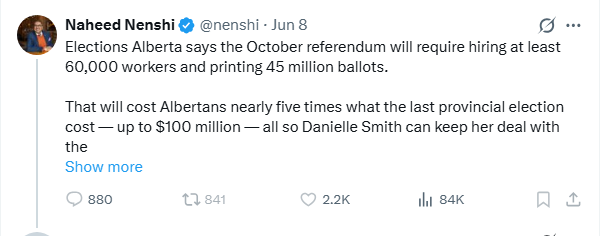
You know the NDP are losing their mind, when their leader is upset about hiring 60,000 government employees.
And for the record, there's 2.9 million eligible voters in Alberta, At best we'll need 18 million ballots.
More than two weeks after "Lead Not Leave" launched, Albertans are still waiting for their plan to fix Canada.
Respectfully, “lead, not leave” is a slogan—not a mechanism. Alberta has already tried leading Canada for decades. We helped elect Mulroney, built Preston Manning’s Reform movement, sent Stephen Harper and Jason Kenney to Ottawa, and continue to support national conservative leaders.
But establishment conservatism has not delivered structural constitutional change for Alberta.
The historical record matters. Meech failed. Charlottetown failed. In 2021, over 62% of Albertans voted for equalization reform, only to be ignored by Ottawa and the premiers.
If "Lead Not Leave" has a credible path to a fair deal, Albertans deserve to see it.
Until then, an independence referendum remains the only practical way to force a real negotiation over Alberta’s future including Alberta's right to become an independent country.
The MOU was sold by some as a breakthrough for Alberta energy. But Cenovus CEO Jon McKenzie now says the proposed West Coast pipeline is “unfinanceable” under Canada’s current regulatory framework.
That is the point.
Ottawa’s impositions still make Alberta energy less competitive, harder to finance, and harder to get to market. Alberta does not need another political promise. We need freedom from the federal barriers holding our economy back. Alberta independence. https://t.co/xgzAxfkZYb
I will "go against" any level of government that tries to interfere with legal, campaign advertising by a registered third-party advertiser.
Thanks for asking.
In Ottawa, an Alberta pipeline is now being labeled as violence against women.
This is not a United Canada, and this is not a place for a Strong Alberta.
On October 19th, remember this and vote for your freedom.
Vote for Option 2.
🚨🇪🇺REMEMBER : Elon Musk just put the EU chief back in her place!
Von der Leyen was preaching about "democracy" until Musk hit her with a truth bomb:
"If democracy is the foundation of freedom, surely your position as leader of the EU should be elected directly by the people?"
Great video! I like Pierre too and I would vote for him in a federal election. We are currently still Canadian and may be forever? Who knows? But what many are starting to realize is that no matter who we vote for, it just doesn't matter out here.
The period from 1870 to 1913 witnessed the most spectacular economic growth in human history, and you can thank the gold standard for making it possible. Real wages doubled in America. Railroad mileage exploded from 53,000 to 254,000 miles. Steel production increased twenty-fold. Population centers transformed into industrial powerhouses virtually overnight. Sound money created the foundation for genuine capital accumulation.
Under gold, entrepreneurs could calculate decades into the future without worrying about central bankers debasing their savings. Andrew Carnegie built his steel empire because he knew the purchasing power of his profits wouldn't evaporate through monetary manipulation. John D. Rockefeller revolutionized oil refining because stable money allowed long-term planning. These men risked enormous sums precisely because gold prevented government from stealing their wealth through inflation.
The productivity gains were staggering. Between 1880 and 1900, manufacturing output per worker increased by 65 percent. Prices fell consistently (deflation was normal and healthy), which meant your purchasing power grew every year you delayed consumption. Real interest rates reflected actual time preference and productivity, not central bank targets. Capital flowed to its most productive uses because price signals weren't distorted by monetary debasement.
Compare this to our fiat era: since 1971, productivity growth has stagnated, real wages have barely budged, and asset bubbles have replaced genuine wealth creation. The Federal Reserve calls 2% annual theft "price stability" while wondering why inequality keeps rising. They've replaced the automatic discipline of gold with the arbitrary whims of PhD economists who think they can fine-tune a $26 trillion economy.
You want to understand why your generation can't afford houses while previous generations built transcontinental railroads? We abandoned the monetary system that funded the greatest economic boom in recorded history.