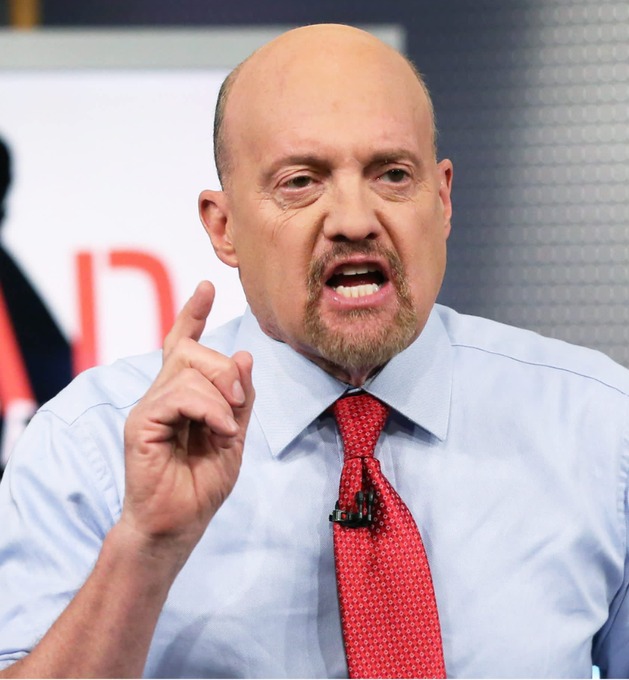
Jim Cramer expressed clear skepticism toward $ASTS, stating that the stock is essentially “fighting the Fed” and that he is not excited about it.
He was even more dismissive of $IREN, bluntly saying “we don’t want IREN.”
Nvidia ($NVDA) is reportedly in talks to provide over $5 billion in credit guarantees to support Nscale’s development of a 460 MW data center. This facility is backed by a ~$45 billion multi-year compute contract with Anthropic ($ANT).
Unlike typical GPU residual-value or take-or-pay backstops, these guarantees would primarily cover power infrastructure and construction financing (land, power, and shell). By leveraging Nvidia’s strong investment-grade credit profile, the structure aims to:
Accelerate deployment of next-generation Vera Rubin (and related) capacity
Reduce borrowing costs for Nscale and similar neocloud customers
Help convert large contracted demand into operational AI compute more quickly
This approach reflects Nvidia’s expanding role beyond chip supplier—acting as a strategic financial backstop to de-risk and scale the AI infrastructure ecosystem. Talks remain ongoing and terms are not finalized (source: The Information, citing people familiar with the matter).
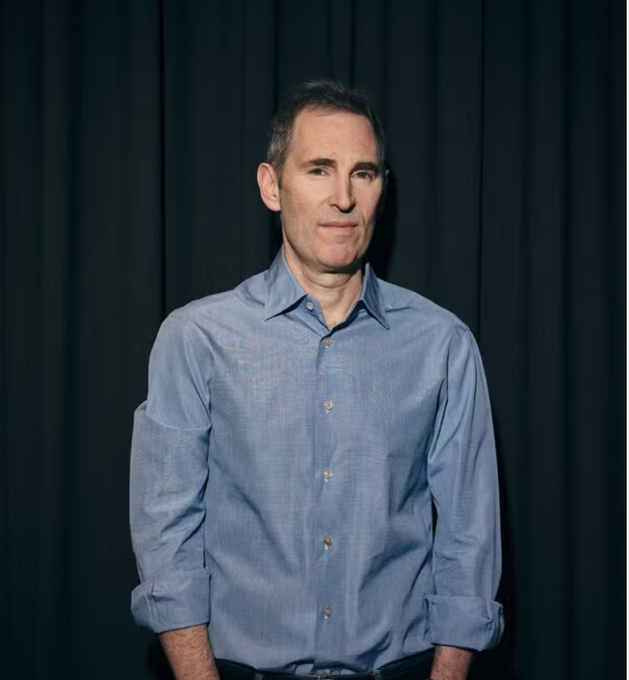
Amazon ($AMZN) plans to begin selling its custom Trainium AI chips to external customers outside of AWS starting in late 2027. CEO Andy Jassy has described this as the foundation for “a very significant business” in external chip sales.
What makes the strategy particularly compelling is Jassy’s observation that the same chips generate substantially higher cumulative cash flow when deployed inside AWS over a 5- to 6-year period. Amazon is therefore positioning itself to capture value on two fronts: upfront revenue from direct chip sales and the much larger, recurring cash flows that come from long-term cloud usage of those chips.
In short, Amazon is building a dual-engine model — selling the silicon while continuing to monetize the infrastructure that runs on it.
$AMZN confirms that Amazon Leo (formerly Project Kuiper) remains on track to begin initial commercial satellite broadband service by the end of 2026. With nearly 400 satellites already in orbit, the company is positioning itself as a major new entrant in the satellite internet market.
Its planned $11.5 billion acquisition of Globalstar (recently approved by the FCC) will significantly strengthen this strategy. The deal provides Amazon with valuable mobile-satellite spectrum and an existing partnership with $AAPL, enabling expansion into satellite-to-phone (direct-to-device) connectivity. This allows smartphones and other devices to connect directly to satellites without specialized hardware.
Meanwhile, competitors $ASTS (AST SpaceMobile) and $SPCX (SpaceX/Starlink) continue building out their own direct-to-device and broadband networks, intensifying competition in the rapidly growing space-based connectivity sector.
$AMZN – Scale Meets the Last 100 Yards
Amazon CEO Andy Jassy has confirmed the company now operates over one million robots across its fulfillment network. These systems already handle key tasks such as stowing, picking, sorting, and intra-facility transport, delivering meaningful gains in speed, safety, and cost efficiency.
The next frontier is clear: automating the final 100 yards of delivery—the last, most expensive, and labor-intensive stretch from vehicle to doorstep. At Amazon’s volume, even modest reductions in labor cost per package compound into substantial margin expansion for the retail business.
With robotics still described by Jassy as being in the “early stages,” continued advances in form factors, grasping, intelligence, and real-world deployment could further widen Amazon’s cost and speed advantage. This is a classic scale-driven operating leverage story: the bigger the network, the more powerful every incremental efficiency becomes.
$INTC
Intel CEO Lip-Bu Tan projects the server CPU market will grow ~5x to over $200 billion within five years, driven by the rise of AI agents.
He noted: “The ratio of CPU to GPUs used to be 1-to-8 and now it is 1-to-4.”
This shift effectively doubles the number of CPUs needed per GPU, as AI agents require significantly more general-purpose compute for orchestration, tool calling, control flow, and sequential logic.
The result is a major new growth vector for $AMD, $ARM, and $NVDA—extending well beyond pure GPU demand and creating a broader AI infrastructure opportunity across the entire CPU ecosystem.
Amazon CEO Andy Jassy confirmed that AWS capacity is already sold out for 2026, largely sold out for 2027, and a meaningful portion of 2028 is also committed—despite ~$220 billion in planned CapEx this year. Customers are consuming new capacity almost as soon as it comes online, constrained mainly by data-center space, power, and memory. Jassy noted Amazon “could invest a lot more and it wouldn’t be a bad use of capital.”
This undersupply is structural: even Google Cloud has started renting third-party compute capacity because hyperscalers cannot build fast enough.
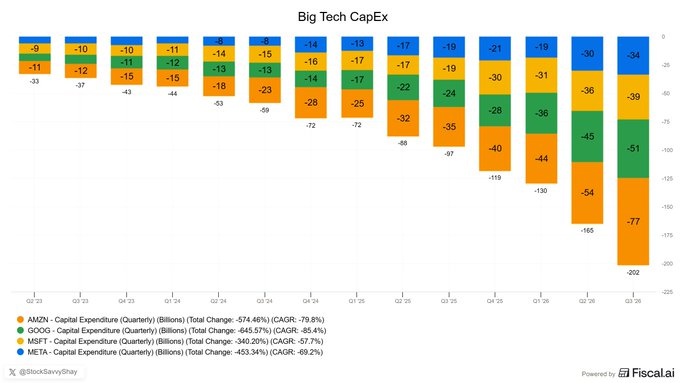
The Big 4 hyperscalers have reported their latest quarterly capital expenditures (primarily for AI data centers, servers, chips, networking, and power infrastructure), with a combined total exceeding $200 billion:
• Amazon (AMZN): ~$77B (Q3 2026 purchases of property and equipment; significantly above prior-quarter levels and analyst estimates; driven mainly by AWS and generative AI)
• Alphabet (GOOGL): ~$51B (Jul–Sep 2026)
• Microsoft (MSFT): ~$39B (latest reported quarter)
• Meta (META): ~$34B (Q3 2026, including principal payments on finance leases)
Key context: These figures reflect the ongoing AI infrastructure arms race. Amazon alone accounts for a large share and maintained its full-year 2026 cash CapEx guidance at approximately $220 billion. Collectively, the four companies’ 2026 guidance is in the range of roughly $720–745 billion (Amazon ~$220B; Alphabet $195–205B; Microsoft ~$170–175B after accounting adjustments; Meta $130–145B). Spending continues to pressure free cash flow at several of the firms while supporting rapid cloud/AI demand growth.
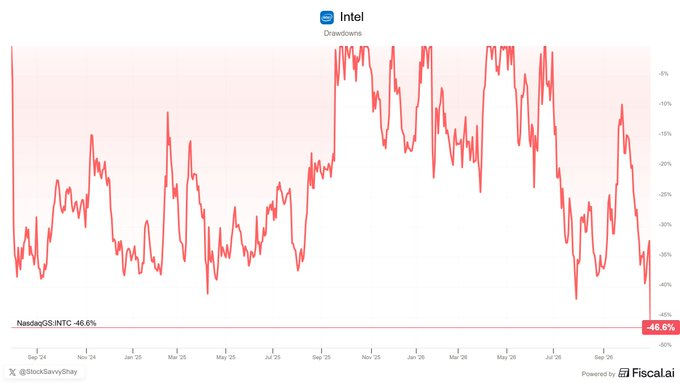
$INTC is currently experiencing its deepest drawdown in more than two years.
As of late October 2026, the stock is trading around $91–95, roughly 32–35% below its recent peak of approximately $142.35 (reached in June 2026). This marks one of the largest peak-to-trough declines the shares have seen since mid-2024.
$AMZN
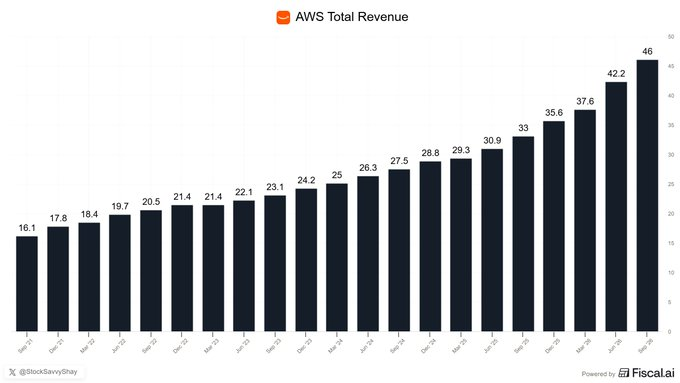
Amazon CEO Andy Jassy stated that AWS projects revenue growth of over 40% in both 2027 and 2028, even though the segment is already generating well over $100 billion annually (Q3 2026 annualized run rate reached approximately $184 billion).
With AWS capacity largely sold out through 2027 and a substantial portion of 2028 already committed, the primary constraint is no longer demand—it is execution. The key question becomes how quickly Amazon can bring additional power infrastructure and Trainium capacity online to convert this strong visibility into realized revenue.
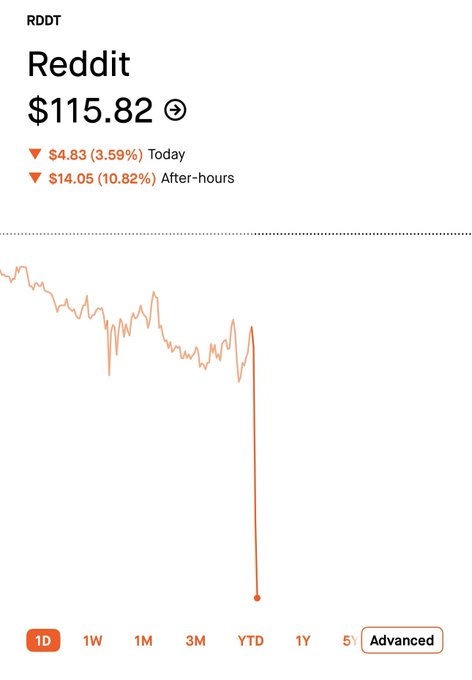
Q3 Actual ResultsMetric
Actual
Estimate
Result
Revenue
$895M
$875M
Beat (+2.3%)
EPS
$1.40
$1.33
Beat (+5.3%)
EBITDA
$402M
$397M
Beat (+1.3%)
Daily Active Users (DAUs)
130.3M
133.4M
Miss (-2.3%)
Q4 GuidanceMetric
Guidance
Estimate
Outlook
Revenue
$1.02B
$1.05B
Below (~-2.9%)
EBITDA
$495M
$509M
Below (~-2.8%)
Key Takeaway:
Strong operational beat on revenue, EPS, and EBITDA in Q3, but softer user growth and more cautious Q4 outlook.
Amazon ($AMZN) Q3 2026 Earnings SummaryAmazon reported mixed Q3 results on October 29, 2026:Revenue: $201.9 billion (slightly below estimate of ~$202.1B; +12% YoY, or +13% excluding FX)
EPS: $1.89 (missed estimate of ~$1.96)
AWS Revenue: $46.0 billion (beat estimate of ~$44.9B; +39.3% YoY — fastest growth in nearly five years, annualized run rate of $184B)
Operating Income: $28.1 billion (beat estimate of ~$26.1B; operating margin 13.9%, Amazon’s highest ever)
Key highlights: AWS continued its strong acceleration, driven by AI demand. North America and International segments also showed solid profitability gains. Net income was $20.7B ($1.89 diluted EPS), down slightly YoY mainly due to the absence of prior-year investment gains related to Anthropic.
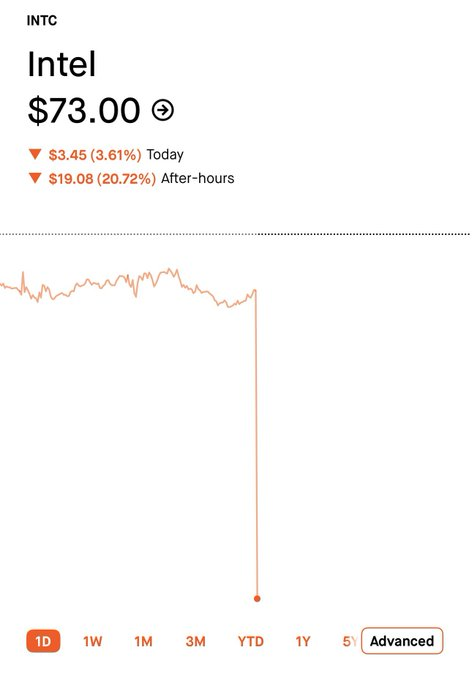
Intel ($INTC) Q3 2026 Earnings SummaryQ3 Results
• Revenue: $16.5 billion (in line with estimates of $16.5B)
• EPS: $0.52 (beat estimates of $0.40)
• Gross Margin: 44% (beat estimates of 42%)Q4 Guidance
• Revenue: $15.5 billion (below estimates of $17.1B)
• EPS: $0.25 (below estimates of $0.43)Intel delivered a solid third-quarter performance with an earnings beat and better-than-expected profitability, but its fourth-quarter outlook came in weaker than Wall Street anticipated, particularly on revenue and earnings. This mixed report highlights ongoing execution progress alongside near-term demand or margin pressures that investors will closely watch.
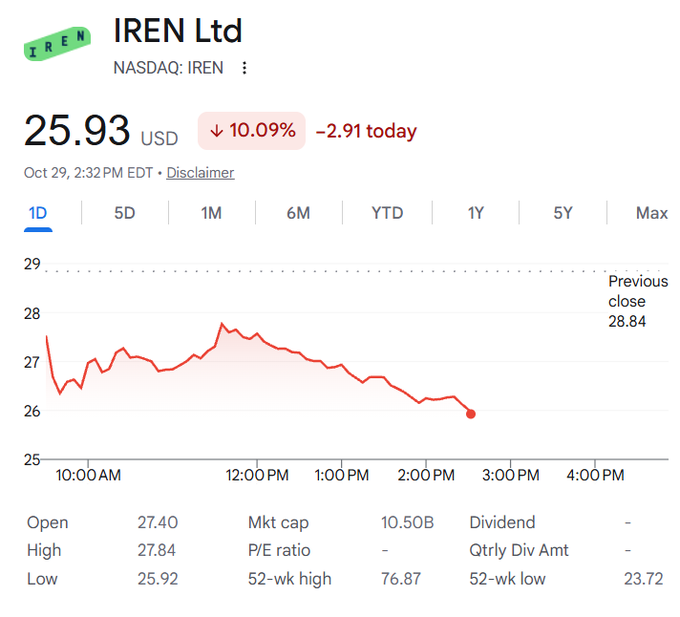
IREN Limited ($IREN) shares are down roughly 7–10% on October 29, 2026 (trading around $26 after a prior close of $28.84). The decline is part of a broader sell-off in AI infrastructure and “neocloud” stocks, driven by concerns over Microsoft’s capital-spending outlook, delayed third-party capacity, high funding costs, and execution risks amid heavy GPU/AI buildout plans.
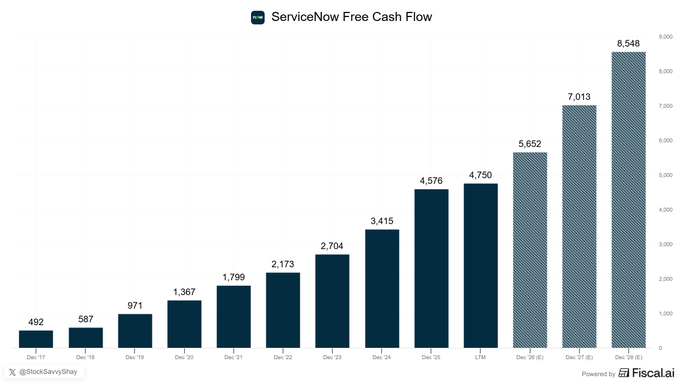
$NOW just posted its worst single-day drop on record, even as free cash flow is still projected to nearly double by 2028.
The core issue is that the market wants clearer proof AI can meaningfully accelerate the overall business. ServiceNow has raised its year-end AI ACV target from ~$1 billion at the start of 2026 to $1.7 billion, and agentic AI production usage is up 13× year-over-year. Yet these gains still need to drive faster growth in a roughly $16 billion subscription base rather than simply sustain the current mid-20% trajectory.
Rocket Lab ($RKLB) has scheduled its 99th Electron launch for next week (NET November 3, 2026), with the 100th rocket already nearing delivery to Launch Complex 1.
While the larger Neutron rocket’s debut has been delayed into 2027 due to carbon-composite manufacturing issues, Rocket Lab continues to expand its operational experience through a high Electron launch cadence and is deepening its defense relationships via multiple U.S. Space Force and other national-security contracts.
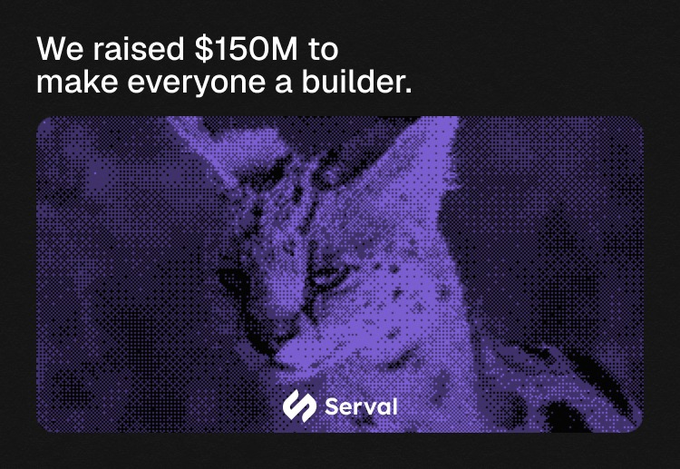
Serval has raised $150 million in a Series C round at a $3 billion valuation, led by Sequoia Capital. The funding will scale Catalyst, its AI automation agent that converts natural-language requests into secure, deterministic workflows for IT, finance, HR, and other departments.
Notably, the company plans to hire more than 100 Automation Engineers (as part of a broader push to add over 500 employees). This underscores a key industry reality: while building AI agents has become easier, the real challenge remains reliably deploying and integrating them into complex enterprise environments.
Robyn has launched an invite-only personal agentic platform that lets users create and deploy AI agents with a single sentence—no complex setup required. These agents come preloaded with the user’s context, can connect to apps, run tasks autonomously (including in the background), and deliver updates via text or the web. Founder Jenny Shao says early users report saving around 20 hours per week.
This points to a clear shift in AI toward true personal agents that operate independently and can be shared more like apps than one-off chatbots.
Meet Robyn, the personal agentic platform built around your life and work.
- Tell her what you need in one sentence. No setup, ever.
- Spin up a fleet of agents preloaded with your context that work while you sleep.
- Access it on the web or just text it.
- 20hrs/week saved per user.
I’m Jenny, and I spent 3 years working with Nobel Laureate Eric Kandel, who mapped out memory in the human brain.
We built all of that into Robyn, making it the first AI capable of taking intelligent action.
Invite only access opens today. We’re giving out 1000 invite codes. Link in first comment. Comment "Robyn" for 100 free credits.
Microsoft ($MSFT) has fully erased its post-earnings gains. After a strong Q1 FY2027 report (revenue $92.28B, +19% YoY; adjusted EPS $4.89; Azure +48% to $33.17B; free cash flow beat by ~$10B), shares jumped roughly 3–4% in after-hours and premarket trading on October 28–29. By midday on the reaction day, however, the stock has given back the entire move and is trading near or below its pre-earnings close amid broader tech weakness (Alphabet’s sharp drop and ongoing AI-capex concerns).