For anyone curious how flat face couplings work (and how air entering the system is kept to an absolute minimum), this animation from Stauff provides a great overview of the operating principle:
People often mistake our new builds for historic renovations. Townsend is no exception. We’re not trying to make anything look old — we’re simply using the methods and materials that were standard a hundred years ago, and for most people the only reference point for that craft is the historic buildings still standing.
When you respect masonry as a material, and how it works in compression rather than tension, you are limited. Arches need certain dimensionality to support the weight above them; natural stones need thickness to span a window; large openings need “buttressing” at the ends to carry the load to the ground.
Historic buildings were guided by these limitations; there was no way around them for thousands of years (until the advent of mass-produced steel).
Our eyes have grown accustomed to the proportions of real masonry buildings, and it’s why modern brick buildings don’t fit into that intuitive understanding. Something looks off. People may not be able to point out why it looks off, or exactly what is different about our buildings, but they sense it. They know it.
@matt_hayes4 and I are good designers (we designed Townsend together), but I believe it’s our respect and understanding of the material itself that makes Building Culture’s work stand out. Rather than trying to overcome the limitations of masonry, making it do something it wasn’t intended to do with steel, we celebrate those limitations.
There is a whole world of exploration within the material. As any artist will tell you: limitations are the key to creativity. The geometries inherent in compression-only buildings reflect the laws of nature, and are harmonious – just like all the great buildings throughout history.
We’re not copying historic buildings; we’re trying to build the future’s historic buildings.
I’m so happy that I read he was okay enough to be cracking jokes while waiting for the emts, because now I don’t have to feel guilty about using those last two pics as reactions to everything for the rest of my life
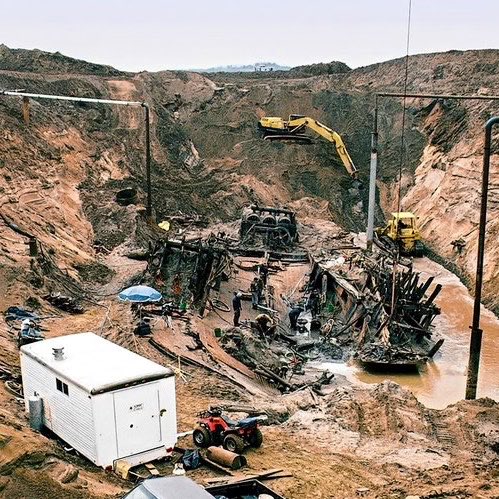
In 1988, the Hawley family began excavating a Kansas cornfield after old river maps, survey records, and local accounts placed the steamboat Arabia beneath it.
About 45 feet down, they reached the wreck.
The Arabia had struck a submerged cottonwood snag and sunk in the Missouri River in 1856. The boat still lay where it went down, but by the time the excavation began, the active river channel was nearly half a mile away.
The Missouri had shifted across its floodplain. Repeated floods buried the abandoned channel beneath sand, silt, and mud until the wreck sat below working farmland.
What came out of that old riverbed was more than a shipwreck.
The cargo was a large commercial shipment from one precisely dated voyage. It had been packed in St. Louis for merchants farther upriver and sank before it could be divided among stores and customers.
The shipment included commercial quantities of footwear, hardware, ceramics, textiles, medicines, preserved foods, tools, and household goods. Archaeologists were looking at merchandise before use, breakage, repair, reuse, and disposal altered the assemblage.
That is rare.
Many nineteenth century sites are built from refuse, loss, demolition, and repeated occupation. The Arabia preserved a shipment before it entered any of those processes.
Waterlogged, low oxygen sediment slowed the decay of leather, wood, textiles, seeds, and food that normally survive poorly at dry sites. The result was an unusually large, tightly dated collection of mid nineteenth century goods from the Missouri River trade.
People remember the Arabia because someone found a steamboat beneath a cornfield.
I remember it because the field used to be the Missouri River.
Putting chicken wire around my kale to keep the chickens from eating all of it so that the caterpillars have something to snack on so they can in turn end up becoming snacks for the chickens.