Official account of DramaPilot — AI-native workflow for short dramas. From idea or novel to script, characters, storyboards, and video. Built by @Solvyn_ai.
One idea is all it takes to create an AI short drama.
DramaPilot takes you from scripts and character design to storyboards, shot control, video generation, and episode export—all in one workflow.
Start creating: https://t.co/A8uxtm55Wc
#DramaPilot#AIShortDrama
This is an original supernatural mystery created with DramaPilot—from story structure and scene planning to connected AI video shots.
Explore DramaPilot: https://t.co/A8uxtm55Wc
What would you do if your own number called—and warned you not to open the door?
Our original AI micro-drama, The Call From Tomorrow, was created with DramaPilot.
Watch “Don’t Open the Door” below. The story script is in the reply.
#AIShortDrama#AIVideo#DramaPilot
The story script behind Episode 1:
THE CALL FROM TOMORROW
Episode 1 — “Don’t Open the Door”
0:00–0:15 — The Impossible Call
At 2:17 a.m., Emma is sketching alone while rain falls outside. Her phone vibrates. The caller image is her own face.
EMMA: “That’s my number.”
An older, exhausted version of Emma answers through the phone.
FUTURE EMMA: “In five seconds, someone will knock.”
0:15–0:30 — The Knock
FUTURE EMMA: “Whatever he says, don’t open the door.”
EMMA: “Who is this?”
The call drops. Five knocks strike the apartment door. Water begins leaking beneath the kitchen sink.
NOAH, FROM THE HALLWAY: “Emma, open up. Your kitchen’s leaking.”
0:30–0:45 — The Shadow
Emma approaches the chain. Her phone suddenly reconnects.
FUTURE EMMA: “That’s not Noah.”
Through the peephole, Noah looks completely normal—except when he shifts his weight, his shadow stays frozen for one beat.
0:45–1:00 — He Knows
Emma receives a photograph of the real Noah lying unconscious one floor below. She backs away from the locked door.
The man outside speaks in Noah’s voice.
IMPOSTOR: “Emma... I know you’re watching.”
The lamp goes dark.
Would you open the door?
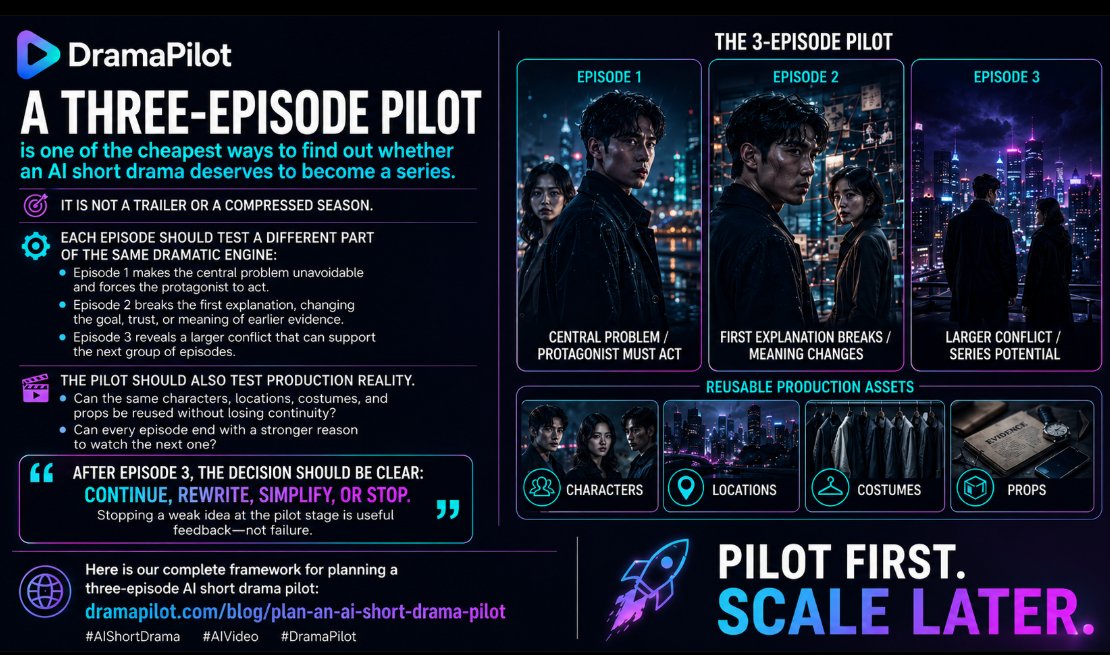
A three-episode pilot is one of the cheapest ways to find out whether an AI short drama deserves to become a series.
It is not a trailer or a compressed season. Each episode should test a different part of the same dramatic engine:
• Episode 1 makes the central problem unavoidable and forces the protagonist to act.
• Episode 2 breaks the first explanation, changing the goal, trust, or meaning of earlier evidence.
• Episode 3 reveals a larger conflict that can support the next group of episodes.
The pilot should also test production reality. Can the same characters, locations, costumes, and props be reused without losing continuity? Can every episode end with a stronger reason to watch the next one?
After Episode 3, the decision should be clear: continue, rewrite, simplify, or stop. Stopping a weak idea at the pilot stage is useful feedback—not failure.
Here is our complete framework for planning a three-episode AI short drama pilot:
https://t.co/Iiod7nXapJ
#AIShortDrama #AIVideo #DramaPilot
We made this AI short drama with DramaPilot.
From one story idea to a structured script, characters, shots, and a finished scene — the goal is not just to generate a beautiful clip, but to keep the story coherent.
Watch the result below. The script is in the reply below.
Made with: https://t.co/15eR9kolEE
Handheld mini DV camcorder footage filmed by the subject herself. Slight hand shake, occasional focus hunting, imperfect framing, natural zoom adjustments, soft tape-like image quality, subtle grain, realistic auto-exposure shifts from bright natural daylight. Natural skin tones, mild motion blur, authentic consumer camcorder aesthetic.
STYLE:
Cozy flower-pressing vlog with gentle ASMR elements. Relaxed pacing, minimal dialogue, candid moments. Focus on satisfying sounds: petals rustling, paper pages turning, book weight settling, tweezers picking up petals, gentle smoothing.
SUBJECT:
Young woman in her early 20s, plain linen dress, hair loose, minimal jewelry, no visible logos or branded items. Calm, gentle energy while preserving flowers.
SETTING:
Small table near a window on a bright afternoon. Soft daylight, a plain heavy book, freshly picked flowers laid out, no visible brand names or packaging in frame.
STORYBOARD:
→ (3s, propped medium shot) Places camera on the table, lays out a few fresh flowers. “Pressing some flowers today.”
→ (3s, overhead shot) Arranges petals flat between two sheets of plain paper.
→ (3s, close-up) Uses tweezers to gently position a delicate petal.
→ (3s, handheld shot) Closes the paper carefully over the flowers. “Just need to keep them flat.”
→ (3s, detail shot) Places the paper between the pages of a heavy book. No dialogue.
→ (3s, medium shot) Stacks a few more books on top for weight. “That should do it.”
→ (3s, macro shot) A previously pressed flower being lifted out, delicate and flat.
→ (3s, propped shot) Arranges the pressed flowers onto a small card.
→ (3s, warm ending shot) Admires the finished arrangement, soft smile. “So delicate and pretty.”
→ (5s, final shot) Sets the card on the windowsill, reaches toward camera. “See you next batch.” Hand covers lens as recording ends.
AUDIO NOTES:
Natural ambience — petals rustling, paper turning, book settling should be clearly audible. Dialogue quiet and casual.
REALISM NOTES:
Authentic body language, natural blinking, genuine soft smiles, occasional gentle pauses, imperfect framing, focus breathing, bright daylight shifts. No copyrighted characters, logos, brand names, or recognizable public figures anywhere in frame. Fully original personal vlog content, not AI-generated or commercial in style.
#AIShortDrama #AIVideo #DramaPilot
Scaling AI short drama production is not about generating more clips. It is about reducing the number of decisions you need to remake for every episode.
A repeatable production system keeps the same story and asset decisions connected:
• Define a series engine: protagonist, goal, opposition, and personal cost.
• Give every episode one job instead of repeating the same conflict.
• Test the premise with a three-episode pilot before building a full season.
• Treat characters, locations, wardrobes, and key props as reusable assets.
• Review shots as a sequence, not as isolated generations.
• Measure failed generations and continuity repairs, not only output volume.
The useful unit is the completed episode. A polished clip that breaks the story, character identity, or adjacent cut is still production waste.
Our complete workflow for building serialized AI short dramas:
https://t.co/ttN7yR6GXn
#AIShortDrama #DramaPilot
One of the biggest challenges in creating AI short dramas or travel vlogs isn’t the video model itself — it’s writing a prompt that stays consistent, feels authentic, and maintains character identity throughout the entire clip.
Today we used Drama Pilot’s script tool (https://t.co/aV7PPSDuJu) to generate the complete video prompt below for a single unbroken 30-second handheld boyfriend vlog in Tokyo. We then generated the final video directly inside Drama Pilot.
How we did it:
1.Went to the Drama Pilot Script page: https://t.co/aV7PPSDuJu
2.Entered the core requirements (realistic boyfriend POV, everyday Tokyo day, continuous 30-second take, strict character consistency, natural handheld feel)
3.The tool automatically produced a structured, ready-to-use video prompt
4.Copied the prompt into Drama Pilot’s video generation module and created the final clip
Full Video Prompt (Generated by Drama Pilot):
Single unbroken handheld boyfriend vlog take throughout, 30 seconds total.
A realistic personal travel vlog filmed by a boyfriend following his girlfriend during a normal day in Tokyo. Use the woman from the reference image as the main character. Maintain her exact facial identity, hairstyle, facial features, body proportions, and overall appearance throughout the entire video. She must remain the same person in every shot.
The camera feels like a real boyfriend holding a small mirrorless camera or phone, not a professional production. Natural handheld movement, imperfect framing, occasional camera shake, spontaneous reactions, authentic everyday moments. The woman does not pose for the camera. She behaves naturally, sometimes forgetting the camera is there.
0–5s: Morning at a small Tokyo apartment
The camera starts recording as the boyfriend casually walks into the room. Soft morning sunlight enters through the window. The woman is sitting near the bed, fixing her hair and preparing for the day. She notices the camera, smiles naturally, laughs, and playfully tells him to stop filming. The camera stays close, slightly shaky, capturing a private everyday moment.
5–10s: Walking through Tokyo neighborhood streets
The boyfriend follows behind her as they leave the apartment. She walks through a quiet Tokyo street, carrying a small bag. Morning shops are opening, bicycles pass by, locals walk along the street. She stops at a convenience store. The camera follows her inside. She looks at different drinks and snacks, turns around and asks the person behind the camera which one she should choose. Natural interaction, casual conversation, realistic body language.
10–18s: Local food experience
The camera follows her through a small Tokyo alley to a cozy local restaurant. She sits down and tries a bowl of ramen or a local dish. The camera captures close handheld moments: her picking up chopsticks, tasting the food, reacting naturally, laughing when the food is hotter than expected. The boyfriend laughs behind the camera. The moment feels unplanned and authentic.
18–25s: Tokyo afternoon exploration
The couple walks through a lively neighborhood. She browses small shops, looks at interesting objects, takes photos, and occasionally looks back at the camera. The camera moves naturally between her face, her hands, the street atmosphere, and small details of daily life. Crowds pass naturally around them. The city feels alive and real.
25–30s: Tokyo night ending
Night falls. The camera follows her through illuminated Tokyo streets. She walks slightly ahead, then turns back and smiles at the camera. They ride a train home. She sits beside the window, watching city lights pass outside. The camera slowly moves closer as she rests quietly, ending like a real personal memory.
Visual style
Authentic boyfriend travel vlog footage. Realistic handheld camera movement. Natural lighting. Casual documentary realism. Unplanned everyday moments. Real human expressions and interactions. Slight motion blur, natural exposure changes, realistic camera autofocus adjustments. No commercial advertisement style. No dramatic posing. No perfect cinematic composition. No text overlays. No logos. No face changes. No identity changes. No artificial transitions. No CGI feeling. Stable character consistency throughout.
Most AI short dramas do not fail because the video model is weak. They fail because production begins before the story and continuity decisions are clear.
A more controllable workflow:
1. Start with one conflict and one viewer question.
2. Plan one complete episode before expanding the series.
3. Lock the character, wardrobe, props, and location references.
4. Turn the episode into scenes, then break each scene into purposeful shots.
5. Use storyboards to solve framing, action, and continuity before generating video.
6. Generate one focused shot at a time instead of asking one prompt to perform an entire scene.
7. Review the shots as a sequence, then add dialogue, sound, captions, and final pacing.
The production unit is not the individual AI clip. It is the completed episode. A beautiful shot is only useful when it preserves the character, advances the conflict, and connects naturally to the shots around it.
We put the complete step-by-step workflow here:
https://t.co/pR4aBescSM
#AIShortDrama #DramaPilot
Built with DramaPilot.
This 30-second AI travel vlog started with a structured script and moved through our connected AI video workflow—from planning to final generation.
More experiments from @DramaPilotLab ↓
https://t.co/A8uxtm55Wc
#AIVideo#DramaPilot
From airport check-in to her first steps in Tokyo—this 30-second AI travel vlog was created through DramaPilot’s AI video workflow, from script and visual planning to final video generation.
Create with DramaPilot: https://t.co/jGzjRH4Ayg
#AIVideo#DramaPilot
From script to final video, this eyewear ad was created with DramaPilot. Build your next AI video workflow here: https://t.co/ZE8haVRIwl #AIStorytelling
From concept to a finished eyewear ad—this video was created with DramaPilot: script, visuals, and video.
An AI storytelling experiment by @DramaPilotLab, powered by @DramaPilot.
https://t.co/jGzjRH4Ayg
#AIVideo#AIStorytelling
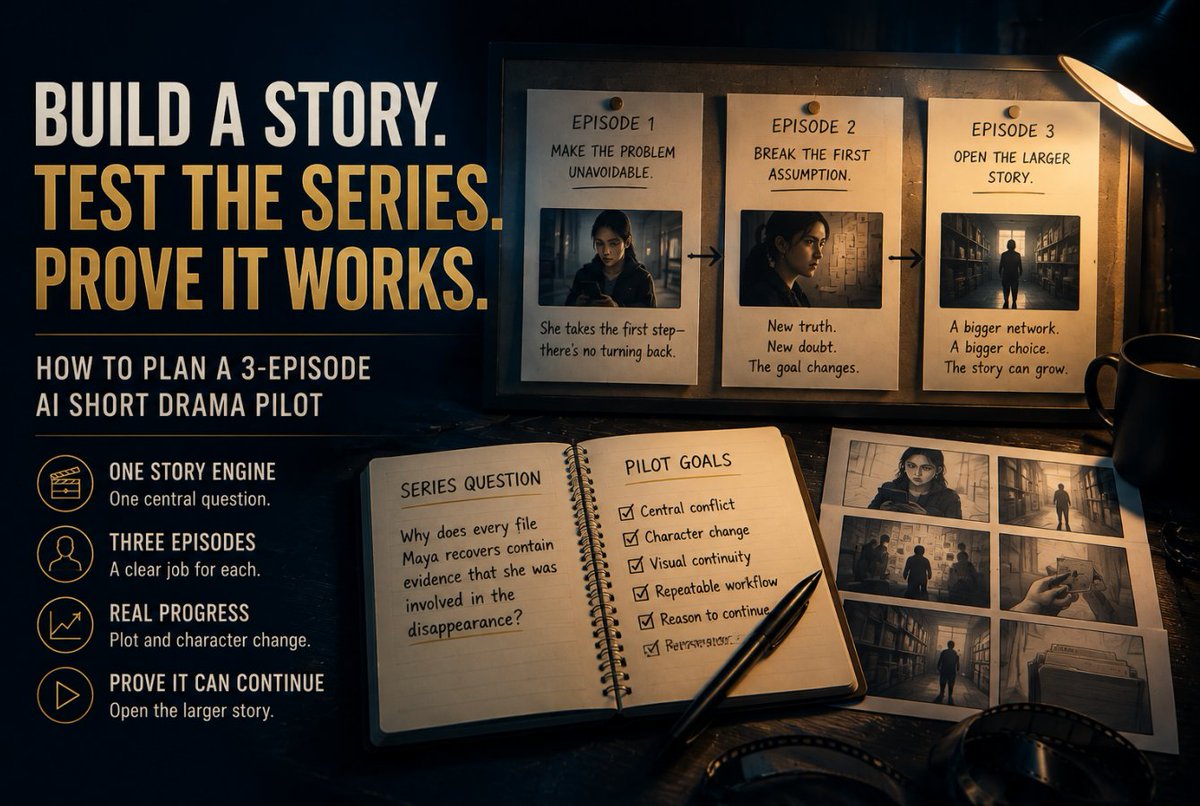
Plan AI short dramas as a chain of changes: one job per episode, one escalating conflict, and one new question at each ending. A 5-episode example: https://t.co/9Bd1u0T9wy #AIShortDrama#DramaPilot
Choose the fewest episodes that can hold real reversals. A bigger count cannot fix a vague premise.
AI mode for story ideas; Novel to script for DOCX: https://t.co/30DKIYwYwe #AIScriptwriting#DramaPilot@dramapilot
After Episode 3, continue, rewrite, simplify, or stop. A pilot is useful when it makes that decision early—before a weak premise becomes a full season.
A 3-episode AI short drama pilot tests whether a story deserves more production: conflict, character change, reusable assets, and connected endings. Checklist: https://t.co/75deLgSb1k #AIDrama#DramaPilot
Keep the asset set small: one protagonist, two or three locations, recurring props, and a visual rule for each place. Reuse gives both production continuity and audience memory.