Evolutionary anthropologist investigating how movement through habitat influences form and behavior of primates, specifically with regards to vocal signaling.
The central thrust of my doctoral thesis on non-human primates: precision landing in time-sensitive locomotor transitions indirectly selects for musical calling. Thanks to @bioRxiv for automatically tweeting my pre-print (and to @AndreaRavignani for the RT!)
https://t.co/d7eo084CGf A new book on "a really admirable way to live" ... E.g., devoted to proving the legend of "Orang Pendek" a habitually bipedal ape living on the island of Sumatra. (FYI: Gibbons currently exist as the most bipedal non-human primate at nearly 10% of locomotor bouts)
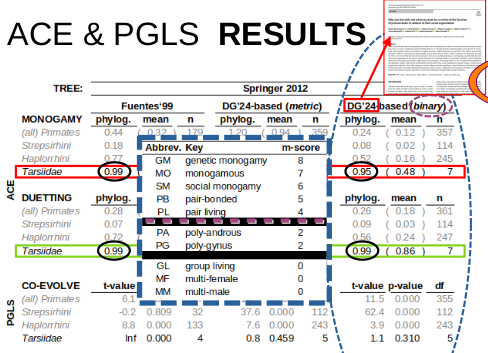
I also attended the IPS'25 meeting where I presented a talk on the strong evolutionary correlations between social monogamy and duetting, especially in tarsiers. We concluded that predation pressure from big mainland cats led to reversals of duetting in tarsiers west of the Wallace line.
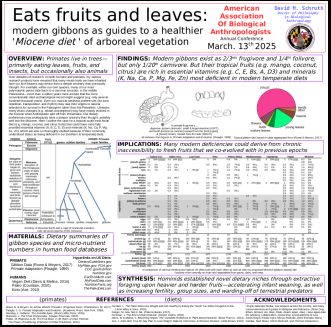
In, 2025 I went to fewer conferences, but I did manage to prominently highlight dietary aspects of "A Gibbon Guide to Health & Harmony" in a poster at the AABA meeting. In both publications, I introduced the "Miocene Diet" as a (more compelling) predecessor to the popular "Paleo Diet"
After my photographic odyssey through SE Asia in 2023, I self-published a book about gibbons! Although a first edition copy was sent to Jane Goodall only months before her passing, very few other primatologists have copies of "A Gibbon Guide to Health & Harmony." https://t.co/E03WmLi5oV
Music/song are terms often reserved only for humans & birds, but what about primates? Researchers probe the origins of musicality by evaluating the links between musical features & potential ecological drivers of its evolution across primate species
#AJBA
https://t.co/2xQKALSfot
@ChrisStringer65@argeire My most recent peer-reviewed article--on the likely very ancient origin of [one of] our most cherished of modern human behaviors: musicality--has generated interest even amongst the vanguard of the out-of-Africa human origins theorists.
Lastly, I am excited to finally have publicly shared my (information-theory based model-selection) findings [from a key PhD chapter] surrounding the motion-based influences on the evolution of musicality in our lineage. https://t.co/pIxAlVI5OS
This past year I traveled to the exotic jungles of Southeast Asia (including Thailand, Malaysia, and the Indonesian islands of Sumatra, Borneo, Sulawesi and Java) where I encountered wild gibbons & tarsiers (as well as many monkeys, langurs, & orangutans)!
I also followed-up on the effects of predation (and groups) on primate acoustic output (e.g. rhythm ~ group size) as part of a larger collaborative project with Joseph Jordania (as well as C. Zuberbuhler, @TecumsehFitch, & Steven Brown) on possible early human defense strategies.
Sojourn to saga: from amateur observations of chimp termite fishing, to NatGeo funding, then a PhD in Ethology. @Dr_jane_goodall discusses movement, art, language, empathy, conservation, and hope on the David Rubenstein Show https://t.co/QwQQHLtqE0
There have been several great "Solo" movies in recent years, but I felt compelled to share a link to this particular recent (2023) documentary: on “finding” the last [a widower] gibbon in an urban park just east of downtown Kuala Lumpur.
https://t.co/kfbCk4BkZi
Short & neat paper https://t.co/OzvWyDzoP0 by @ChiaraDeGregor7, @AndreaRavignani, @Marco_Gamba, and colleagues on isocronyism in 3 crested [Vietnamese] gibbons housed in European zoos. Great to see more study on these species that have been so rarely observable by westerners.
Incredibly proud to see this out at last: https://t.co/pgEm7ZzfCd We show that speciality and ecology are in fact the least significant forces in brain size evolution once we account for parental provisioning #comparative#brain#birds
Many of these ideas, especially relating to mate-choice, parental care, monogamy, spatial-ecology, and signalling of musicality were explored in a preprint https://t.co/cdCqXogVVd using primate brain data 8/8
2022 was both an intellectually inclusive and productive year of theorizing, coding, and writing. I presented at 7 academic meetings, showcased 2 software packages, and also embarked into doubly unusual (topic and evidence) territory for a new preprint 1/8
I unveiled two new R packages: one that facilitates merging of 'primate' database tables @_useRconf https://t.co/rs1YQYXZoK, and another 'mmodely', that combines model selection (and averaging) with phylogenetic regression analyses https://t.co/sdM7RNv3DO 7/8