Most teams are building the wrong layer of their agent stack.
There are three rungs to agent orchestration, and each one has a different right answer on build versus buy.
Rung one is a single prompt chain. Buy it, any orchestration platform handles this without drama.
Rung two is a multi-step workflow with branching and retries. Still buy it and configure it. Building this yourself is reinventing a wheel that several vendors already sell.
Rung three is multi-agent work where your own business logic lives in the handoffs between agents. That's the one worth building, because the logic is the product and no platform can know what you know about your business.
Most teams build rung three tooling for a rung one problem, then wonder why nothing ships.
Follow for more frameworks like this one, and like this if you've watched a team over-engineer an orchestration layer nobody needed yet.
Does the AI model matter? Shar says it's the idea, not the tool. Products are still running on GPT-4 while everyone is excited about GPT-6.
Full interview with a tax-tech PM at Wolters Kluwer → https://t.co/lGEmCYXx8R
#AIProductManager#Startups
Product management in the 90s and early 2000s looks almost quaint next to today's checklist. Lower stakes, fewer users, barely any regulation. A data leak back then just didn't make the news.
We added QA processes, privacy law, staged rollouts, and entire review boards since then. And bugs still ship. Data still leaks. The simplest feature still takes longer than it should.
More process didn't eliminate the problems. It just made them more expensive to have.
Like this if you've sat through three approval meetings for a change that still broke in production anyway, and follow for more on what actually changed in this job and what didn't.
T3 Code just crossed 1,042 GitHub contributors, and its creator Theo dropped a stat worth sitting with: open weight models make up less than 0.5% of its traffic.
T3 Code is open source. Anyone building on it can plug in any model they want. They're voting with API calls, and the vote isn't close.
Theo also pointed out that saying this three months ago would've gotten him death threats and a pile of ratio'd replies. This time, nothing. The usage data won the argument faster than any post could.
That's the actual lesson for anyone building agent products: watch what people run, not what people say they believe in online.
Follow if you'd rather build for real usage than for Twitter consensus, and like this if you've seen the same gap between what a community says and what it ships.
Alibaba's new benchmark for coding agents, Co-Design Bench, skips synthetic prompts. It tests 273 real tasks pulled from requests that had already caused failures in production.
The best model, GPT-6 Astra, fully completed 26.4% of them. The same models clear 99% on the older benchmarks most teams still quote.
Partial credit is the difference. Those older evals score an agent on how much of a task it got right. Your users score it on whether it's done.
If your own eval suite still rewards "mostly correct," you're optimizing for a number your users will never see.
Like this if you've shipped a feature that aced the demo and died in production, and follow for more on what's actually worth measuring before you ship.
Who is AI software for? People are building basic AI agents for small businesses that can't afford a $2,000-a-month product, like tax tools for mom-and-pop shops.
Full interview with a tax-tech PM at Wolters Kluwer → https://t.co/lGEmCYXx8R
#AIAgents#SmallBusiness
Can AI coding tools make you a millionaire overnight? Shar says that's a falsity. You can build real products, but discovery and product-market fit still come first.
Full interview with a tax-tech PM at Wolters Kluwer → https://t.co/lGEmCYWZjj
#VibeCoding#AIProductManager
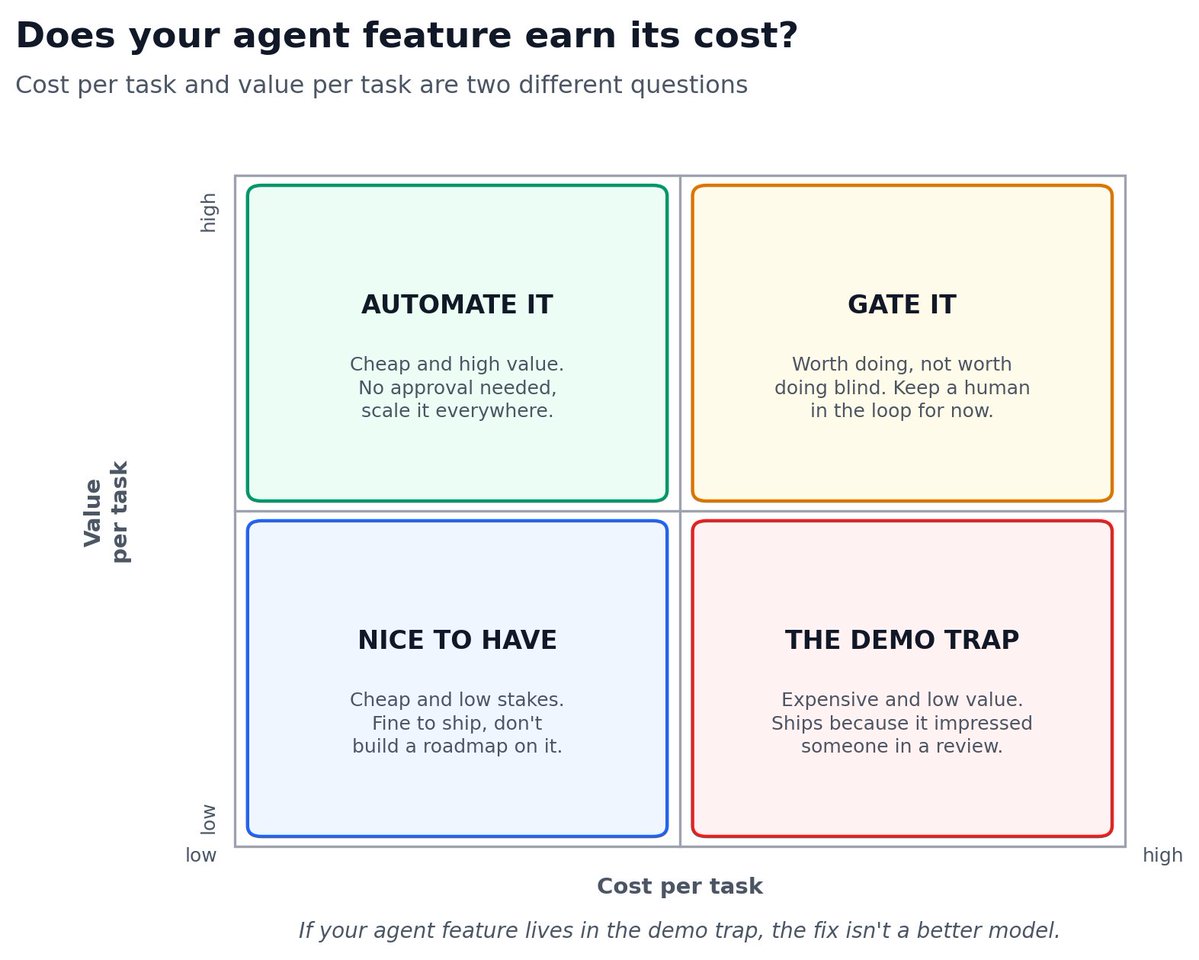
Most teams evaluate an AI agent feature by asking if it works. What matters more is what it costs per task against what that task is worth.
Plot those two axes and you get four different product decisions.
Low cost, high value: automate it everywhere, no approval needed.
High cost, high value: worth doing, but keep a human in the loop until the cost drops.
Low cost, low value: fine as a nice to have, do not build a roadmap around it.
High cost, low value: the one that ships anyway because the demo looked great.
If your agent feature lives in that last box, the roadmap problem isn't the model. It's the business case.
Follow for more frameworks like this one, and like it if you have shipped something from that last box.
What if your company blocks ChatGPT? Use it at home. Build your own ideas and put them on your personal website to show you can work with AI tools.
Full interview with a tax-tech PM at Wolters Kluwer → https://t.co/lGEmCYXx8R
#AIProductManager#PMJobSearch
Most product discovery I have watched isn't discovery. It is stalling with extra steps.
Discovery earns its place when you are testing a genuinely risky bet, comparing real alternatives with users, or building the case leadership needs before funding something expensive.
It turns into theater when you already know the answer, when a cheap MVP would tell you faster, or when you are copying a solution a competitor already proved works.
When discovery takes longer than building would, you have stopped reducing risk and started avoiding a decision.
Like this if you have sat through discovery that was really just delay, and follow for more PM reality checks.
Alibaba just put Qwen4-Max into preview with no benchmark numbers attached.
There's no chart claiming it beats GPT or Claude, no percentile score, just a short post about deeper knowledge and stronger coding, then an invitation: put it to the test on a real problem, show us what you build.
Most frontier model launches lead with a benchmark chart because that is the fastest way to earn trust before anyone has touched the thing. Skipping that step reads as confidence, or as an admission the numbers aren't ready.
Either way it is a smart bet if your chart isn't strong yet. Let your users become the case study pipeline instead of making a claim you might have to walk back later.
Follow if you track how AI labs manage the story before the product can carry it alone.
Anthropic shipped five new office tools this week: Claude Meetings, Whiteboards, Sheets, Data, and Connectors. Three of them are still labeled beta.
Normally that's a yellow flag. Shipping half-finished products in your highest scrutiny week looks reckless.
But this is roadshow week. Anthropic's IPO is reportedly targeting something near a 1.4 trillion dollar valuation, and Microsoft's stock dipped within hours of the announcement.
For a company about to pitch investors, breadth beats polish right now. "We compete across the whole office stack" is a stronger slide than "our features are fully baked." Most product teams get punished for shipping unfinished work during their highest visibility week. This week, for Anthropic, it's the whole point.
Like this if you've ever watched a launch get timed for the room instead of the user, and follow for more reads on how AI companies actually ship.
Can non-coders build prototypes? ChatGPT lets a PM or a founder who isn't extremely technical build one. "A very incredible thing to have in your hands."
Full interview with a tax-tech PM at Wolters Kluwer → https://t.co/lGEmCYXx8R
#ChatGPT#AIProductManager
How fast is AI taking over work at big regulated companies? It depends on what security teams allow. With regulators watching, companies scale back before they speed up.
Full interview with a tax-tech PM at Wolters Kluwer → https://t.co/RpOWEXXZhO
#AIProductManager #EnterpriseAI
@AlexshevPm@AlexshevPm Right, and that's the step teams skip when there's pressure to show a fix already landed. A cheap test now beats an expensive rollback later.
How does Amazon use AI in product management? Underperforming processes are called defects. Find them with data, root-cause them with AI at scale, tell leaders where to invest.
Full interview with an Amazon PM → https://t.co/iybZyhpYdK
#AmazonPM#AIProductManager
@andrewsthoughts@andrewsthoughts The GitHub branches comparison makes it click. Identity feels like the real unlock though, most tools still treat an agent like a dumb service account. Watching how you handle that.
@lennysan@lennysan Tracks with what I'm seeing. AI eats the PRD and slide busywork, but deciding what not to build was always the harder job and that hasn't changed. Does the report split IC growth from PM leadership growth?
@lucasrantzau@lucasrantzau That's the real moat then, not the agent stack. Curious what you actually screen for in an interview to spot someone who already has that bar versus someone who just talks a good game about it.
@alex_dreyfus@lucasrantzau@alex_dreyfus Fair push. Short version until I actually write it up: hire for judgment first, then let people practice saying no on small decisions before a big one lands in front of them.