Somalia has been repeatedly insulted by Trump, yet its president @HassanSMohamud responds with a boneless grin, seemingly oblivious.
National leaders are meant to defend their country’s dignity, not cower in silence.
That grin 😁
Stop it!
@TheVillaSomalia#Somalia#Trump
@rigathi This sudden display of concern rings hollow.
You have previously attacked this community along tribal lines and now want to appear sympathetic when it is politically convenient.
Stop this nonsense.
@Ijabril But your excellency Mr Ambassador, over 95% of your appearances are opening new restaurants and officiating weddings. Focus on policies and national interest engagements.
@rigathi Ok. But stop using language that promotes tribalism, communal division, or vitriol.
Speak as a national leader whose words unite the country, not inflame it. Be calm, inclusive leadership.
Don't start vitriolic, divisive rhetoric now.
Engage communication expert before u utter
@Asmali77 If they are shooting videos and enjoying themselves, they have done nothing wrong. Leave them alone. So many youths are doing tik toks on the streets.
Every body is damn corrupt in Somalia. All our leaders are genetically corrupt beyond remedy!
The President s corrupt. There is evidence @HassanSMohamud.
The Prime Minister s corrupt @HamzaAbdiBarre
Seat of governance s corrupt @TheVillaSomalia
No nope
#Somalia#CORRUPTION
@HarunMaruf While the @jumuiya has chosen selective silence 🔕
Failure of Somalia foreign policy on friendship and collaboration with neighboring counteies while spending huge money on creating slippery relations with far away countries like Serbia or Azerbaijan 😀
@MOFASomalia
@MOFASomalia@AbdisalamDhaay The silence of the East African Community Secretariat is deliberate and telling.
You are talking to all these far away countries but the @jumuiya has given you the Silent treatment while all other countries and blocks have issued statements
How can anything function when every department, every ministry, and every public office is riddled with corruption on an unprecedented scale?
You take us for fools.
Donor funds are being looted openly, with no credible mechanisms to track the money or close the loopholes.
This is not isolated misconduct. It is systemic. Everyone steals
Somalia is on a steep downhill trajectory driven by the failure of President Hassan Sheikh Mohamud and his inner circle.
While the government remains consumed by corruption, incompetence, and obsessive re-election manoeuvres, leadership has collapsed, and institutions are virtually nonexistent.
The United States will withdraw military and financial support from Mogadishu, exposing a state that survives only on external scaffolding.
As support fades, the government will collapse and armed groups Al-Shabaab will take control of the capital.
This failure will trigger a geopolitical domino effect.
The United States will move first, followed by Ethiopia and then Kenya, recognising Somaliland as a matter of strategic realism.
Somaliland’s recognition will not be an act of betrayal, but the direct consequence of Mogadishu’s inability to govern, secure its territory and provide leadership.
Here Somali unity was not destroyed by foreign plots. It is being destroyed by failed leadership of this corrupt government.
#Somalia
#Somaliland
#SomalilandRecognition
@AJEnglish@ntvkenya@BBCWorld@BBCAfrica@BBCSomali@EU_in_Somalia@US2SOMALIA
The return of former President Mohamed Abdullahi Farmaajo @M_Farmaajo must be viewed through the lens of constitutional integrity and national memory.
His previous administration was defined by entrenched corruption, escalating insecurity, widespread nepotism, and a deliberate erosion of institutional accountability.
Throughout his tenure, the state drifted further away from transparency and good governance.
He continues to face serious accusations of siphoning public funds and funnelling them into foreign networks in Turkey, Dubai, and Kenya which are allegations that strike at the heart of public trust and violate the most basic principles of fiduciary responsibility.
His illegal two-year term extension remains one of the darkest constitutional crises in recent Somali history.
By relying on political manipulation, election interference, and bribery, he attempted to force through an unconstitutional mandate.
His move to dissolve Parliament and to unlawfully dismiss the caretaker Prime Minister was nothing short of a direct assault on the separation of powers, aimed purely at entrenching himself in office.
Under his leadership, Somalia’s foreign policy collapsed.
He severed relations with key neighbour countries, recalled ambassadors, and isolated the country diplomatically at a time when regional cooperation was crucial.
This isolationism placed Somalia in a deeper political and economic hole and damaged its standing in the international community.
Now, despite this track record, Farmaajo seeks re-election in 2026.
Such an ambition disregards the failures, abuses, and constitutional violations that characterised his previous tenure.
He should not be entrusted with the presidency again.
Leadership requires accountability, reliability, and respect for the rule of law, qualities he repeatedly failed to demonstrate.
Somalia deserves forward-looking leadership, not a return old corrupt leaders defined by crisis, corruption and regression.
#Somalia
#Corruption
#Mogadishu
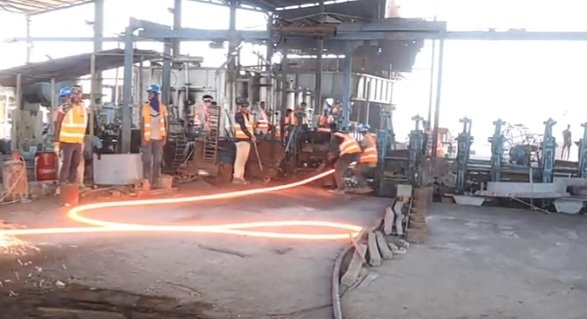
PRESIDENT BAREFOOT IN A STEEL FACTORY!
The inauguration of Banadir Steel was meant to mark a new dawn for Somali industry.
A proud testament to resilience and progress.
Instead, it exposed the deep fault lines of Somali governance and the hollowness of political symbolism that passes for leadership.
As images circulated of the President and his entourage walking through an active steel plant without helmets, reflective vests, or protective boots, the event ceased to be about industrial triumph.
It became a visual manifesto of everything that is wrong with the Somali state pointing to a leadership class that breaks the very laws it proclaims, and an advisory circle around the presidency too uninformed about industrial and occupational laws.
This was not a minor oversight. It was a public violation of occupational safety and health law, staged before our eyes, in a country struggling to rebuild its credibility.
The rule of governance gave way to the rule of appearances.
Banadir Steel’s management shares in this failure.
No serious industrial enterprise allows any person, however powerful, to enter a hazardous zone without proper protective gear.
By indulging the optics of power instead of upholding the discipline of safety, the company began its life on a foundation of impunity rather than integrity.
It is even crazier. None of the company staff working in the background during the visit were wearing PPE!
This incident is not just about missing helmets. It reveals the absence of technically competent advisers around the President, the weakness of regulatory systems, and a culture of governance that confuses ceremony for progress.
A government that cannot model compliance cannot inspire progress.
Mr president @HassanSMohamud, fire some of your advisers as they are too incompetent to guide you properly.
@TheVillaSomalia again sleeping on the job.
And the @SomaliaMolsa is as oblivious as ever.
And finally @MoH_Somalia chronically Institutionally inept!
@DalsanTv@sntvnews1
#Somalia
SOMALIA’S SECURITY CRISIS: POWER WITHOUT ACCOUNTABILITY!
Somalia stands at a crossroads.
After decades of conflict and fragile peace, the promise of a professional, accountable security sector still feels distant.
Across the country, citizens continue to live under fear, not only of armed groups but often of those who claim to protect them.
The National Intelligence and Security Agency (NISA) has evolved from a counter-terrorism body into one of the most powerful institutions in the country.
With broad powers of detention and surveillance, and almost no independent oversight, @HSNQ_NISA has become a law unto itself.
Journalists, activists, and political opponents have been detained, interrogated, and silenced often without warrants or fair trial.
Even more disturbing is the growing evidence that many of the rapes and sexual assaults reported across Somalia are committed by security personnel themselves.
Survivors often face intimidation, stigma, or outright threats when they try to seek justice.
The very forces meant to defend the people have become sources of trauma and fear.
Adding to this crisis is the epidemic proportion of drug and alcohol abuse among members of the security forces.
Substance use has become both a symptom and a driver of indiscipline, violence, and moral decay within the ranks.
Heavily armed men under the influence of drugs/alcohol pose a grave danger to civilians and to national stability itself.
Yet, the issue remains largely ignored and swept under the rug by those in power.
Equally alarming is the fact that many security personnel finish their official shifts in the morning, only to resurface at night as perpetrators of the very insecurity they are paid to combat.
Armed robberies, kidnappings, and extortion incidents frequently involve individuals with state-issued weapons and uniforms.
This dual identity (protector by day, predator by night) has eroded public trust and blurred the line between law enforcement and criminality.
The lack of accountability, supervision, and welfare support for these officers has created a dangerous underworld sustained by impunity.
At the same time, the integration of clan-based militias into formal security forces remains deeply flawed.
Fighters loyal to local leaders and clan interests are being absorbed into national units without proper vetting or retraining.
The result is an army whose allegiance is uncertain, where discipline, human-rights awareness, and professionalism is lacking.
An army built on fragmented loyalties cannot safeguard a nation just emerging from civil strife.
Meanwhile, corruption, weak command structures, and federal–state rivalries continue to undermine morale and effectiveness in the security sector.
Without tangible reforms in the security forces, Somalia risks sliding back into another cycle of civil war.
Somalia deserves a security system that protects its people, not one that preys on them.
@hrw@SNAForce@SoPoliceForce@TheVillaSomalia@EU_in_Somalia@HassanSMohamud@AJEnglish@LarryMadowo@BBCAfrica@BBCSomali@US2SOMALIA@SwedeninSomalia@ATMIS_Somalia@CNNAfrica
#Somalia #HumanRights #Accountability #EndImpunity #StopRape #SecurityReform #NISA #RuleOfLaw #JusticeForAll #PeaceBuilding
RUSHING INTO A STORM: SOMALIA’S ELECTIONS NEED JUSTICE, NOT SPEED
Democracy can not be built on quicksand.
Yet Somalia today is rushing toward a “one person, one vote” election while standing on a foundation riddled with cracks in the form of insecurity, corruption, exclusion, and institutional fragility.
The government’s drive to fast-track voter registration and constitutional reforms may look like progress, but beneath the surface lies a dangerous gamble.
A true election is not defined by ballot boxes or biometric kits contracts.
A credible election is defined by trust, fairness, and inclusion.
None of these railguards exist yet in Somalia today.
Large parts of the country remain outside government control.
Al-Shabaab rules over large swathes of the country, collects taxes, and intimidates communities who have never seen any form of government.
In such ungoverned zones, who will guarantee safety for election workers or voters?
How can we talk about universal suffrage when vast populations live in fear?
Meanwhile, the electoral commission itself lacks independence, capacity, and accountability.
It can not yet deliver credible results — not because our people lack will, but because the system was never built to stand on its own feet.
The courts that should arbitrate disputes are deeply corrupt, captured by clan interest and politics.
When justice can be bought, election petitions will become theatrics where the verdict is sold to the highest bidder.
And where there is no justice, there will be violence waiting to fill the void.
Even worse, the ongoing registration has already shown bias.
The major clans already dominate the voter registration process, minorities are sidelined, and entire communities like the Bantu communities, Benadir, and displaced families are being quietly erased from political visibility.
What is currently uniting some sections of the nation is instead the old divides based on clanism and nepotism.
This is not democracy.
It is a hurried process meant to validate power, not to return power to the people.
If Somalia proceeds down this path (rushing reforms for political gain while ignoring the country’s wounds), we risk sliding back into the very quagmire we struggled to climb out of.
A contested election in a broken system will not bring legitimacy. It will bring another disastrous civil war.
We must repair what is broken in the governance system before we pretend to celebrate what is not built.
Strengthen the electoral commission and clean the judiciary before we entrust them with electrol disputes.
Protect minorities before we call it equality.
Secure the country first before we declare universal suffrage.
Somalia deserves an election that heals not one that divides.
The current government regime may call it progress, but history will judge whether it was a race toward democracy or a sprint towards another major disaster like the one that engulfed Somalia in 1991.
@TheVillaSomalia@HassanAKhaire@HassanSMohamud@AAbdishakur@US2SOMALIA@EU_in_Somalia
#Somalia
#SomaliaElections #Democracy #Justice #Governance #Inclusion #Peacebuilding #Accountability
@_AfricanUnion
🇪🇬 Egypt hosted the Gaza Peace Summit.
Yet not a single African nation or the AU, apart from the host, had a seat at the table.
The absence of the African Union and other African states in a summit on a global humanitarian crisis reflects a troubling marginalization of the continent’s voice in peace and justice affairs.
#AfricanUnion #GazaSummit #SharmElSheikh #AfricaForPeace #AUVoiceMatters #Gaza #GlobalJustice
The proposal to introduce Swahili language in Somalia’s education system should not be seen as cultural dilution, but as a strategic opportunity for connection and progress.
Somalia today stands at the threshold of deeper integration with the East African Community (EAC).
In this regional context, language is not merely communication — it is infrastructure. Just as roads and ports connect economies, a shared language connects people, trade, and governance.
Swahili already serves as the linguistic backbone of the EAC, enabling cooperation among over 200 million speakers across Kenya, Tanzania, Uganda, Rwanda, Burundi, South Sudan, and the Democratic Republic of Congo.
For Somalia, embracing Swahili complements — not competes with — Somali and Arabic languages.
Somali remains the language of identity and heritage, Arabic the language of faith and diplomacy, while Swahili can become the language of regional integration and opportunity.
Learning Swahili will:
1) Enhance trade and mobility, especially for Somali youth seeking education and employment across the EAC.
2) Promote cross-border business, tourism, and investment by breaking communication barriers.
3) Strengthen regional peace and cooperation, since shared language reduces mistrust and fosters understanding.
4) Position Somalia as a regional player, rather than a linguistic and economic outsider.
No nation has ever weakened by learning more languages — but many have missed opportunities by isolating themselves linguistically.
Somalia can lead with confidence, preserving its identity while expanding its influence.
In an interconnected East Africa, multilingualism is not assimilation; it is empowerment.