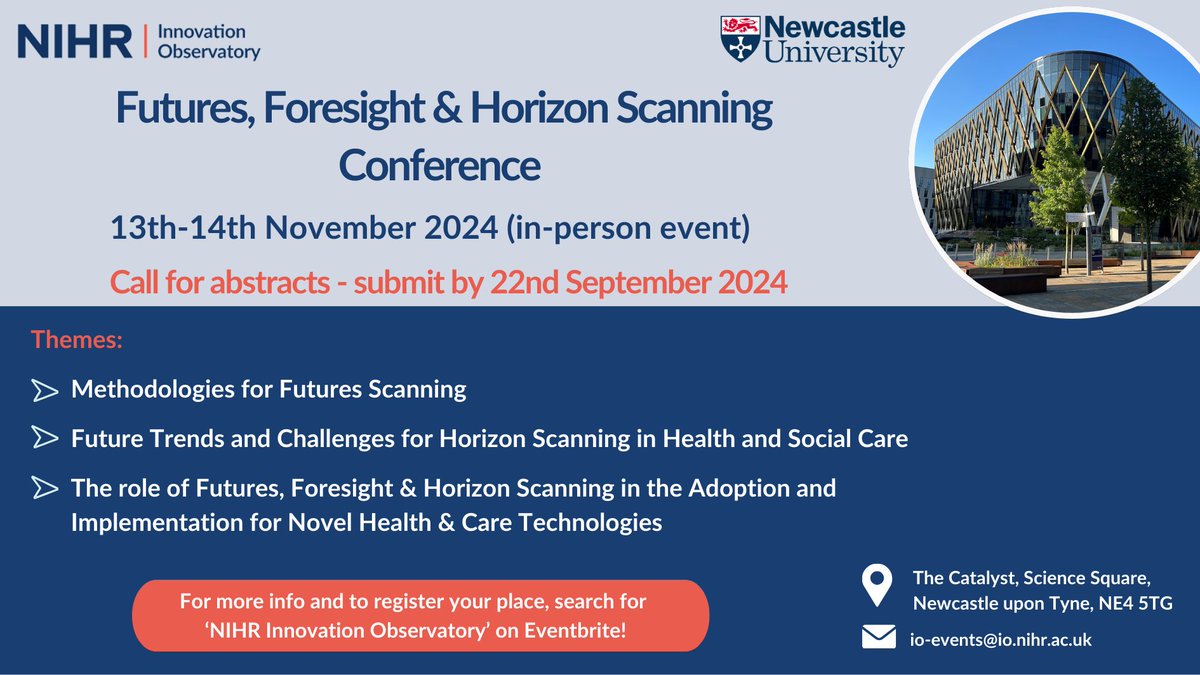
📢Call for Abstracts📢
We are excited to invite submissions for abstracts to our upcoming Futures, Foresight & Horizon Scanning Conference, set to take place on November 13 and 14, 2024 at @TheCatalystUK , Newcastle upon Tyne.
We invite submissions on the following themes:
· Methodologies for Futures Scanning
· Future Trends and Challenges for Horizon Scanning in Health and Social Care
· The Role of Futures, Foresight and Horizon Scanning in the Adoption and Implementation for Novel Health and Care Technologies
Important Dates:
· Closing date for call for abstracts: 23:59 (BST), September 22, 2024
· Notification of acceptance for selected abstracts: from September 30, 2024
For details and to submit your abstract click here: https://t.co/Ecpr2D9xF9
Abstract themes and submission guidelines can be found here: https://t.co/x0STseF1W2
Register your place at the conference here: https://t.co/BE2NaRO8Po
#health #future #conference #foresight #horizonscanning
📢We are thrilled to announce our upcoming Futures, Foresight & Horizon Scanning Conference, set to take place on 13th & 14th Novermber, 2024.
📅Mark your calendars and get ready to embark on a journey into the future at @TheCatalystUK , Newcastle-Upon-Tyne.
For details, and to register your place, visit the Eventbrite page: https://t.co/Xjl0jJe5zq
One of the best lineups I've seen for ages. Possibly on par with Reading & Leeds 2007.
And it's free to attend.
There's still time to register if you can make it. This is going to be a good one - don't miss it.
We can't wait to welcome everyone to our 'Hacking Child Tech' event on June 4/5th! We're thrilled to have so many great #speakers and #presenters with a range of expertise related to #childhealth!🗨️👀
Not long now to register your #free space to attend👇 https://t.co/45oNGEAUPO
Last week, I spoke about AI and regulations at an event at the U.S. Capitol attended by legislative and business leaders. I’m encouraged by the progress the open source community has made fending off regulations that would have stifled innovation. But opponents of open source are continuing to shift their arguments, with the latest worries centering on open source's impact on national security. I hope we’ll all keep protecting open source!
Based on my conversations with legislators, I’m encouraged by the progress the U.S. federal government has made getting a realistic grasp of AI’s risks. To be clear, guardrails are needed. But they should be applied to AI applications, not to general-purpose AI technology.
Nonetheless, some companies are eager to limit open source, possibly to protect the value of massive investments they’ve made in proprietary models and to deter competitors. It has been fascinating to watch their arguments change over time.
For instance, about 12 months ago, the Center For AI Safety’s “Statement on AI Risk” warned that AI could cause human extinction and stoked fears of AI taking over. This alarmed leaders in Washington. But many people in AI pointed out that this dystopian science-fiction scenario had little basis in reality. About six months later, when I testified at the U.S. Senate’s AI Insight forum, legislators no longer worried much about an AI takeover.
Then the opponents of open source shifted gears. Their leading argument shifted to the risk of AI helping to create bioweapons. Soon afterward, OpenAI and RAND showed that current AI does not significantly increase the ability of malefactors to build bioweapons. This fear of AI-enabled bioweapons has diminished. To be sure, the possibility that bad actors could use bioweapons — with or without AI — remains a topic of great international concern.
The latest argument for blocking open source AI has shifted to national security. AI is useful for both economic competition and warfare, and open source opponents say the U.S. should make sure its adversaries don’t have access to the latest foundation models. While I don’t want authoritarian governments to use AI, particularly to wage unjust wars, the LLM cat is out of the bag, and authoritarian countries will fill the vacuum if democratic nations limit access. When, some day, a child asks an AI system questions about democracy, the role of a free press, or the function of an independent judiciary in preserving the rule of law, I would like the AI to reflect democratic values rather than favor authoritarian leaders’ goals over, say, human rights.
I came away from Washington optimistic about the progress we’ve made. A year ago, legislators seemed to me to spend 80% of their time talking about guardrails for AI and 20% about investing in innovation. I was delighted that the ratio has flipped, and there was far more talk of investing in innovation.
Looking beyond the U.S. federal government, there are many jurisdictions globally. Unfortunately, arguments in favor of regulations that would stifle AI development continue to proliferate. But I’ve learned from my trips to Washington and other nations’ capitals that talking to regulators does have an impact. If you have a chance to talk to a regulator at any level, I hope you’ll do what you can to help governments better understand AI.
[Original text (with links): https://t.co/tw2iT0ooLT ]
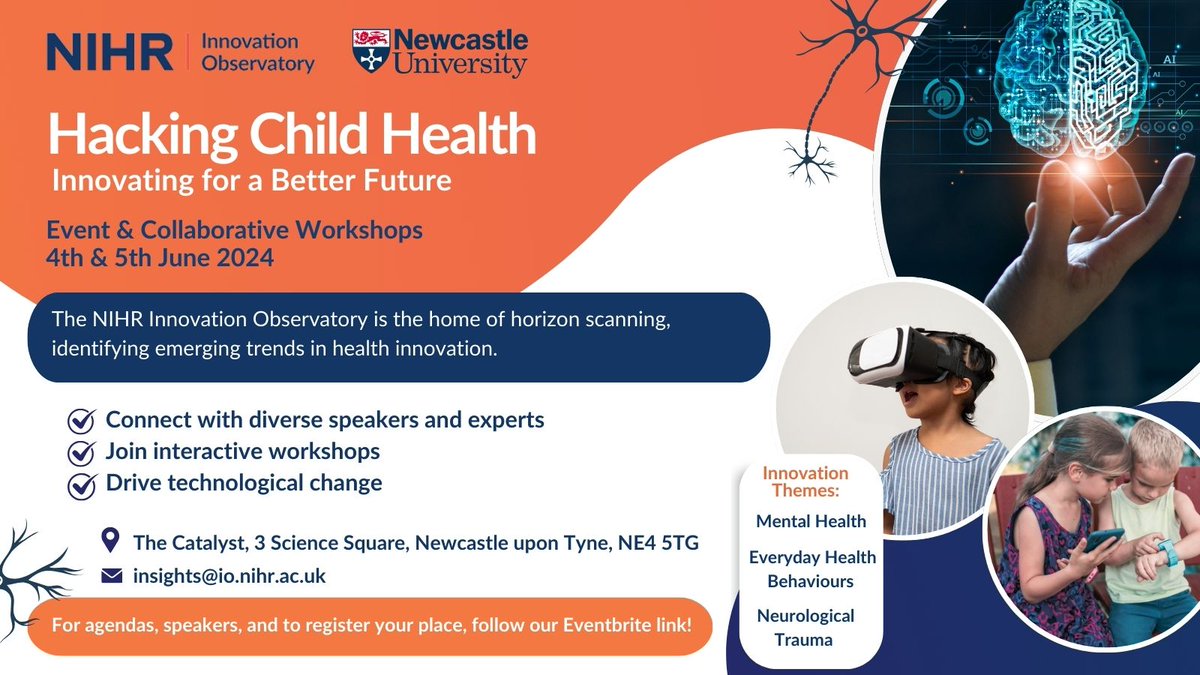
Join @NIHRIO at @TheCatalystUK on 4th and 5th June for the Hacking Child Tech event. Learn, discuss and explore innovations and gaps in the child health space with experts from around the world.
https://t.co/rEglk34j2Z
#NewcastleHelix#Newcastle#NorthEast
#HackingChildTech national event - registrations open! 💡 Join us 4-5th June 2024 to explore #healthtech innovations landscape for children, and connect with diverse experts.🤝Highlight topics: mental health, health behaviour, and neurological trauma: 👇
https://t.co/wMqX64RvpB
🚨JOB ALERT🚨
We have a fantastic opportunity for experienced researchers to join our team at the NIHR Innovation Observatory, as both Research Assistants and Research Associates, to contribute to the delivery of a range of outputs! Find all the info here👇https://t.co/NiCw6l1ogE
A really insightful session with @NIHRIO Public Advisory Group today and very appreciative of all that attended - including our new members. Great discussion, including ways to ‘demystify’ horizon scanning, optimum ways of research communication, outreach… 🗣️🧠👂🏾
Be sure not to miss @KunongaPatience's presentation on the development of a framework for considering inequalities/inequities in evidence synthesis at the Cochrane-Equity webinar series on the 17th of January 2024! 👇
Register here so you don't miss out: https://t.co/kNoB2pDToC
BIG NEWS on @OpenSAFELY from us, @NHSEngland, and @DHSCgovuk
I’m delighted to say OpenSAFELY’s future is now secure as NHS England infrastructure, and we will cautiously expand to cover non-COVID research areas.
THREAD!
https://t.co/52Lk585fDg
‼️CALL FOR ABSTRACTS NOW OPEN‼️
You are invited to begin submitting proposals for research discussion sessions, rapid fire presentations, and poster walkarounds at #HSRUK24!
Submissions will close on January 15th, don't miss out: https://t.co/KTyrML4At1
Extremely pleased to say that our new grant mapping report is live! The report illustrates research grants awarded between January 2015 and October 2022 mapped against the Top 11 priorities identified in the 2015 Palliative and end of life care Priority Setting Partnership.