Spain being more progressive than the nations it conquered. The countries you have colonised are stuck with the values you have left them hundreds of years ago.
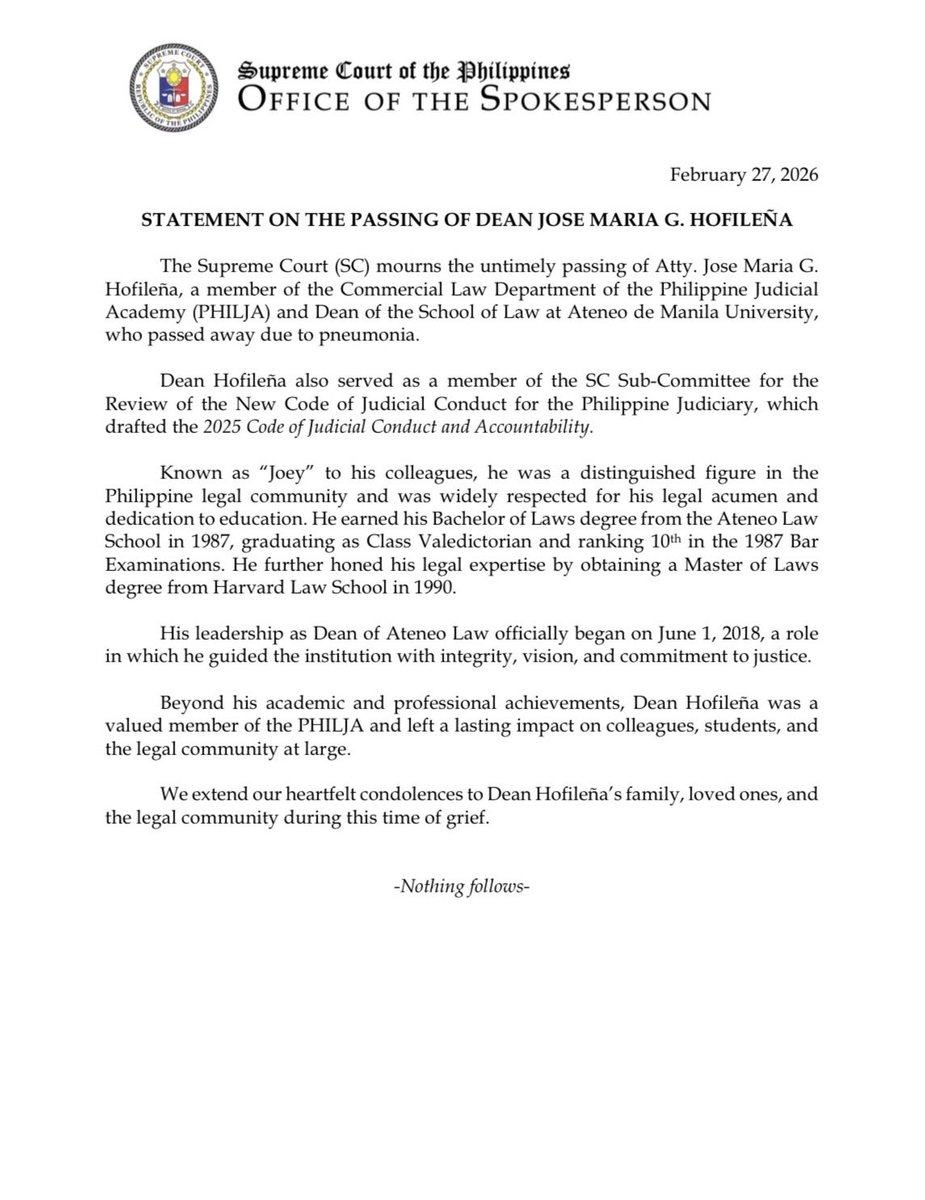
It is with deep sadness that we inform the University community of the passing of Atty Jose Maria “Joey” G Hofileña, Dean of the Ateneo Law School, on 26 February 2026.
Read the obituary: https://t.co/MzPiaBZF1E
The #SupremeCourtPH (SC) has ruled that same-sex couples who live together may be recognized as co-owners of property under Article 148 of the 𝘍𝘢𝘮𝘪𝘭𝘺 𝘊𝘰𝘥𝘦, provided there is proof of actual contribution.
In a Decision written by Associate Justice Jhosep Y. Lopez, the SC’s Second Division granted a woman’s complaint for partition of property and recognized her as a co-owner of the house and lot she shared with her same-sex partner.
Article 148 of the 𝘍𝘢𝘮𝘪𝘭𝘺 𝘊𝘰𝘥𝘦 governs the property relations of couples who are living together but cannot legally marry, acknowledging co-ownership based on their actual contributions.
The two women lived together as a couple. A year into their relationship, they purchased a house and lot, and agreed to register the property in one partner’s name to facilitate banking transactions.
Upon separation, they agreed to sell the property and divide the proceeds equally. One partner signed an 𝘈𝘤𝘬𝘯𝘰𝘸𝘭𝘦𝘥𝘨𝘮𝘦𝘯𝘵 stating that the other had paid about 50% of the purchase and renovation costs.
However, she later refused to sell the property and denied that her former partner was a co-owner.
To protect her interest, the former partner annotated an adverse claim on the title and demanded partition of the property. When this failed, she filed a case for partition of real estate and damages, relying on the 𝘈𝘤𝘬𝘯𝘰𝘸𝘭𝘦𝘥𝘨𝘮𝘦𝘯𝘵 as proof of co-ownership.
The SC granted the complaint for partition of real estate, as it clarified the provisions in the 𝘍𝘢𝘮𝘪𝘭𝘺 𝘊𝘰𝘥𝘦 governing the property relations of unmarried couples living together.
Article 147 applies to unmarried couples who may legally marry. Property acquired during their cohabitation is presumed jointly owned.
Article 148, on the other hand, applies to couples who are not permitted to marry. Only properties obtained through actual contribution are considered common property.
Since the 𝘍𝘢𝘮𝘪𝘭𝘺 𝘊𝘰𝘥𝘦 only allows marriage between a man and a woman, the SC held that same-sex couples necessarily fall under Article 148.
Here, the SC found that the signed 𝘈𝘤𝘬𝘯𝘰𝘸𝘭𝘦𝘥𝘨𝘮𝘦𝘯𝘵, where one partner admitted that the other paid about half of the property costs, was a binding admission and sufficient proof of actual contribution. This established co-ownership.
Read the full text of the press release at https://t.co/yjEQQVShu8.
Read the full text of the Decision at https://t.co/PrGAAS6Ydb.
Read the Concurring Opinion of Senior Associate Justice Marvic M.V.F. Leonen at https://t.co/TGg13bUwaN.
Read the Concurrence of Associate Justice Amy C. Lazaro-Javier at https://t.co/6ixJ7sDPIC.
Copying of this content is subject to the SC PIO’s Credit Attribution Policy: https://t.co/F48RF1vtzZ.
Taxpayers may refuse tax audit requests that are not within the scope and limits of audit instruments such as letters of authority (LOAs) and mission orders, according to the Bureau of Internal Revenue (BIR).
READ MORE: https://t.co/QB35MEj2UD
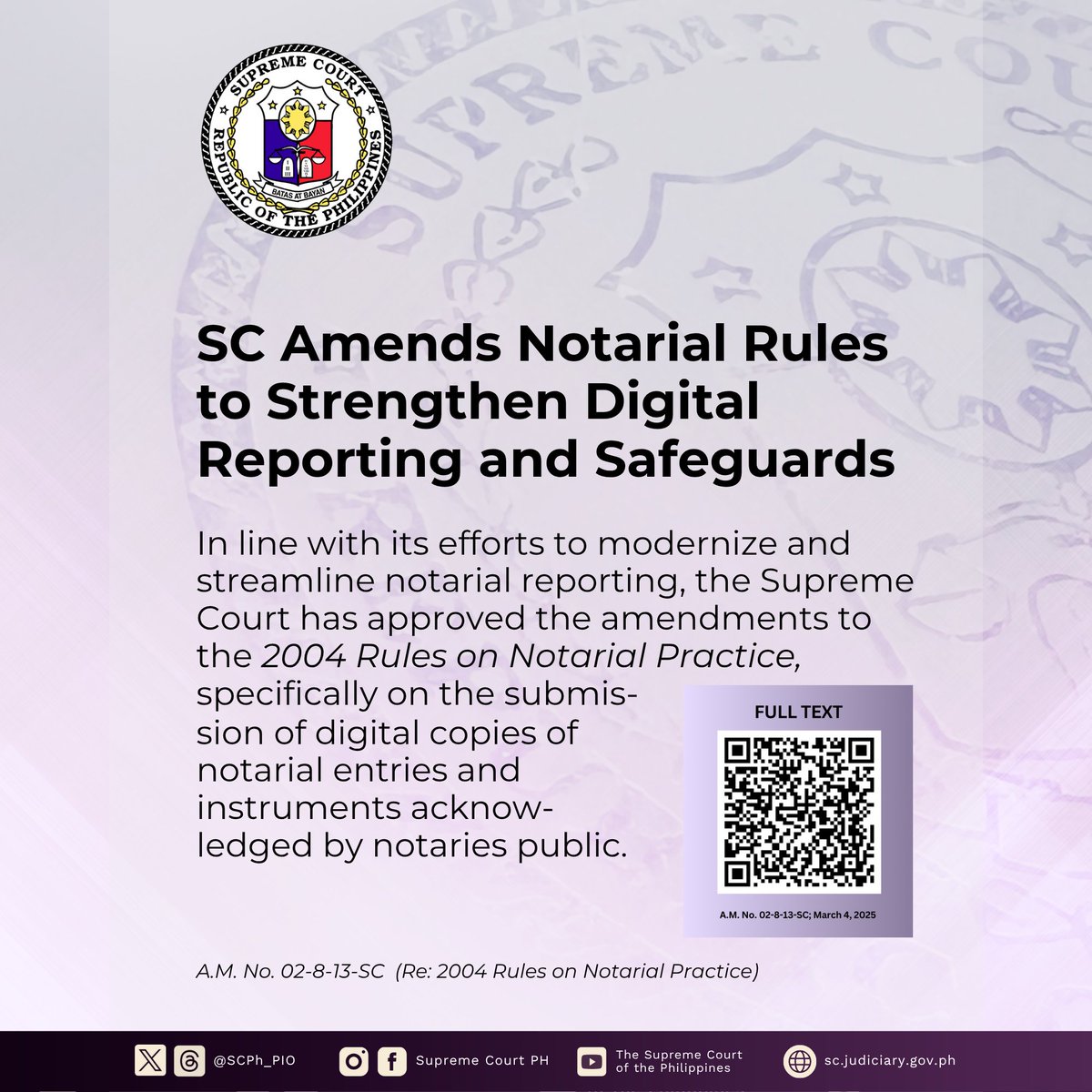
In line with its Strategic Plan for Judicial Innovations 2022-2027, the #SupremeCourtPH (SC) has amended the 2004 Rules on Notarial Practice (2004 Notarial Rules) to modernize and streamline notarial reporting.
In an En Banc Resolution in A.M. No. 02-8-13-SC, the SC approved amendments to the 2004 Notarial Rules, specifically on the submission of copies of notarial entries and instruments acknowledged by notaries public.
Under the Amended 2004 Notarial Rules, notaries public are now required to keep in portable document format (PDF) the certified copy of each month’s notarial entries and the duplicate original copy of instruments acknowledged before them.
These should be emailed to the clerk of court within the first 10 days of the following month using the notary public’s official email address. If there are no entries for the month, a formal statement confirming this must be submitted instead.
All PDF files must be sent as direct attachments to the transmittal email. They must not be submitted as external links to cloud storage, file-sharing platforms, or similar sites. PDF files should not be compressed into archive formats such as ZIP (.zip) or RAR (.rar), and must not require additional extraction or conversion prior to access.
Notaries are prohibited from charging any fees for digitizing, transmitting, or processing these documents.
Courts retaining electronic duplicate original copies of notarized documents are directed to conduct an inventory and assessment of these materials. A report on the results must be submitted to the Office of the Court Administrator, with a copy furnished to the SC’s Management Information Systems Office.
The Amended 2004 Notarial Rules was published on June 6, 2025, in two newspapers of general circulation and shall become effective 15 days from publication or on June 21, 2025.
Read the full text of the SC’s March 4, 2025 Resolution in A.M. No. 02-8-13-SC, Re: 2004 Rules on Notarial Practice, at https://t.co/iqgnPmrfie.
Copying of this content is subject to the SC PIO’s Credit Attribution Policy: https://t.co/F48RF1vtzZ.
The #SupremeCourtPH has taken an important step towards modernizing legal processes by approving the Rules on Electronic Notarization (E-Notarization Rules) – a significant reform that leverages technology to make notarial services more accessible and efficient nationwide.
Under A.M. No. 24-10-14-SC, the Supreme Court En Banc approved the E-Notarization Rules and the Guidelines on the Accreditation of Electronic Notarization Facility Providers (Accreditation Guidelines). These rules introduce Electronic Notaries Public (ENPs), who are authorized to perform notarial acts for individuals located anywhere in the Philippines and, in certain cases, even abroad.
This expanded jurisdiction addresses a key limitation of the 2004 Rules on Notarial Practice (2004 Notarial Rules), where traditional notaries public were restricted to performing notarizations only within their territorial jurisdiction. By allowing ENPs to provide services across the country, the new rules ensure greater accessibility, particularly for those in remote or underserved areas.
The updated framework enables 3 forms of electronic notarization:
- In-Person Electronic Notarization (both principals and witnesses must be physically present)
- Remote Electronic Notarization (principals and witnesses may connect virtually to ENP via videoconferencing)
- Mixed In-Person and Remote
To enhance security, the E-Notarization Rules implements Multi-Factor Authentication (MFA) such as facial recognition, biometrics, and one-time passwords, in compliance with regulations set by the Bangko Sentral ng Pilipinas. The integrity of the electronic notarial book, or the register showing the chronological record of electronic notarial acts, is also safeguarded against tampering. Additionally, all data stored in the ENFs are protected under the Data Privacy Act.
The E-Notarization Rules applies exclusively to electronic documents in Portable Document Format (PDF) or Portable Document Format Archival (PDF/A). Paper documents with handwritten signatures, notarial wills, and depositions will continue to follow the 2004 Notarial Rules.
A part of the Strategic Plan for Judicial Innovations 2022-2027 (SPJI), this initiative aligns with the Supreme Court’s commitment to innovation and expanded access to justice by allowing notarization for electronic documents, including remote notarization through accredited software applications. This reform supplements the traditional mode of notarization under the 2004 Notarial Rules and marks a key milestone in the Court’s ongoing digital transformation.
The E-Notarization Rules takes effect 15 days after its publication on March 9, 2025.
Read the press release in full at https://t.co/VRgzhj5ZCl.
Read the full text of A.M. No. 24-10-14-SC, Rules on Electronic Notarization, at https://t.co/fsjHeiAmjb.
Copying of this content is subject to the SC PIO’s Credit Attribution Policy: https://t.co/F48RF1vtzZ.