Helping Individuals and Teams Succeed in Sales | Sales Trainer | Business/Sales/Personal Coach | Joyful & Positive Approach to Everything | Published Author
Border Patrol pulls over a 20-year-old in Slidell, LA for “white lights on the back of your vehicle… your reverse lights are on the whole time.”
Then, before writing a single ticket, the agent asks: “What’s your citizenship?”
The driver, Alan Laureano, was born in Slidell. His passenger — his 13-year-old stepbrother — was born in Pearl River, Louisiana. Both are U.S. citizens.
Didn’t matter. Twice, on camera, the agent tells Laureano he’s going to “check” the kid and “if he’s illegal, I will take him.”
He tries to open the 13-year-old’s car door himself. Laureano locks it and rolls the window down instead.
The agent then interrogates the child directly — full name, spelling, date of birth, birthplace — while Laureano stands his ground and refuses to hand over his own ID, telling the agent he doesn’t have the right to stop him over a taillight.
Immigration attorney Michael Gahagan reviewed the video and called it what it is: “an illegal detention.” Border Patrol isn’t authorized to detain someone over a traffic violation — they need independent reasonable suspicion of an immigration violation, and that has to come first, not get invented after the stop.
DHS’s after-the-fact statement claims the stop was based on “reasonable suspicion or probable cause of federal law violations” — but doesn’t say what that violation was. WWL Louisiana asked twice. No answer either time.
This is the pattern: pretext stop, pivot to citizenship, threaten a kid with removal before confirming anything. It only looks “routine” until you’re the one being asked to prove you belong in the country you were born in.
The moral alteration in an unthinkable expanse of people who call this place home has been stunning in its velocity and stomach-turning in its depths. The worst part is that we can’t reach them in the ways reasonable human beings can be reached.
Before Fox News, we could meet the people around us on the common ground of our shared faith in Jesus, our respect for the Constitution, the clarity of objective truth, or shared compassion for vulnerable people. Now, they no longer have use or tolerance for such things.
Those of us who’ve lost people we love to this curated pestilence should file a class-action suit against Fox News for thirty years of malpractice and murder: for the relationships they’ve destroyed, the deaths they’ve been complicit in, the betrayal of the public trust, and for purposefully killing the goodness in human beings who will never be who they might have been otherwise.
https://t.co/ROP6EohIcb
Check out the latest article in my newsletter: #40: This Father's Day, the Inheritance No One Can Sign Over https://t.co/lRn63WSCFL via @LinkedIn
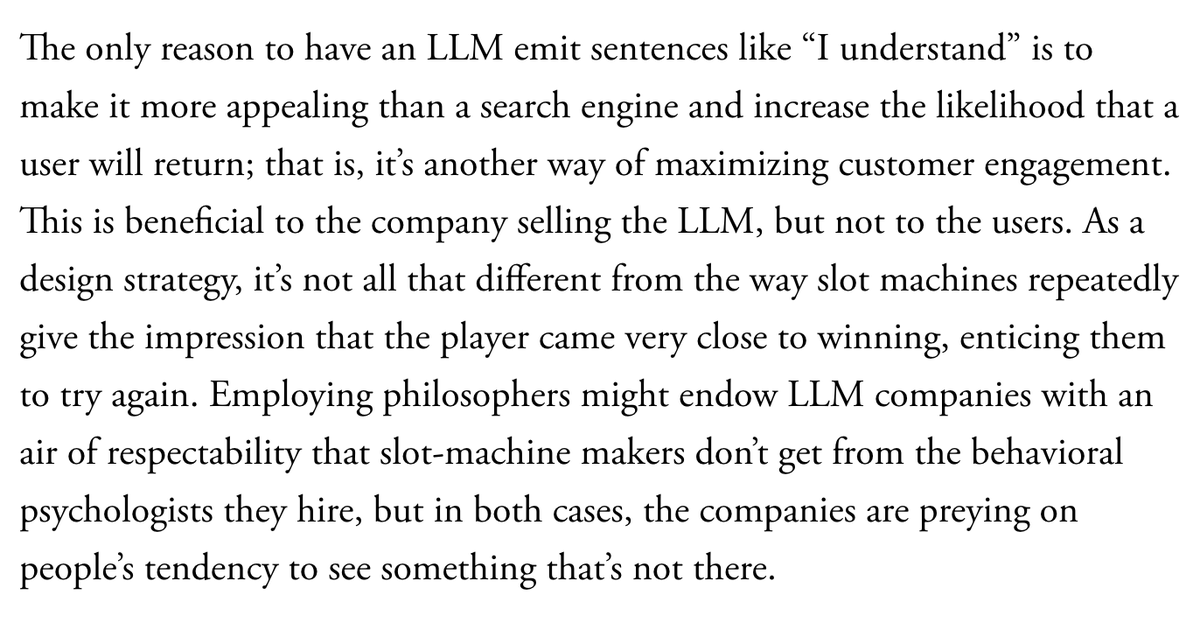
Compelling essay by sci-fi writer Ted Chiang on why LLMs are nowhere near consciousness, but why it serves the interests of LLM companies to constantly suggest that they might be.
I've pulled one quote below, but the whole article is worth reading.
Costco put a hard ceiling on how much money it's allowed to make on every item in the building. 14% on national brands, 15% on Kirkland. Bring in a product priced one point above that and a buyer kills it before it ever hits a shelf.
That sounds like a company leaving billions on the table. It is. And it's the most profitable decision in modern retail.
Run the bull case for marking up like everyone else. Walmart sits around 25%. Kroger and the traditional grocers run 25-50%. Price Costco's $249B in merchandise like a normal store and gross profit roughly doubles. Every spreadsheet says raise prices.
Here's what those spreadsheets miss. The product is the $65 card you buy before you're allowed through the door. Everything on the shelves exists to make that card feel worth renewing. Membership fees hit $4.8B last year, cost almost nothing to deliver, and throw off two-thirds of operating income. Renewal sits at 90%, the kind of retention most software companies never reach.
So Costco treats the 21% discount as customer acquisition spend. Every dollar it refuses to mark up makes the $65 renewal feel automatic. Cheaper shelves, stickier subscription.
Now read the chart as a spending report. The number next to each store shows how hard it can discount before the model breaks. Costco can sit at negative 21 because the membership line eats the loss. Walmart can't follow without a second revenue stream it doesn't have.
Walmart makes money when you buy. Costco makes money when you walk in. Whole Foods, at 40% above Walmart, has no membership fee underwriting its prices, so the margin has to come off the shelf.
The discount is the moat. The trade was never close.
Andrew Schulz on Thomas Massie losing: “For a long time I’ve hated when coastal elites shit on southern states and say they’re dumb. And then an election like this comes up and they fucking fall for it and it’s just like congrats man you guys lived up to every single stereotype”
8,000 Meta workers got fired by email this morning. Singapore got the notice at 4 AM. The moment the email arrived, their laptops, work email, and accounts went dark. That is how a $1.7 trillion company tells you it is over.
Inside Meta, this round has a name. They are calling it "Pralaydin," which is Hindi for "day of catastrophe." Reuters reports this is the third firing round of 2026, and the full year could end with 22,000 people gone. About one in five Meta employees.
Analysts at Evercore say firing these 8,000 people will save Meta around $3 billion a year. That sounds like a lot. Zuckerberg has been writing much bigger checks for AI hires. Last summer he paid an ex-Apple engineer named Ruoming Pang $200 million to come work on AI. He paid another AI researcher, Andrew Tulloch, a reported $1.5 billion over six years. He wrote a $14.3 billion check just to get the CEO of an AI startup called Scale to join the team.
The same week Meta laid off 8,000 office workers, the company is still planning to spend somewhere between $125 and $145 billion this year on AI data centers and the chips to run them. The firings save about 2% of that.
Two days before the layoffs began, Meta picked 7,000 of the survivors and moved them onto brand new AI teams. The people getting hit in this round are mostly engineers and product managers. Another wave is already planned for later this year.
Meta is not in trouble. Far from it. The company made $56 billion in revenue in just the first three months of 2026. That was up 33% from a year ago. Pure profit in those same three months was nearly $27 billion. The stock is off its September high but Meta is still worth $1.7 trillion.
The severance is good on paper. 16 weeks of base pay, plus two extra weeks for every year you put in, plus a year and a half of health insurance. The average payout works out to about $360,000 per person.
The money does arrive. But finding a new job is brutal. Engineers who got cut in earlier Meta rounds say they have sent out hundreds of job applications and heard back from almost nobody, even with Meta on the resume.
So a wildly profitable company is firing 8,000 office workers via 4 AM email and instant lockout, while writing checks worth hundreds of millions of dollars to a small group of new AI hires. The Singapore workers reading their termination email at 4 AM were paying for the next $200 million hire.
Check out the latest article in my newsletter: #33: The Career Gap AI Just Made Bigger. And Why I Am Asking You to Back RISEUP@work https://t.co/U3G0dH6NGB via @LinkedIn