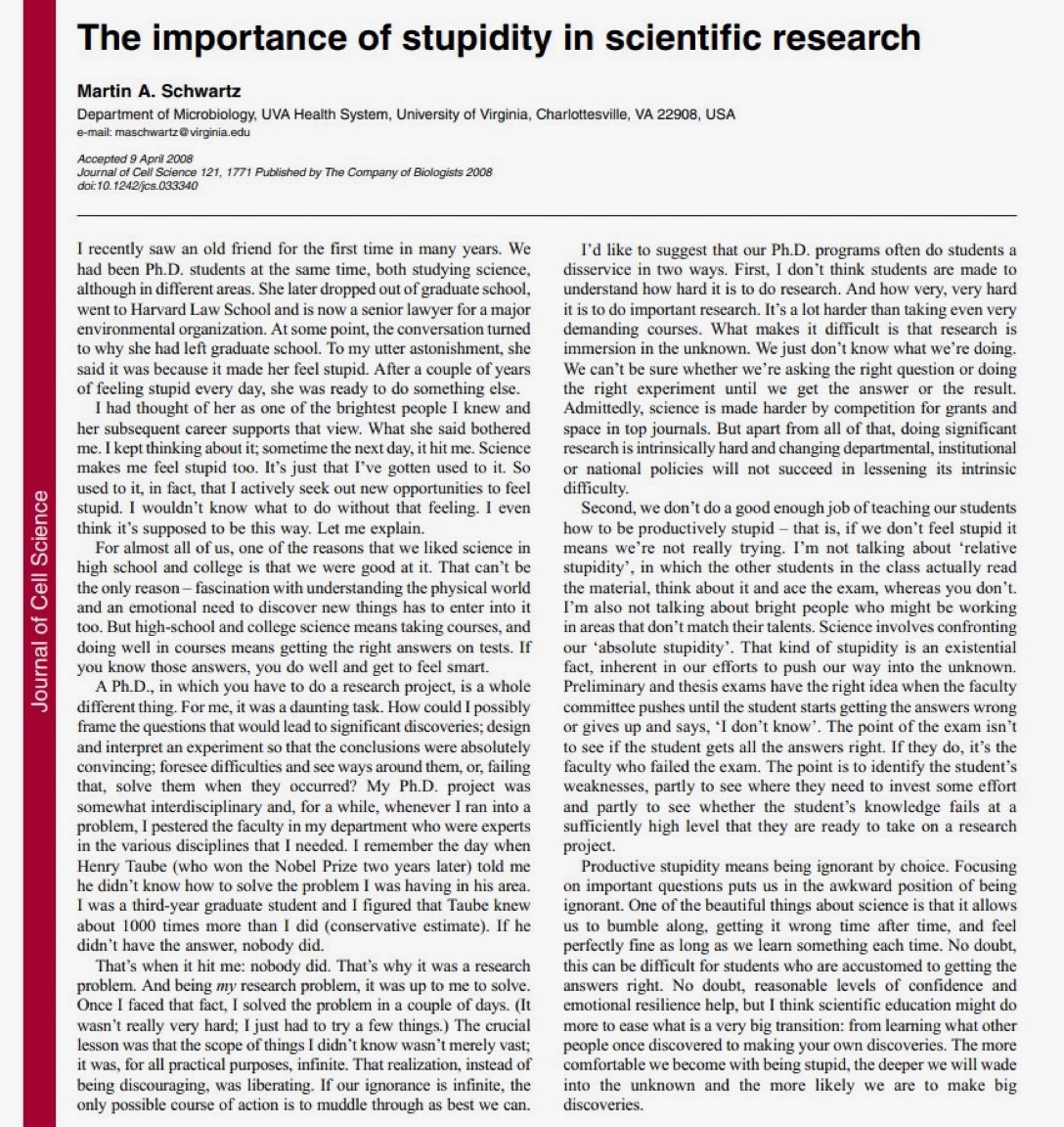
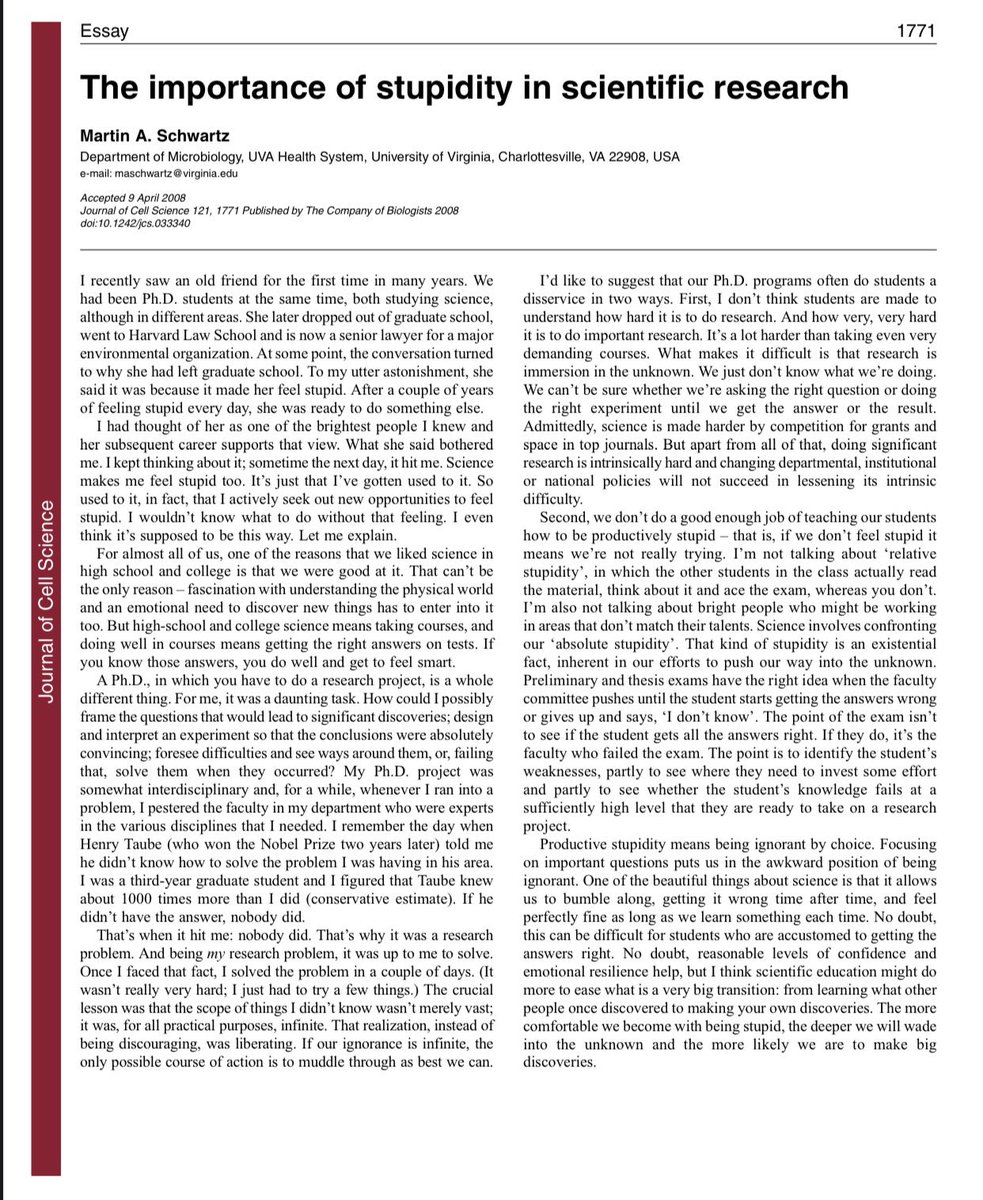
This article should be mandatory reading for every medical student, PhD candidate, researcher—and honestly, for anyone who mistakes expertise for certainty.
“The importance of stupidity in scientific research” sounds provocative, almost offensive. But Martin Schwartz is not glorifying incompetence. He is describing the real operating system of discovery.
Science is not built on knowing.
Science is built on tolerating not knowing.
That distinction matters.
Most of education rewards correctness.
School teaches us to answer.
Exams reward speed, certainty, and precision.
You feel intelligent when you get things right.
Research is the opposite.
Real research begins exactly where competence ends—at the frontier where nobody knows the answer, including the people you thought must know.
That moment is psychologically brutal.
You ask the expert.
The expert shrugs.
You assume you’re missing something.
Then you realize: no—this is the work.
You are not failing.
You are standing at the actual boundary of knowledge.
That feeling—“I must be stupid”—is often not a sign of inadequacy.
It is often the first sign that you are finally asking an important question.
Medicine struggles with this.
We train doctors to avoid uncertainty, to fear being wrong, to perform confidence.
But the best clinicians and the best scientists know how to sit inside ambiguity without collapsing into fake certainty.
This is why AI in medicine also deserves caution.
Systems trained only to reproduce established answers may become extraordinarily good at passing exams while being terrible at discovering what matters next.
Guideline intelligence is not the same as scientific intelligence.
Discovery requires productive stupidity:
the willingness to stay with the uncomfortable,
to look ignorant,
to ask naïve questions,
to be wrong repeatedly without protecting your ego.
Most people want the authority of expertise.
Very few want the humiliation required to earn it.
But progress lives there.
Not in certainty.
Not in performance.
Not in sounding smart.
In the quiet discipline of saying:
“I don’t know… yet.”
And continuing anyway.
New findings show that transcription factor #CREB drives the progression from #alcohol-induced #pancreatic inflammation to #cancer, particularly in #KRAS+ cells. Deleting CREB markedly reduced precancerous lesions and preserved acinar cell function. https://t.co/B6DuCo5qO6
@GIMedOnc Impressive results for this KRASi but it's important to note it is not an antibody. One of the (many) reasons KRAS has been difficult to target. The development of these small molecule inhibitors has been nothing short of a heroic effort by talented scientists in the field.
🔔 This poignant review by @DrDosch and colleagues summarizes the unique role of myeloid cells and the innate immune system in the pathogenesis of liver metastases in visceral malignancies.
📣 Narrative review from Gastro Hep Advances! #OpenAccess
🔗 https://t.co/WuPQRr0Mui
Name an underrated team entering the 2023 season.
For me, it's the #Steelers - Their roster is actually very impressive if the 2nd-year leaps from players such as QB Kenny Pickett and WR George Pickens is as real as it appears.
They have depth in every single position except maybe CB and already have a couple of impressive rookies like LB Nick Herbig, CB Joey Porter, OT Broderick Jones and possibly Darnell Washington.
Omar Khan has been great since taking over as GM for Kevin Colbert. This is a team on the rise.
After the Steelers, the #Seahawks are another team that could actually dominate this season if their Defensive Line improves in run defense.
Just published—
Remodeling of Stromal Immune Microenvironment by Urolithin A Improves Survival with Immune Checkpoint Blockade in #PancreaticCancer, by Mehra et al.
https://t.co/bJwrgGK3Hl
@UMiamiHealth#openaccess