Wut is financial engineering? I have an @X account now.
Give me a follow @drecronye so that we can stay rich together.. 👀
Sharing insights on money, progress, profits, losses, growth, whatever....
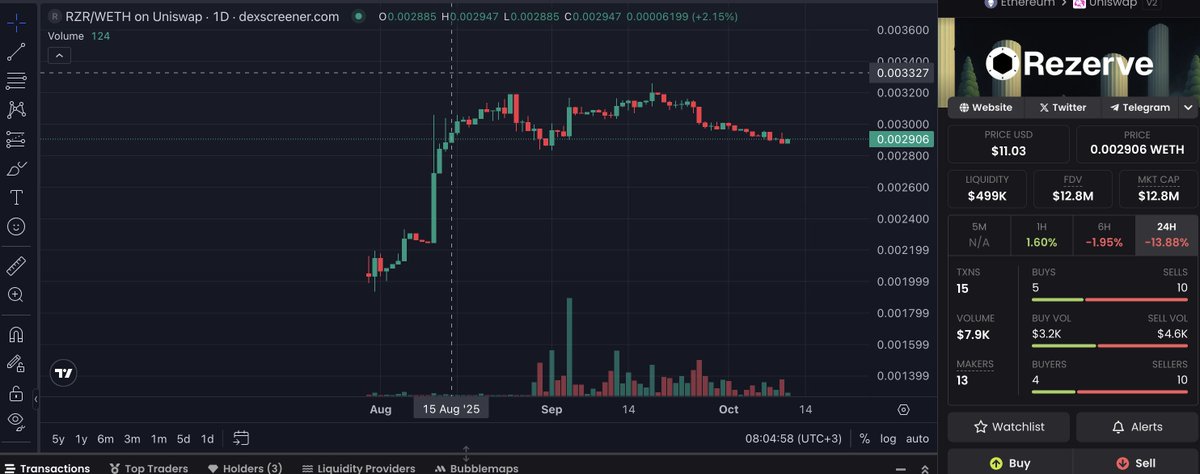
RZR/USD might have dipped, but when you look closer, it’s clear that the drop was driven by ETH’s 10% slide — not weakness in RZR itself. In fact, the RZR/ETH pair has shown remarkable strength, and I expect this resilience to continue as conditions stabilize.
Remember… buy when there’s blood in the markets 🩸. You’re essentially getting your favorite tokens at a discount.
From my perspective, Trump’s market moves often follow a familiar pattern: he shakes the markets with bold announcements to gain leverage, then scales back once he’s achieved his objective.
This looks like another replay of that playbook. The recent China tariff escalation feels more like a scare tactic than a lasting policy shift just like the "Liberation Day" tariffs earlier this year, which were softened after a 90-day cooldown.
Bottom line: don’t panic. This is just another temporary storm. Stay calm, stay focused, and buy the blood 😈.
🔹 @flyingtulip_ Fundraising Model
Andre Cronje’s new project at @SonicLabs, a bold rethink of how fundraising works in crypto.
Here’s the model:
1) Fixed-Supply Token Sale (Private + Public)
• FT sold in two rounds: private + public.
• Supply fixed from day one (non-inflationary).
• 100% goes to buyers; team gets zero upfront.
• No team stash → no pump-and-dump; shifts focus from price games to building product revenue.
• Fixed supply → eliminates dilution risk.
• Team exposure only later, by buying FT with protocol revenue → real alignment.
⚠️ Risk: Fixed supply alone doesn’t guarantee value; revenue must back it.
2) On-Chain Treasury (Not Spent Directly)
• Raised funds go to an on-chain treasury governed by smart contracts; rules for spend/invest are transparent.
• Keeps the principal separate from operating expenses, preventing “burning the raise.”
• Removes the need for constant new token sales.
• Provides on-chain transparency and auditability.
3) Parking Treasury in Low-Risk DeFi
• Capital deployed in safe, liquid strategies (blue-chip lending, stablecoin farming).
• Conservative ~4% APR assumption (vs. 3–6% historic).
• Provides steady funding without dilution; buys time to build real products.
⚠️ Risk: Yields vary, contracts carry risk; sustainability still depends on protocol revenue.
4) Perpetual Redemption Right (Wallet-Linked)
• Each initial investor address receives a perpetual redemption right: burn FT anytime and redeem up to the original principal.
• Right is tied to the wallet, not to circulating tokens.
• Gives investors a permanent downside floor, boosting trust from cautious capital.
• Wallet-link prevents infinite arbitrage: each investor can only redeem up to their own cap.
5) Non-Transferability Until Sale Ends
• Tokens non-transferable during the raise.
• Prevents mid-sale arbitrage (“buy cheap, redeem high”), protecting treasury reserves.
6) Secondary Market Sales & Treasury Effect
• After transfers open, selling FT in the secondary market removes redemption rights for that wallet (until it buys again).
• Reserves tied to that wallet’s claim are freed and used by the treasury/foundation for buyback & burn.
• Secondary sales both remove coverage for sellers and strengthen the deflationary mechanism via buyback & burn (first anti-inflationary engine).
⚠️ Risk: Re-buy restores rights (up to principal). Treasury must stay disciplined.
7) Limited Arbitrage Post-Launch
• If FT trades below redemption value, wallets can arbitrage up to their cap.
• Arbitrage is real but strictly limited.
⚠️ Risk: Collective arbitrage possible; controlled only via redemption management.
8) Redemption Management (Queue + Daily Limit)
• Requests enter a transparent on-chain queue, executed in order.
• Daily cap slows outflows, prevents bank runs, and allows treasury to unwind.
⚠️ Risk: If revenue is weak, queues grow long and payouts are delayed.
9) Using Treasury Yield
• Annual yield (~4%) first covers operations (dev, audits, infra).
• Any surplus goes to buyback & burn → structural deflation (second anti-inflationary engine)
10) Protocol Revenue — The Core Engine
• Serves as the third and strongest anti-inflationary engine, alongside treasury yield and secondary buybacks, creates reinforcing deflationary mechanics that reduce effective supply and drive upward price pressure.
• Funds ongoing product innovation and team growth, driving lasting sustainability.
• Underpins the model’s sustainability, without consistent protocol income, the other two engines lose momentum.
🎯Final Takeaway
Flying Tulip’s model combines fixed supply, a conservative treasury, wallet-linked redemption rights, redemption queues, and a revenue-tied team economy.
It addresses three chronic crypto pains:
• no investor protection,
• short-term token pumping,
• dilution/inflation.
But survival depends entirely on the protocol’s ability to generate real, sustainable revenue.
In the real world you work hard hours and get fiat in return. A currency that the government can print at any point in time.
In the crypto you put in real assets and get tokens in return. A currency that crypto bros can also print at any point in time.
What's the difference?
I have just completed my risk analysis on $ETH, $BTC & $XAU (Gold) on a hodling strategy that gives returns.
The results are quite interesting and points to why $RZR is best poised to capture the most upside with $ETH
A thread 🧵
And the last bit is the gains with $ETH & $BTC
With each cycle we see lesser and lesser gains, but year on year, both assets have returned at least 100% RoR.
Since $RZR is backed by $ETH, this means that $RZR's price performance should at LEAST be 100% RoR.
Bullish 🚀
There is one crazy whale that has aped in over $3.4mn into Rezerve's USDC vaults
https://t.co/lT3KwFR0Nz
His wallet holds over 14mn$ of assets. I hope he stakes his $RZR rewards.
Total lent USDC is now 6mn$. Absolutely insane 🔥