Recently, I’ve been really touched by students’ dissertation presentations, which cover important topics regarding AI and TikTok use. They all made excellent points, and I’m grateful for their work. #psychology#nychhc https://t.co/P3z6NagOgD
I’m pleased to share that my private practice now has a new office space. My new office is located in the Upper East Side of Manhattan.
Please visit my website (https://t.co/ClEozHLj56) to learn more or schedule a consultation.
My new article is now live on Psychology Today: Integrating Mind and Body in Patients With Chronic Illness | Psychology Today https://t.co/Vvw4zHjAy9 I discuss one of the clinical challenges I’ve encountered when working with patients who have chronic medical conditions. Enjoy!
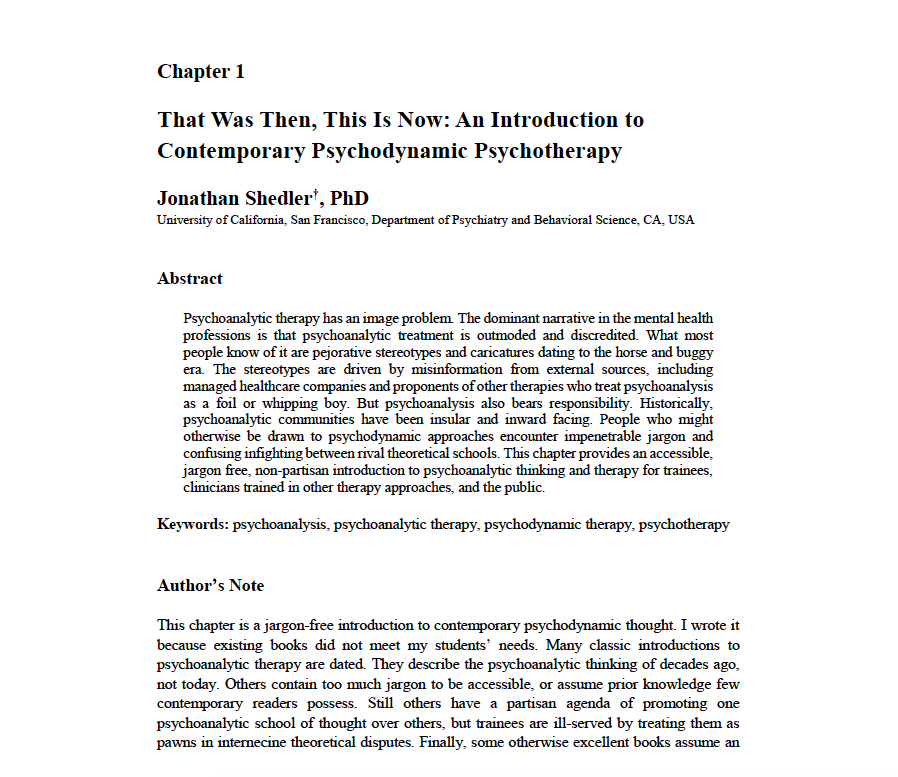
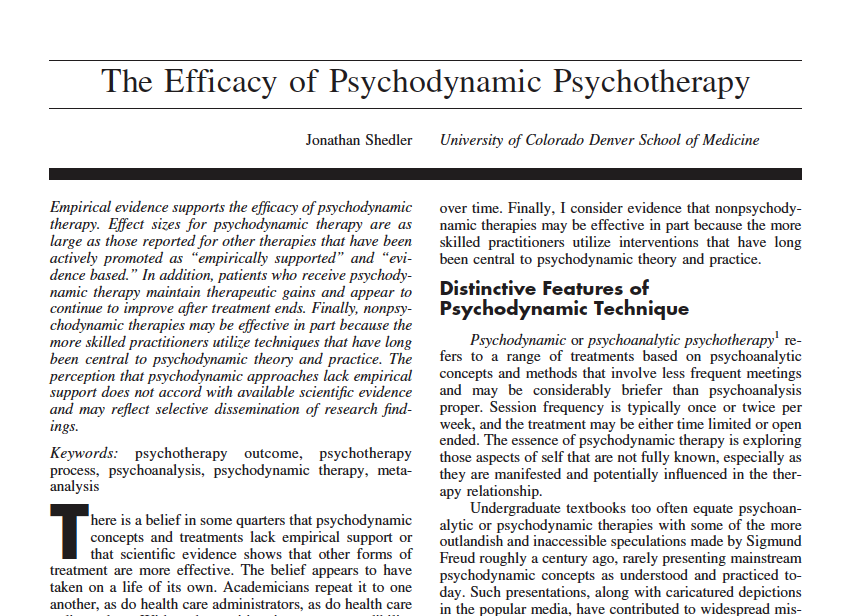
“Most psychoanalytic therapists have no idea how to respond to the question (all too common at social gatherings), “Are you a ‘Freudian?’ The question has no meaningful answer, and I fear that any answer I give could lead only to misunderstanding.
In a basic sense, all mental health professionals are ‘Freudian’ because so many of Freud’s concepts have simply been assimilated into the broader culture of psychotherapy. They now seem so commonplace, commonsense, and taken-for-granted that people do not recognize they originated with Freud and were radical at the time.
For example, most people believe trauma can cause emotional and physical symptoms; that our care in the early years shapes our development; that people have competing, contradictory motives and desires; that sexual abuse of children occurs and has disastrous consequences; that emotional difficulties can be treated by talking; that we sometimes find fault with others for the very things we do not wish to see in ourselves; that it is exploitive and destructive for therapists to have sexual relations with patients; and so on.
These and many more ideas that are widely accepted among therapists are ‘Freudian.’ In this respect, every contemporary psychotherapist is a (gasp) Freudian, like it or not. Even the practice of meeting with patients for regularly scheduled appointment hours originated with Freud.
In another sense, the question ‘Are you a Freudian?’ is unanswerable because no contemporary psychoanalytic therapist is a ‘Freudian.’ What I mean is that psychoanalytic thinking has evolved radically since Freud’s day—not that you would know this from reading psychology textbooks. In the past decades, there have been sea changes in theory and practice. The field has grown in diverse directions, far from Freud’s historical writings. In this sense, no one is a ‘Freudian.’
Psychoanalysis is continually evolving new models and paradigms. The development of psychoanalytic knowledge did not end with Freud, any more than physics ended with Newton, astronomy with Copernicus, or the development of the behavioral tradition in psychology ended with John Watson.”
(full text below)
Happy 4th! My new article is now live on Psychology Today: Adult Play: A Neuroscientific and Psychoanalytic Perspective. It explores how play continues to matter in adulthood. Hope you enjoy it, and wishing you a great summer! ⛱️🌞😎https://t.co/pQffskUavA
New article is now published on Psychology Today! I explored the role of repression, one of the key concepts in psychoanalysis, to help clarify diagnosis: Avoidable vs. Unavoidable: How Freud Distinguished Phobia from OCD | Psychology Today https://t.co/oo4l8Ujy7e
I’m excited to share my first post today. Stay tuned for more updates in the new year!
Working in a Hospital is a Marathon, Not a Sprint | Psychology Today https://t.co/qiSpoX7aay
"Psychological health is not merely the absence of symptoms; it is the positive presence of inner capacities and resources that allow people to live life with a greater sense of freedom and possibility"
https://t.co/NXiKFRpXLI