CBC’s Vancouver anchor just said the quiet part out loud about Alto — and about his own CBC
Ian Hanomansing, hosting from Vancouver, on the Toronto–Quebec City high-speed line: “For us sitting here in Vancouver, that proposed project seems awfully far away. And so should taxpayers who aren’t going to get sort of the daily or weekly or monthly benefit of that, should they be paying for it as well?”
That is the whole case against Alto in one breath. A roughly 1,000 km corridor between Toronto and Quebec City. Official construction range: $60–90 billion. Parliamentary Budget Officer this week: $75–113 billion, and that is construction only. A Globe document put the 40-year all-in figure near $150 billion once operating and maintenance are counted. Design phase alone is already $3.9 billion. Rural eastern Ontario is fighting expropriation and farmland severance for a train many of them will never ride. British Columbia, the Prairies, and the Atlantic get the invoice
Then the second slip, which is worse: “You talk to one expert and at the end of that interview you think to yourself, okay, that’s clearly the answer. They’re right on that. And then you go talk to somebody else. And they also sound really persuasive. And it’s almost like the last person you talk to is the one that carries the day… there’s no trick here. It’s not like they are somehow, you know, getting paid by the people who are sponsoring this rail line anyway… two very different points of view.”
He is advertising a debate format as if it were a novelty. Two experts. Neither on the payroll of the Crown corporation building the line. Audence get both sides
That is the minimum a public broadcaster is supposed to do on a nine-figure megaproject. The fact that a senior CBC host has to flag it — “no trick,” not bought, actually different views — is an admission that the default product is the last persuasive voice in the room, usually the one nearest Toronto and the cabinet that green-lit this under Trudeau in February 2025
Alto is not a national project. It is a corridor project priced like a national one, sold with nation-building language, and underwritten by people who will watch it on television from 4,000 kilometres away
Hanomansing noticed. Most of the CBC coverage still hasn’t @brodiefenlon
For years, Canada's Liberals attacked conservatives and Pierre Poilievre for wanting to increase our oil production telling us we don't know how to build an economy even though they gave us a lost decade, claiming peak oil, and telling our allies there is no business case.
I'm going to give Mark Carney credit here as under him, the rhetoric took 180 degree turn;
"Oil demand will continue to be significant for decades to come. Even under any plausible net-zero scenario, the IEA forecasts the world will still need tens of millions of barrels of crude a day.
So the question is: who will emerge as the world's trusted suppliers?
It should be us. It must be Canada." 🔥
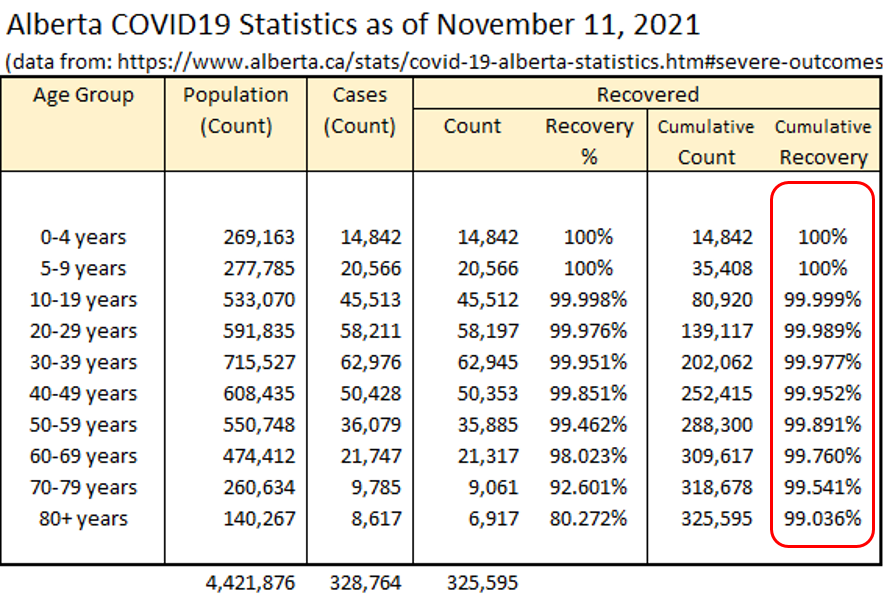
From my own charts, created from government data (in this case Alberta).
After 325,000 lab-reported cases, COVID had a 99.036% survivability rate in the general population.
100% for the under 10 years old group.
I had to use 3 decimal places to prevent the spreadsheeted from rounding up to 100% survivable for anyone under 70 and in moderate health.
@MattooShashank I can’t understand why tax money is being spent to get H1B holders from the US. It’s a lot of money being spent on something that won’t happen. You would need to poach 25000 H1B’s with average income of 200k in Canada to break even.
The Bank of Canada is monetizing the debt. The central bank will buy bonds directly from the government. Carney's deficits will be financed by creating new money out of thin air, rather than by raising taxes or borrowing money from private investors. This will lead to higher inflation and a loss of our purchasing power. WE WILL ALL BE POORER! We cannot afford these deficits!