I think this paper is really important. Favoring unbiased estimators can actually increase bias when coupled with selective reporting, and we have lots of reasons to think that economists are doing plenty of this.
Excited to share a new paper with @jfischman, just accepted at JEL.
We argue that empirical research tends to be biased and overconfident due to a weakness in the dominant econometric framework: insufficient attention paid to humans “in the loop” with the research process. 1/
Test score gains fade.
But long-term outcomes like graduation and earnings often persist.
So what does that mean for judging school success?
@drewhalbailey joins The Education Gadfly Show to discuss the fadeout effect.
Listen: https://t.co/kM6LhYSobH
@CEDR_US I buy it! As an addendum to your first explanation, we think there's probably also nonzero transfer from test score value added to other kinds of value added measured later.
📢 #EdWorkingPapers: @tw_watts, @EmmaRoseHart, & @drewhalbailey analyze 87 RCTs to assess persistence of educational intervention effects & find that fadeout is common. Intervention characteristics explain a small share of differences in persistence.
📄 https://t.co/oyTRofyxoh
Why do educational intervention impacts fade? Isn't catch-up a good thing? Are sleeper effects real? Does fadeout mean failure?
@drewhalbailey, @tw_watts, and I address these questions & more in an EdNext piece & 4 new working papers!
https://t.co/Hqsgr1h512
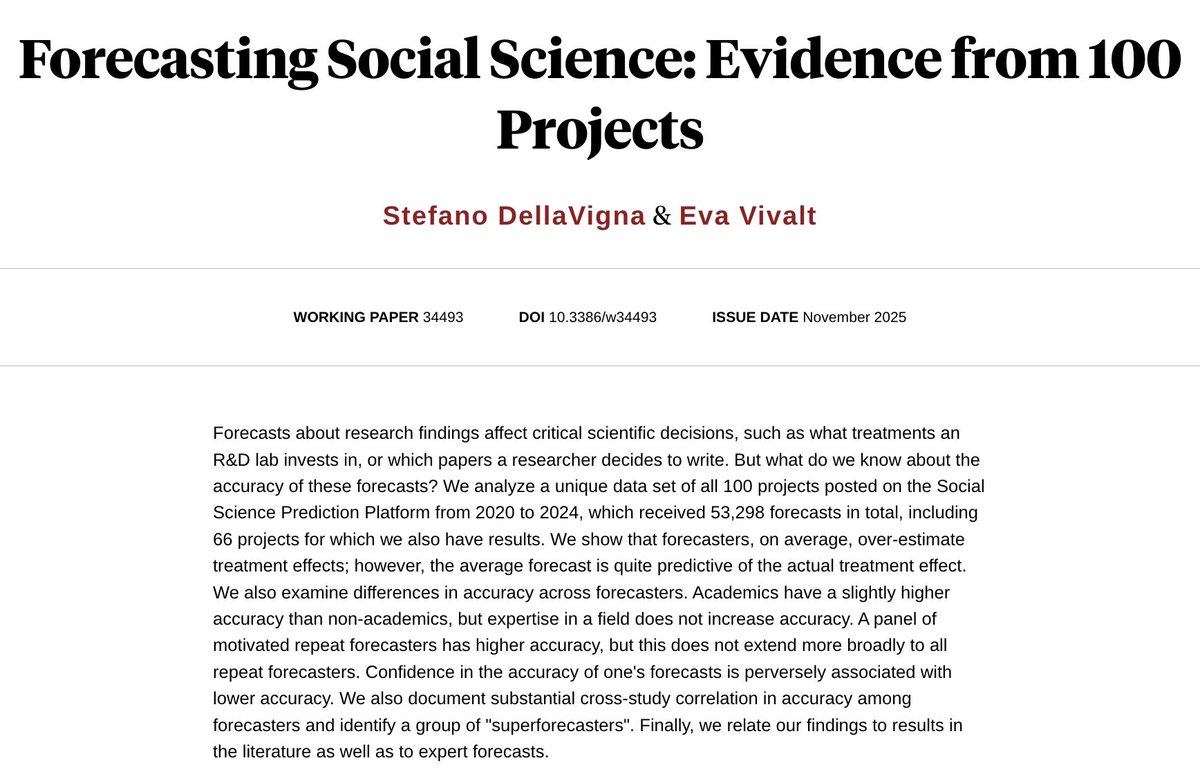
🚨 New working paper!
How well do people predict the results of studies?
@sdellavi and I leverage data from the first 100 studies to have been posted on the SSPP, containing 1,482 key questions, on which over 50,000 forecasts were placed. Some surprising results below.... 🧵👇
A clear and compelling read on IES. I hope policymakers pay attention to this. There is a very strong bipartisan case to be made for continuing to fund the development, evaluation, and syntheses of evaluations of educational programs and policies.
Helping teachers learn what works in the classroom − and what doesn’t − will get a lot harder without the Department of Education’s Institute of Education Sciences https://t.co/q5CzvofN38 via @ConversationUS
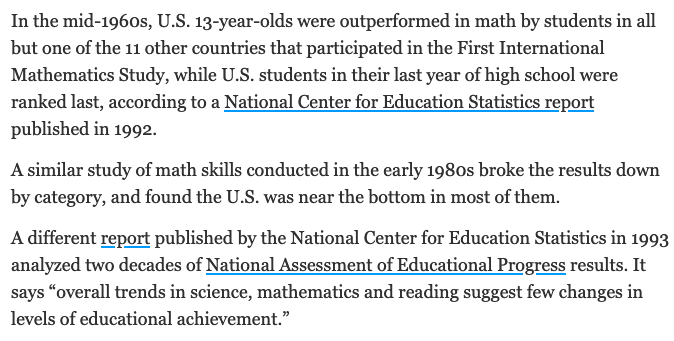
@JoeJ45665 @AndrewRAConway Hadn’t heard that claim before about changes in US performance over time! Not even close to true though. Here’s a nice summary of the US’s performance on international assessments going back to the 1960s.
https://t.co/aCoW3ngYLG
One of my favorite IES resources are the practice guides. There are 5 guides with the research about teaching math. Given the two stop work orders I received last night (to stop work on 2 upcoming IES STEM practice guides), I'd download these now.
https://t.co/pEPAxrRje7
Our new review, with @tw_watts, @EmmaRoseHart, and April Yu, summarizing some recent work on "Learning about Development from Interventions" is published open access at Annual Review of Developmental Psychology. Comments, questions, insults welcome.
https://t.co/QPXwQw7znm
@FlowTap1 I’m a grinch relative to the median ed policy researcher (long term effects are often overestimated), but a merry elf relative to many of my individual differences colleagues (they are often positive and frequently large enough to pay for themselves!).
@MatthewBJane Without reading the paper, maybe they're not doing casewise deletion, so the pretest sample is a subset of the posttest/difference score sample.
Last year, Killingsworth, Kahneman, and Mellers published a paper reporting that, for a group of unhappy people, money does not improve happiness.
@dingding_peng, @sewenz, and I wrote separate critical comments of it, which were published today.
This is just to say
I don't believe
your diff-in-diff
Forgive me
the effects
are way too large
plus forking paths
And so many
other things happened
during that period