New affiliated member of the #dvugroup: Oliver Preston!
Oliver has just started his PhD at the Uni of Sheffield to develop #machinelearning methods to understand and visualise the performance of #nonlinearstructures to avoid #failures
https://t.co/7otL7oXBbp
#ML#SHM
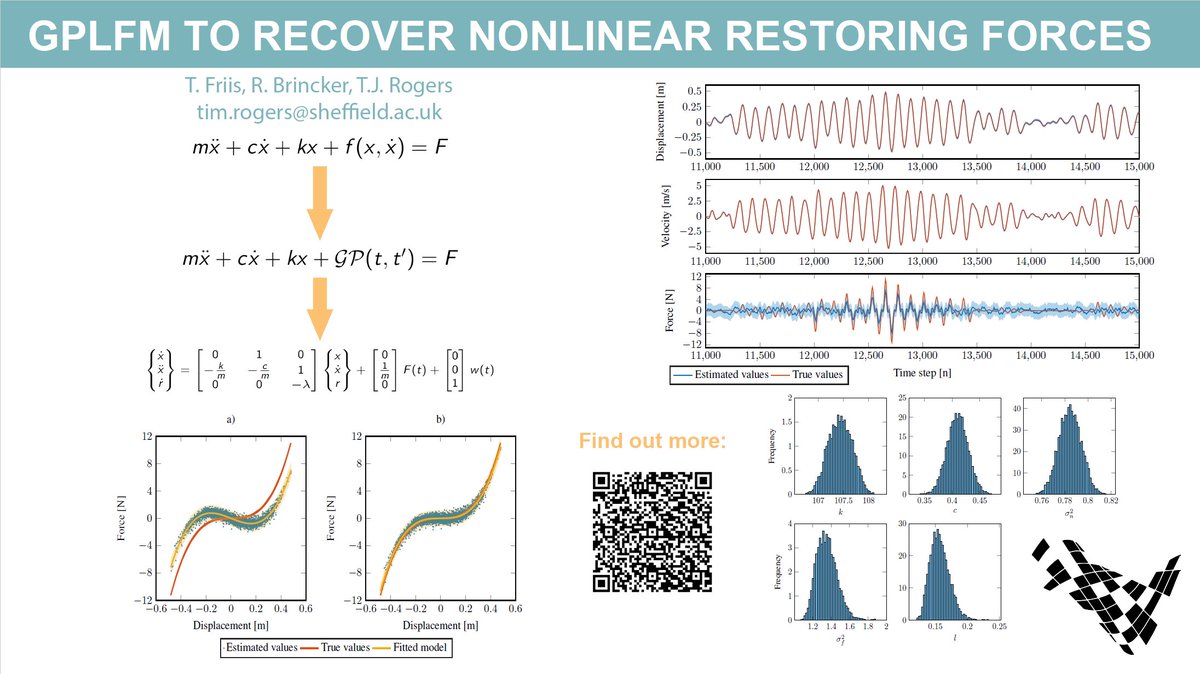
What if you could treat nonlinear system ID as a linear input-state-parameter problem?
Find out in this work just published in MSSP... We use GP latent force models in a modern reimagining of the restoring force surface method to do just that.
https://t.co/nQeuTkhnlu
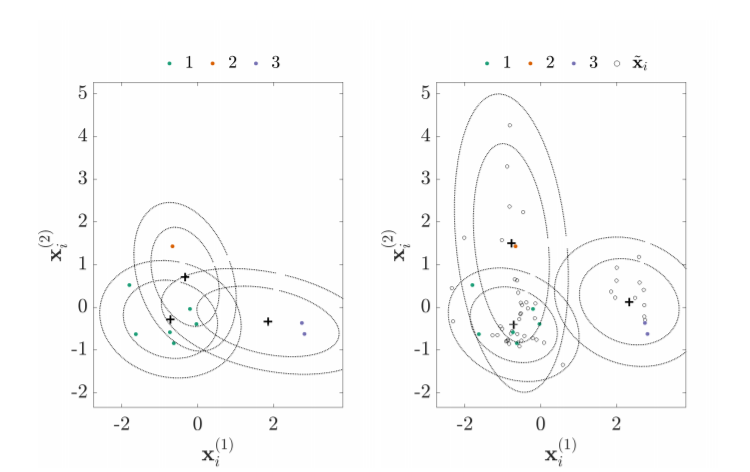
Super happy to be able to share: A sampling-based approach for information-theoretic inspection management. My first in Proceedings of the Royal Society A and it's some lovely work with @lwrncebull on active learning Dirichlet processes for SHM.
https://t.co/yuD4AtJMHa
I'm looking for a postdoc to join me working on ML and Bayesian stuff for system ID in structural dynamics. I can vouch that the DRG and @SheffMechEng is a great place to work. Check out the job advert in link below.
https://t.co/LVfBH9MV79
Tomorrow lunchtime we'll be holding a #lunchbytes on Better #MATLAB, Better Research featuring talks from Fred Sonnenwald and @drgTim
from Sheffield and @walkingrandomly from @MathWorks https://t.co/qzzRlxlrl1
Now available in MSSP, this lovely work by @mattrjones11 (me, Keith Worden and @lizzyintheDRG) for localising acoustic emission sources in structures with complex geometry. You can find it here: https://t.co/O4rpKhYXEA
#postdoc on mathematics or numerics of wave scattering in random materials to work with me! Happy to consider candidates with experience in either #acoustics, elastic waves, #ultrasonics, or electromagnetic waves.
https://t.co/pofm3VBEV1
Predicting wave loads on offshore structures was one of the first things I worked on in my PhD. Dan's latest work with Ulf, @lizzyintheDRG and I shows one nice approach using Gaussian process NARX as a grey-box model. You can read it here: https://t.co/FriYxOkYau
Very pleased that our paper on Probabilistic Inference For SHM has been featured in the Editor's Choice section for @asceasmejrues. You can read it here: https://t.co/jq1fJDuBuq
also available at https://t.co/8g2ijXReiy
This wins the award for most beautiful results figures from any paper I have been involved it. It's also fantastic work from @mattrjones11 on damage localisation with GPs.
Our latest paper is available on arXiv! We look at developing a probabilistic framework for localising acoustic emission events in complex structures using Gaussian processes. Find it here: https://t.co/nvGOOJYB8D
Really good to see this work with Paul Gardner and others in the DRG published in MSSP. We introduce a novel importance sampling based scheme for inferring model discrepancy. https://t.co/eSoS65nLXa
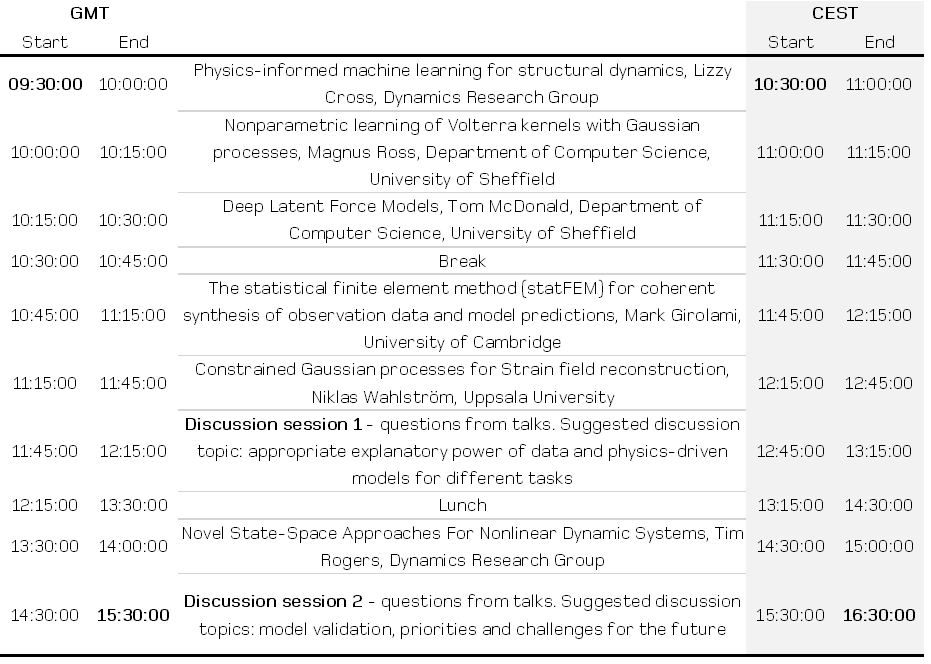
Really excited for the grey-box day of the annual DRG workshop that's happening today. You can catch @lizzyintheDRG, @drgTim and lots of other interesting speakers talking about their work on physics-informed machine learning for problems in structural health monitoring.
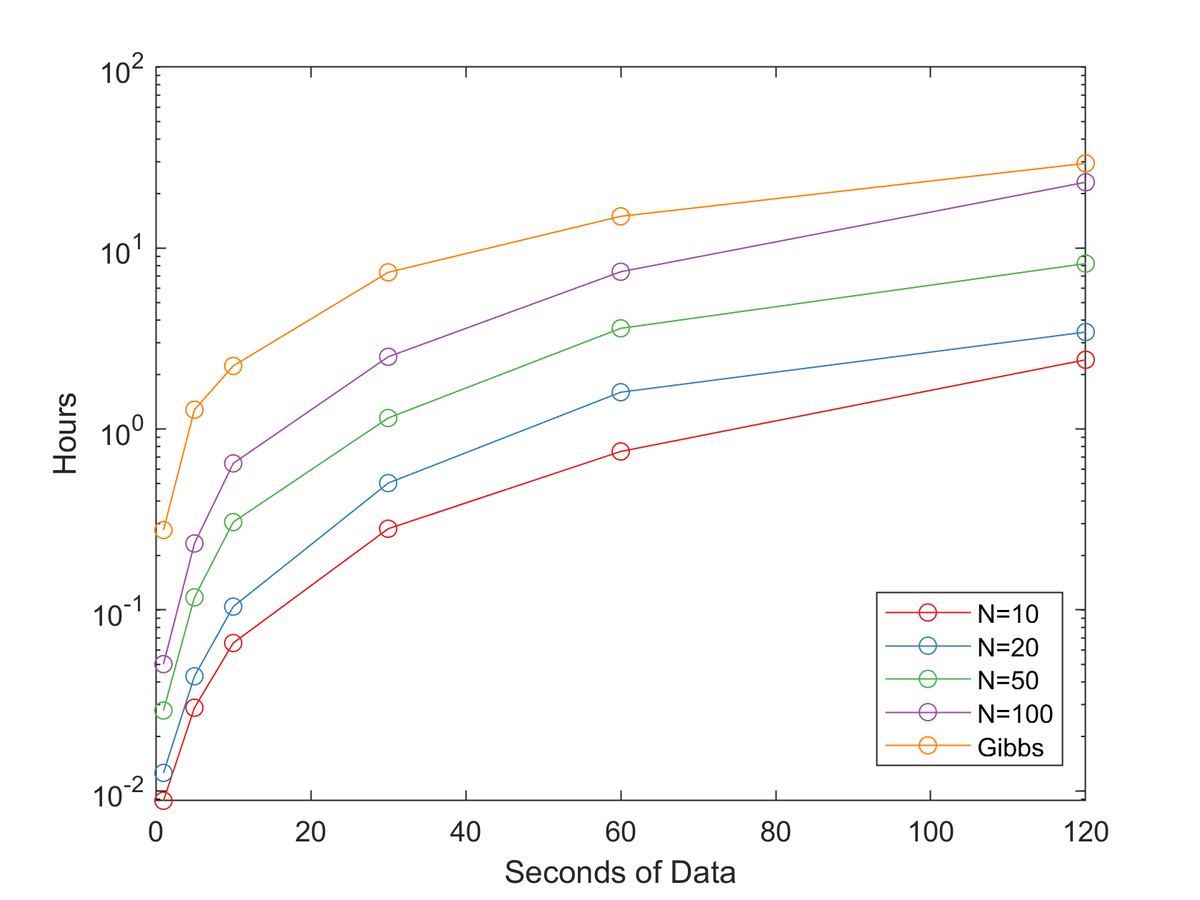
Really exciting results coming soon. We are seeing huge speed up compared to batch Gibbs solutions by moving to an SMC scheme tailored for solutions to linear dynamic systems.
As well as lots of great work being shown at #ISMAUSD our paper on input-state estimation in nonlinear systems has also been published today. You can now find it here: https://t.co/DrgzTCvgWv it was very exciting to see Particle Gibbs performing so well.
It was great to work with Konstantinos Tatis, Vasilis Dertimanis and @Lne_Chatzi from @ETH_en along with @lizzyintheDRG and Keith Worden from Sheffield on spatiotemporal input-state estimation to be presented at #ISMAUSD
Interested in knowing more on what we do? You‘ll find a great summary at this year‘s ISMA conference:
- Parametric #nonlinear ROMs with Konstantinos Vlachas, Adam Brink, Agathos K. & Tatsis K.
- #metamaterials for Vibration Abs…https://t.co/uG736O0ycr https://t.co/hKEq1R06r8
Virtual #ISMA2020 starts today, I will be presenting some great work by Tobias Friis on recovering unknown nonlinearities using Gaussian Process Latent Force Models.