Why were the textbooks wrong about brain plasticity?
Spotlight by Harriet Dempsey-Jones (@DrHarryDJ) on a recent @NatureNeuro article by @HunterSchone and colleagues
Free access until Nov 9: https://t.co/ehLDGuxAD2
So textbooks only had half the story, and interpreted this as plasticity.
We now know, apparent reorganisation often reflects methods, not maps. Schone et al. reveal a deeper truth: cortical body maps are surprisingly stable.
Read my TICS Spotlight:
https://t.co/Rm8rAiFXB5
🧠 New TICS Spotlight from me!
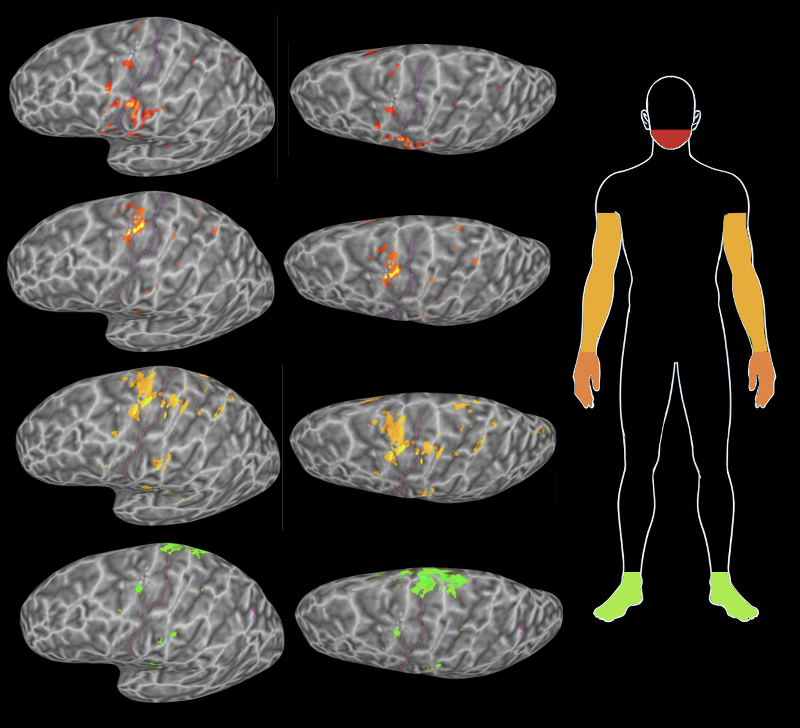
For decades, textbooks said the brain’s body map “reorganises” after amputation. But Schone et al. show something striking: the missing hand map persists in the brain, waiting for the right probe.
https://t.co/IOX0dH6gkx
But body-map stability was hiding in plain sight. Two culprits:
1️⃣ Animal models can’t tell us if they “move” phantom limbs.
2️⃣ Mapping methods (e.g., winner-takes-all) made stability look like remapping.
Congrats to Fernanda and Alex on their new review in JoV looking at human retinotopic mapping: From empirical to computational models of retinotopy
https://t.co/0DivEcMKp9
Do you have expertise in fMRI and/ or spectroscopy, and an interest in applying your skills to help understand how motor neuron disease affects the brain's body map? If so, see our ad for a Postdoctoral Researcher position at Uni of Queensland, Australia: https://t.co/Gu0TL5mWQt
Though there were some important nuanced differences that experimenters should consider depending on what aspect of representation they are trying to look at. Read the full paper here https://t.co/4QARCUdwPi
Have you been worried that everyone is using very different experiments to look at hand representation in the brain? We compared hand maps in somatosensory cortex when you actively move the fingers (left) and when static fingers are touched (right)... 1/N
Have you grown up with textbook animal work from the 80s, stating an amputated finger's 'cortical territory' gets invaded by its neighbours? Confused by human amputee research mainly showing stability, and want a direct face-off? Our new paper's out: https://t.co/vThtkC0p0O. 1/🧵
So, we've been temporarily 'amputating' peoples' fingers with anaesthetic to examine brain plasticity...
We now show that while some analyses suggest brain reorganisation after 'amputation', new methods reveal the original representation persists https://t.co/0p2Dciu0wf
Congrats to Antonio and @PatrickHaggard for their work on our new paper in @CurrentBiology showing a strong interference of movement on tactile spatial percepts and vice versa in self-touch https://t.co/QEwIzXAJPM
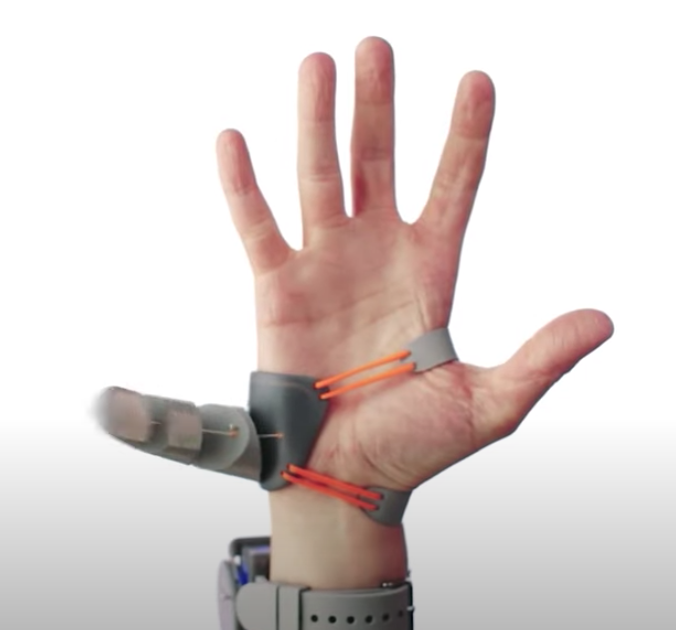
What would you do with a third thumb?
Our new paper looking at the role of somatosensory signals in motor control of this device is just out in the Journal of Neural Engineering. Congrats @LucyDowdall1 and @PlasticityUCL 😎
https://t.co/LxS9wg9HM1