I redid my primer on Kubernetes for data scientists.
I show how to navigate, debug and understand infra you are likely already using through an end to end example.
https://t.co/wsBFGOEcRZ
This is lovely stuff from @guardianeco. A nice simple explainer of how #geomorphology underpins the functioning of #rivers, and how restoring them benefits people and wildlife.
Why rivers shouldn't look like this – video https://t.co/PxOWLB1kIw
Identifying hydrologic events?
Finally pushed an update to https://t.co/ARM8nwUlPK
The event choice using baseflow filtering now works with any baseflow filter.
Also made the github public! https://t.co/gUA7wDYkhq
GMDSI New Releases: Data Space Inversion tutorial out now and webinar registrations open for 'Demystifying uncertainty and its policy repercussions' 28th Feb and 'So we've ticked the uncertainty box. What happens next?' 9th May. Info - https://t.co/EaVzgHYPMu
Interested in pursuing a PhD in river pollution in the UK? Apply for this project and work with the awesome @PrytulakJ, Barbara Palumbo-Roe and myself in collaboration with @NorthumbrianH2O. Get in touch if this project might be for you!
Comparing clean air for disease mitigation with clean drinking water is compelling (for this water scientist). Seems kind of consistent when we consider the pushback on water reform in NZ (dare I tag #3waters)
Because we didn't just have clean water for a few yrs, & then decide when infections re-emerged that exposure to pathogens was a good thing! We learned that water sanitation had huge benefits in terms of public health and should be maintained continuously. Same with clean air.
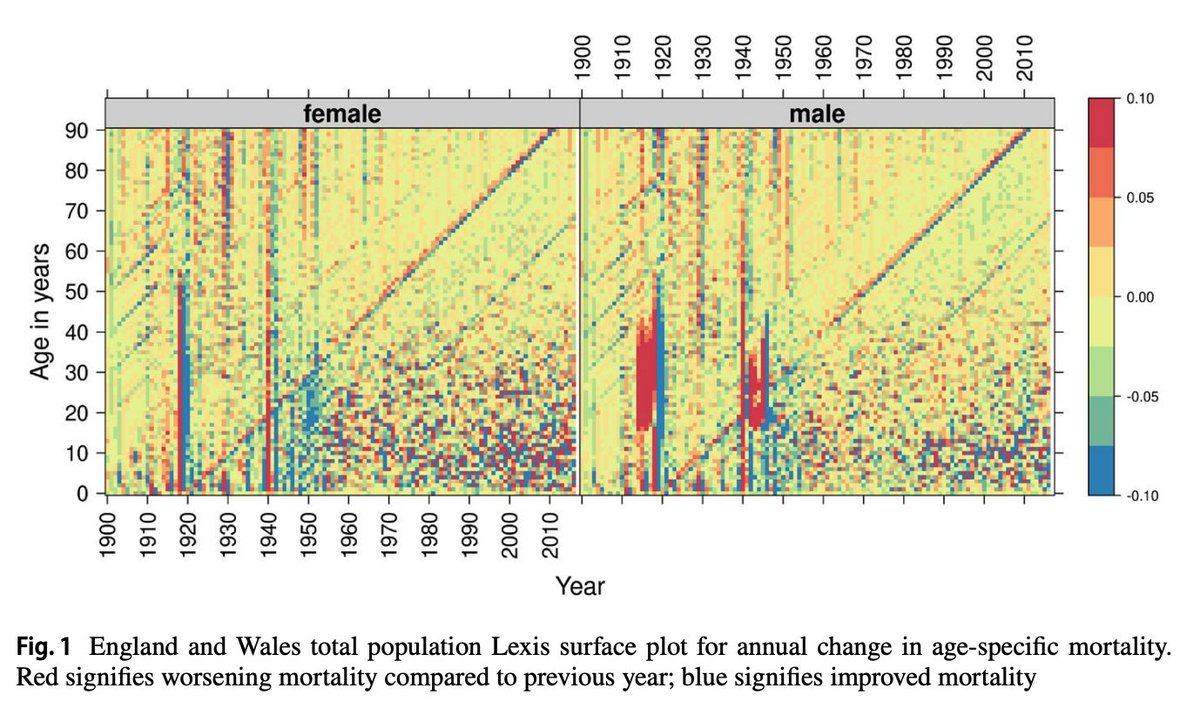
This Lexis plot depicting UK mortality across the 20th century is wild. I had no idea cohort effects (diagonal 'scars') were so strong. Events like the 1918 flu led to not only high annual mortality, but an increase in mortality across one's lifetime. HT: @salonium's newsletter.
My most exciting work so far on systematic integration of deep learning and physical model is published in WRR. https://t.co/mgT1x4qwiN To summary, now we have a regionalized physical model with similar performance to pure data-driven LSTM, achieving NSE median 0.732 in CAMELS.
I love this video from RIKEN in Japan.
It models the flow of exhaled air in various different settings under different conditions.
As well as the flow patterns being very beautiful, it also highlights the importance of good quality masks (FFP2/FFP3)
https://t.co/kP4CJfwmqW
I love this video from RIKEN in Japan.
It models the flow of exhaled air in various different settings under different conditions.
As well as the flow patterns being very beautiful, it also highlights the importance of good quality masks (FFP2/FFP3)
https://t.co/kP4CJfwmqW